Most people who freeze up with flash have memorized a few settings that worked once, and those settings fall apart the moment the sun moves or the room gets darker. A fixed order of decisions, run the same way with a small Westcott FJ strobe or a big one, gets you to a good frame faster than any saved power number.
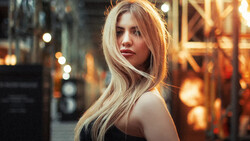
JC Carey builds his whole approach around that idea, calling it a process instead of a recipe, and then tests it across a dim barn, a farmyard, a river, and an open field at 1 p.m. The order is ISO, then focal length, then aperture, then shutter speed, and only then the light. Aperture is the first real creative call for him, chosen for depth of field and never for exposure. In the barn, he starts with a Westcott FJ100 at f/4 and 35mm, sets 1/100 s to keep the doorway looking reasonable, and lets the model fall into shadow on purpose. When she comes out too dark with the flash on, he leaves every camera setting alone and turns the strobe up about two-thirds of a stop. Reaching for the aperture dial would undo the decision he made about what should be sharp.
The flash-off comparisons are some of the most useful moments. Without the strobe, Carey drops to 1/60 s, the slowest he trusts handheld, and still has to push ISO to 1,000 before the model looks right. By then, the barn interior is fine and the outdoors is completely blown. ISO brightens everything at once, so there's no way to save both. With the strobe back on, he can drag the shutter for ambient grit and still get a sharp subject, since the burst of flash freezes motion even at shutter speeds you couldn't otherwise hold. He sums it up with a line that keeps coming back throughout: every lit picture is two separate exposures, one set by the camera and one set by the light.
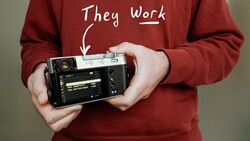
If you shoot mirrorless, the two-exposure idea lines up with something your viewfinder already does. Most current bodies simulate exposure in the electronic viewfinder, so when you underexpose the ambient on purpose, the preview looks dark, because the flash isn't in it. In a studio where you've dialed the ambient down to black, that can leave you composing in a nearly black viewfinder. Sony, Canon, and Nikon all include a setting to turn the simulation off: Sony calls it Live View Display or Setting Effect, Canon uses Exposure Simulation, and Nikon labels it Apply Settings to Live View. A useful way to use it is to leave simulation on while you set aperture and shutter, since that preview is a fairly honest picture of your ambient exposure. Switch it off once the strobe is doing the work on your subject. The camera screen then becomes a tool for the first exposure, and the test shot handles the second.
Outside against a weathered red barn, Carey switches to a Westcott FJ250 and a Westcott Rapid Box Switch Octa-S. He stops down to f/8 at 70mm to keep the wood texture crisp and holds 1/200 s to stay at normal sync while underexposing the background so the colors deepen. He shows the "correct" ambient exposure at 1/20 s, and it's a flat frame that looks nothing like what he's after. A hot spot on the wall gets fixed by feathering the box away from the background while keeping it aimed so the model can still see its face. Once he moves to a full-length shot, the Octa-S can't cover her, so he swaps to a Westcott Rapid Box Switch Octa-L. Pulling it back to keep it out of frame roughly doubles the distance, so he adds two stops of power, and the exposure lands right where it was. Later sets bring in a Westcott FJ400 II, a Westcott FJ800, a 300mm focal length, high-speed sync, a dual-base-ISO trick, and a river shoot, and the order of decisions stays exactly the same through all of it.
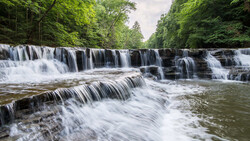
Carey's river and Land Rover setups are in the video above.


Join the Fstoppers community for free
-
Post comments and join in the discussions
-
Browse the site ad-free
-
Share your work and get featured in the community
-
Compete in the photo contests for fun and prizes
No comments yet