
Almost every photographer I know has, at some point, confessed to feeling like a fraud. They land a big client and immediately worry they'll be exposed. They deliver a gallery and brace for the email saying the photos are terrible. They scroll through their peers' work and wonder how they ever had the audacity to call themselves professionals.
This is often called Imposter Syndrome (more precisely, the impostor phenomenon, since it's not a formal diagnosis), and it has become a badge of honor in creative communities. We talk about it openly, support each other through it, and reassure ourselves that even the greats felt this way.
But here's the uncomfortable truth nobody wants to discuss: not everyone experiencing what feels like Imposter Syndrome is on that side of the equation. Some photographers convinced they're undervaluing themselves are actually overvaluing themselves. Impostor feelings may not be the driver. They've stumbled into a neighboring trap, the Dunning-Kruger Effect, and misdiagnosed themselves. The question you need to ask yourself, honestly and without ego protection, is which one are you actually experiencing?
Understanding the Curve
In 1999, psychologists David Dunning and Justin Kruger published research that would eventually become one of the most referenced concepts in discussions about competence and self-assessment. Their methodology was straightforward but revealing. They administered tests in logical reasoning, grammar, and humor to undergraduate students, then asked those students to estimate how well they performed relative to their peers. The results were striking and consistent across every domain they tested: participants who scored in the bottom quartile dramatically overestimated their performance, often placing themselves above average. Meanwhile, top performers slightly underestimated their ranking, assuming others found the tasks similarly manageable.
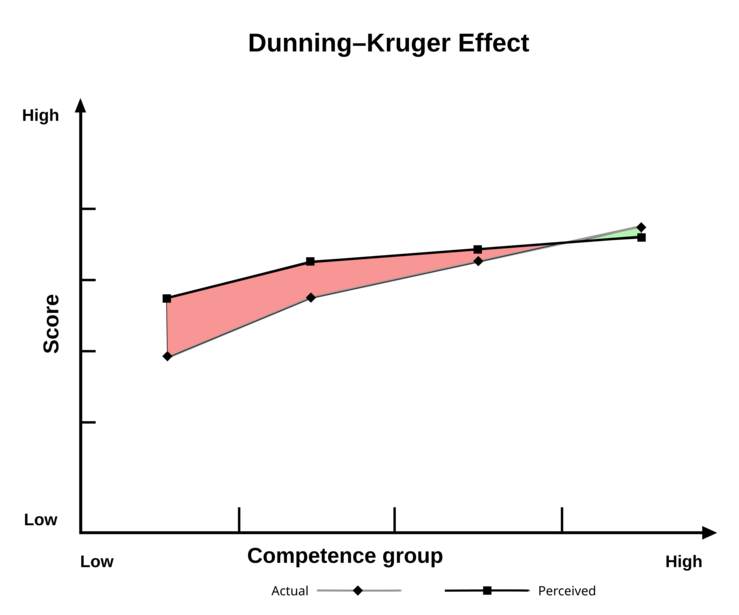
Evaluating your own performance requires the same skills as performing well in the first place. If you lack the knowledge to answer questions correctly, you also lack the knowledge to recognize which answers are wrong. This is the leading explanation for the pattern, though researchers continue to debate how much of the effect comes from genuine metacognitive limits versus statistical artifacts like regression to the mean. When you plot this relationship between actual competence and perceived competence, you get a curve that has become infamous in professional circles.
The curve begins with what people often call the "peak of inflated confidence" in simplified versions of this model. This is where you find photographers who just figured out how to shoot in manual mode and now believe they've unlocked the secrets of the craft. They watched a few YouTube tutorials, bought a decent camera, and took photos that friends and family praised enthusiastically. To them, professional photography looks pretty straightforward. Point the camera at the thing, adjust some settings, click the button, add a preset in Lightroom. How hard could it be? These photographers are convinced they're operating at a high level because they lack the knowledge required to recognize what high-level work actually looks like. They don't know what they don't know, and that ignorance feels exactly like confidence.
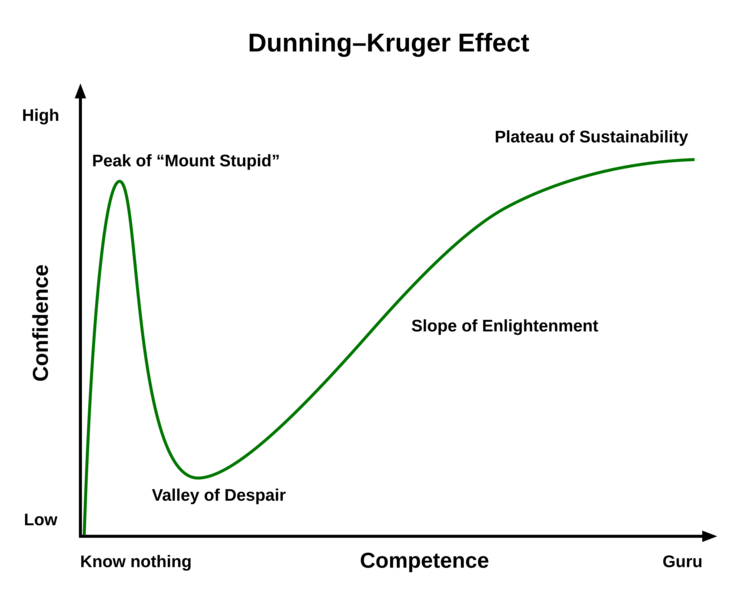
After the peak comes what people sometimes call the "Valley of Despair." This is where photographers land after they've been in the game long enough to understand the depth of the craft. They've studied lighting and composition. They've seen what masters can do with the same equipment. They've experienced enough failures to recognize that their early confidence was laughably misplaced. These photographers often feel worse about their abilities than when they started, even though they're objectively far more skilled. Their taste and critical eye have developed faster than their technical abilities, leaving them in a constant state of dissatisfaction with their own work. They know enough to know what they don't know.
Why Feeling Like a Fraud Is Actually Good News
Here's the counterintuitive reality that should bring some comfort to those of you sitting in that valley: your feelings of inadequacy are almost certainly a sign that you're on the right track. The discomfort you feel when you look at your work isn't a character flaw. It's evidence that your ability to evaluate photography has matured to the point where you can see gaps between where you are and where you want to be.
Think about it this way. When you were just starting out, you probably loved almost everything you shot. Every sunset looked like a masterpiece. Every portrait felt like a breakthrough. You didn't have the visual vocabulary or the reference points to understand what separated your work from truly exceptional photography. Now you do, and that knowledge is both a blessing and a burden. You can see the subtle differences in how professionals handle light, compose with intention, and capture moments with precision you haven't yet achieved. This awareness feels bad, but it's actually the engine that drives improvement.
Top performers in many fields may underestimate their own competence, and the reason is fascinating. When you've done something so many times that it becomes second nature, you lose the ability to recognize how difficult it is. A seasoned wedding photographer might think their ability to manage chaotic family dynamics, shifting light, and tight timelines simultaneously is nothing special because it feels effortless now. They forget the years of learning that made it feel effortless. They assume everyone can do what they do because, from the inside, it doesn't feel remarkable.
The Real Danger Zone
In my experience, photographers who doubt themselves rarely cause significant damage. They might undercharge for a while. They might turn down opportunities they were actually ready for. They might spend too long second-guessing their creative choices. These are problems, certainly, but they're self-correcting. Experience and positive feedback eventually recalibrate their self-assessment.
The photographers who genuinely threaten their own careers and the broader industry are the ones operating from the peak of that curve, convinced of their excellence while lacking the skills to back it up. These are the shooters who take on weddings they're not equipped to handle and deliver results that devastate couples. They're the ones who charge premium rates for mediocre work because they genuinely believe they deserve premium rates. They respond to client concerns with defensiveness rather than curiosity and blame external factors for every shortcoming.
The photography industry has a remarkably low barrier to entry, which is both its greatest strength and its most persistent weakness. Anyone with a camera and a dream can hang out a shingle and start accepting money for their services. This accessibility has democratized the craft and allowed talented people to build careers without traditional gatekeepers. But it has also created an environment where the Dunning-Kruger Effect can flourish unchecked. There's no licensing exam, no mandatory apprenticeship, no objective standard that separates professionals from enthusiastic amateurs. The only feedback mechanisms are client reactions and peer assessment, both easy to dismiss if you're committed to protecting your ego.
Diagnosing Yourself Honestly
So how do you figure out which phenomenon is driving your emotional relationship with your work? They're not mutually exclusive. Someone can be overconfident in their technical abilities while feeling like a fraud in client interactions. Self-assessment tends to be domain-specific. Still, identifying your dominant pattern helps you figure out the right response. Imposter Syndrome calls for reassurance and perspective. The Dunning-Kruger Effect calls for humility and continued education. Applying the wrong treatment makes things worse.
If you're experiencing genuine Imposter Syndrome, certain patterns will be familiar to you. You fixate on minor technical flaws that no client would ever notice. You attribute successful projects to luck, timing, or the subject matter rather than your own skill. You compare your behind-the-scenes process to other photographers' polished final presentations. You feel like each new project will finally expose your incompetence, regardless of how many successful projects preceded it. You might even self-sabotage by underpricing or avoiding growth opportunities because you don't feel ready for the next level.

The Dunning-Kruger Effect manifests very differently. If this is your pattern, you probably react to criticism with immediate defensiveness or dismissal. When clients express dissatisfaction, your first instinct is to question their taste rather than your work. You look at successful photographers and assume their advantages come from better equipment, more connections, or favorable circumstances. You believe you've essentially figured out photography and that continued learning is unnecessary. You might find yourself frustrated that the market doesn't recognize your value, convinced that success is a matter of exposure or marketing rather than craft.
The most telling difference is this: people with Imposter Syndrome are constantly looking for evidence that they're not good enough and finding it everywhere. People experiencing the Dunning-Kruger Effect are constantly looking for evidence that validates their self-assessment and ignoring everything that contradicts it.
The Uncomfortable Takeaway
If reading this article has made you feel a bit defensive, if you've found yourself mentally arguing against the descriptions of Dunning-Kruger behavior, that reaction might be worth examining. The whole point of the effect is that it can be hard to see from the inside, especially without strong feedback loops. The people most affected are often the least equipped to recognize it without outside input. True self-awareness requires actively seeking out perspectives that challenge your self-image, not just collecting evidence that supports it.
On the other hand, if you've read this and felt a wave of relief because you definitely, certainly, absolutely suffer from Imposter Syndrome and not that other thing, pump the brakes for a moment. That certainty might be worth questioning. The goal isn't to diagnose yourself with the more flattering option. It's to develop an accurate understanding of where you sit so you can make appropriate decisions about your career.
Here's what I've come to believe after years in this industry: if you regularly feel like you don't belong, if you're haunted by the sense that you're fooling everyone, if you look at your portfolio and see mostly room for improvement, you're probably doing fine. That discomfort is the feeling of growth, and growth is what separates working professionals from people who plateau early and stay there.
But if you've read this entire article thinking about other photographers who really need to hear this message, maybe read it one more time with fresh eyes.




Join the Fstoppers community for free
-
Post comments and join in the discussions
-
Browse the site ad-free
-
Share your work and get featured in the community
-
Compete in the photo contests for fun and prizes
2 Comments
With every shoot, I feel huge impostor syndrome.
Every. Time.
But I still love it.
I don't so much feel like a fraud but sometimes wonder if I’m good enogh to stand out from the crowd. Anyone can be technically gifted but actually creating photographs with that special ‘decisive moment’ is a whole new skill level entirely.