An f/2.8 zoom usually costs more, weighs more, and takes up more room in your bag than its f/4 counterpart, and the price gap between the two versions of the same focal range can run to hundreds of dollars. A wrong choice in either direction tends to end the same way, with a second purchase or an expensive lens that keeps getting left at home.
Regret cuts both ways, and Martin Castein builds his answer around that idea. Buy the 70-200mm f/4 and you might spend six months second-guessing it, then buy the faster version anyway, which is a costly way to discover what you wanted from the start. Buy the f/2.8 because it feels like the professional choice, and you may find yourself staring at a hefty chunk of glass every time you pack, wondering whether it's worth the trip. Castein used to shoot weddings, and he still wouldn't give one answer for every focal range. He'd want a 24-70mm f/2.8, he'd be content with an f/4 wide angle zoom, and he could easily see himself picking the 70-200mm f/4 too.
His first test is narrower than "low light." For Castein, f/2.8 earns its place when low light meets a moving subject: a basketball game in a school gym, a wedding reception, a stage performance. He was happy with an f/4 telephoto zoom in dark churches, because once a ceremony begins, people mostly stay put, and he could let his shutter speed drop and still get usable frames. Children racing around a dim reception take that escape route away. Once you've reached the highest ISO you'll accept and the slowest shutter speed you trust, the extra stop gives you a choice between a faster shutter or a lower ISO at the same shutter speed. A landscape at dusk reverses the whole calculation, since the mountains aren't going anywhere, a tripod handles the long exposure, and you probably wanted f/8 or f/11 for depth of field regardless.
Stabilization and noise reduction have both shifted where that low-light line falls, though they act on different parts of the problem. In-body stabilization and optical stabilization steady the camera, which lets you use slower shutter speeds on static scenes, yet neither one freezes a child mid-sprint, because subject motion depends entirely on shutter speed. Noise reduction works on the other side of the equation. Tools like Lightroom's Denoise and DxO PureRAW let you push ISO further than you might have trusted a few years ago, which raises the ceiling before an f/4 lens runs out of room. You can find your own limits in an afternoon. Shoot a moving subject in the dim venue you visit most at 1/250 s, 1/125 s, and 1/60 s, note the slowest speed where faces still hold up, then run the high-ISO files through your usual denoising workflow and see how far you're comfortable going.
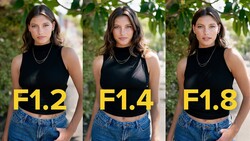
Portraits break his tidy rule. On a 24-70mm, he often reaches for f/2.8 even in bright conditions, because tight urban spots fill the background with walls, cars, and railings, and he can't always move a subject far away from them. The wider aperture softens a background that sits closer than he'd like. He's just as clear that f/4 still produces strong separation when the subject has room to stand well away from what's behind them, and that turning an interesting location into colored soup isn't automatically an improvement. Comparing two files at 200% will always show a difference, so he asks a more practical question: whether that difference improves the pictures he likes to take. At 70-200mm, the way he positions people already delivers plenty of separation, which is why he has happily used f/4 versions of that lens on paid work.
Castein's thinking on wide angle zooms, what several heavy lenses feel like after five hours in a backpack, and how an 85mm f/1.4 prime changes the job of every other lens in the bag are all covered in the video above.

Join the Fstoppers community for free
-
Post comments and join in the discussions
-
Browse the site ad-free
-
Share your work and get featured in the community
-
Compete in the photo contests for fun and prizes
3 Comments
I understand all the questions one would ask themselves. Nice to see both portraits and landscapes in the question's being asked. Also the thoughts about using throughout a day not just one place and time.
A zoom is way better than a lot of prims anyway. I use many telephotos of selection of f/4 and one f/2.4.
One thing not mentioned is telephotos (most not all) have OSS/IS, like the Sony FE 12-24mm f/2.8 GM and f/4 G do not so not carry arounds. Low light is a great time but I mentioned before the cameras that have ISO Invariance meaning you can capture a image at a low ISO but in post brighten that image just by increasing the exposure and some shadow sliders, you may not see on the camera screen but in your mind you know you have the image you want and even at a lower ISO maybe that first ISO that is cleanest of the two level ISO that have the least noise, this is were playtime gets the info your mind needs. The shutter speed you would also like to be faster can also come into play but knowing by playtime or on the spot retake. Sometimes what you want will not be seen on the camera but in post. Astro photographers learn early that what your dream image is mostly in post
What few ever look at is the M.M. number at the bottom of the LCD screen this lets you know if exposure is +/- 0.0 and lets you adjust settings for brighter or dim images also never turn off camera NR but know if bracketing and an images SS is below 1 sec the camera turns it off.
1. while out capturing the Milky Way on a local beach some Navel Archenemy students walked by and this is what i got in post and sent to each, also not shown is a sea turtle laying eggs that also came out, a A7M3 + FE 14mm F1.8 GM 5s f/1.8 Image stabilization (SteadyShot) with camera body so like OSS, just info. Hand Held.
2. taken with the A7M3 + FE 24-240mm f3.5-6.3 OSS yes on a tripod but the foreground was dark and not visible but the camera has ISO Invariance. At 126mm and f/6.3, 10s
3. and 4. MW capture with a Sony 7SM1 and Voigtlander HELIAR-HYPER WIDE 10mm F5.6, 25s, ISO 4000 not a telephoto but to show what can be done in post with a f/5.6 lens and a non ISO Invariance camera just SW play. both processed years ago before all the masking things or great NR.
It is what your mind see's and what you can do to make it and look real with no PSing.
Martin as you know, being an older photographer forces one to constantly weigh lenses in your head, here is my work around. For a casual road trip, longish walkabout or maybe a bit of street action, I take a 24-120 f4 or 70-300 f5.6 or sometimes both. However, if I have a specific location or subject and want to get creative I pack the 24-70 f2.8 or a 70-200 f2.8 plus a couple of primes and drive as close to the location as possible. If you can take the weight issue out of the equation it frees up your lens decision making. If I couldn't drive then a bike or public transport or a cab, anything to avoid carrying weight over distance or up an incline. Of course where you live may limit those options but for me, it works. Good video, thank you.
If its RF 2.8 L lens, well then answer is never. I dont want to be limited in choice only to be able to choose Canon most expensive lens plus tax for sheep. EF adapter and i can get what ever i want and for cheap.