Portraits that fall flat usually trace back to a handful of choices made before and during the shoot, not to some missing gear or secret edit. Focal length, color, light, and how your subject moves all pull weight, and small shifts in each one add up fast.
Working on location, Julia Trotti walks through the exact decisions she makes as the shoot unfolds. She opens on the RF 135mm f/1.8 L, which she reaches for because the first spot is a flat wall of greenery and flowers with no real layers behind the subject. The long focal length compresses that background, pulls it in tight, and turns it into smooth bokeh so the model separates cleanly from everything behind her. Trotti pairs matching your focal length to the environment with a second habit most people ignore: color theory. She scouts the location in advance, reads its palette, and then asks the people she shoots with to bring specific clothing, which is how a light blue dress ended up tying together a scene full of green and yellow.
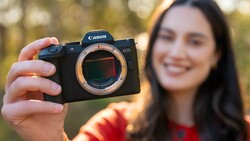
Light gets the same intentional treatment. Trotti shows the difference between direct light, where the sun faces the subject for a bright, punchy, high-contrast look that shows off styling and color, and backlight, her favorite, where the sun sits behind the subject for a soft, glowing feel. She deliberately mixes both across a single session so the final set has variety rather than one repeated mood. Movement is her closing tip, a practical one for anyone who shoots people who freeze up. She tells subjects from the start they don't need to wait for instructions, and when energy dips, she asks for a walk, a spin, or a jump to break stiff posing and catch candid moments. She's also testing the Canon R5 II throughout, sharing unedited 100% crops alongside her finished frames.
The lens pairing deserves a closer look because it's a principle you can borrow no matter what you shoot. Trotti runs the 135mm next to the RF 50mm f/1.4 VCM, and the logic is that the two lenses complement each other instead of overlapping. The 135mm delivers tight compression and close headshots; the 50mm pulls back to include the environment and give the images context. When you build a kit, that's the question to sit with: does a new lens cover ground your current glass can't, or does it just repeat what you already own? Two focal lengths that sit far apart give you distinct perspectives from the same location, which is often cheaper and more useful than chasing a third body or a faster aperture. It's also a reminder that variety in a portrait set comes from decisions, not luck.
On the camera itself, Trotti is candid about where she lands on resolution. The R5 II is 45 megapixels, and she calls the 30-to-45 range a sweet spot for portrait and commercial work, noting she doesn't want the file sizes that come with 60- or 100-megapixel sensors. She found the files easy to work with, liked how Canon renders color, and got a high ratio of in-focus frames in a genuinely difficult situation: shallow depth of field, a moving subject, strong backlight, and tall grass cluttering the foreground. She also points to the Lumix S1R II, Nikon Z 8, and Sony a7 IV as other bodies she rates in that resolution band, so you have alternatives to weigh if you shoot a different system.
Watch the full breakdown in the video above to see Trotti's lighting and posing choices play out shot by shot.





Join the Fstoppers community for free
-
Post comments and join in the discussions
-
Browse the site ad-free
-
Share your work and get featured in the community
-
Compete in the photo contests for fun and prizes