






















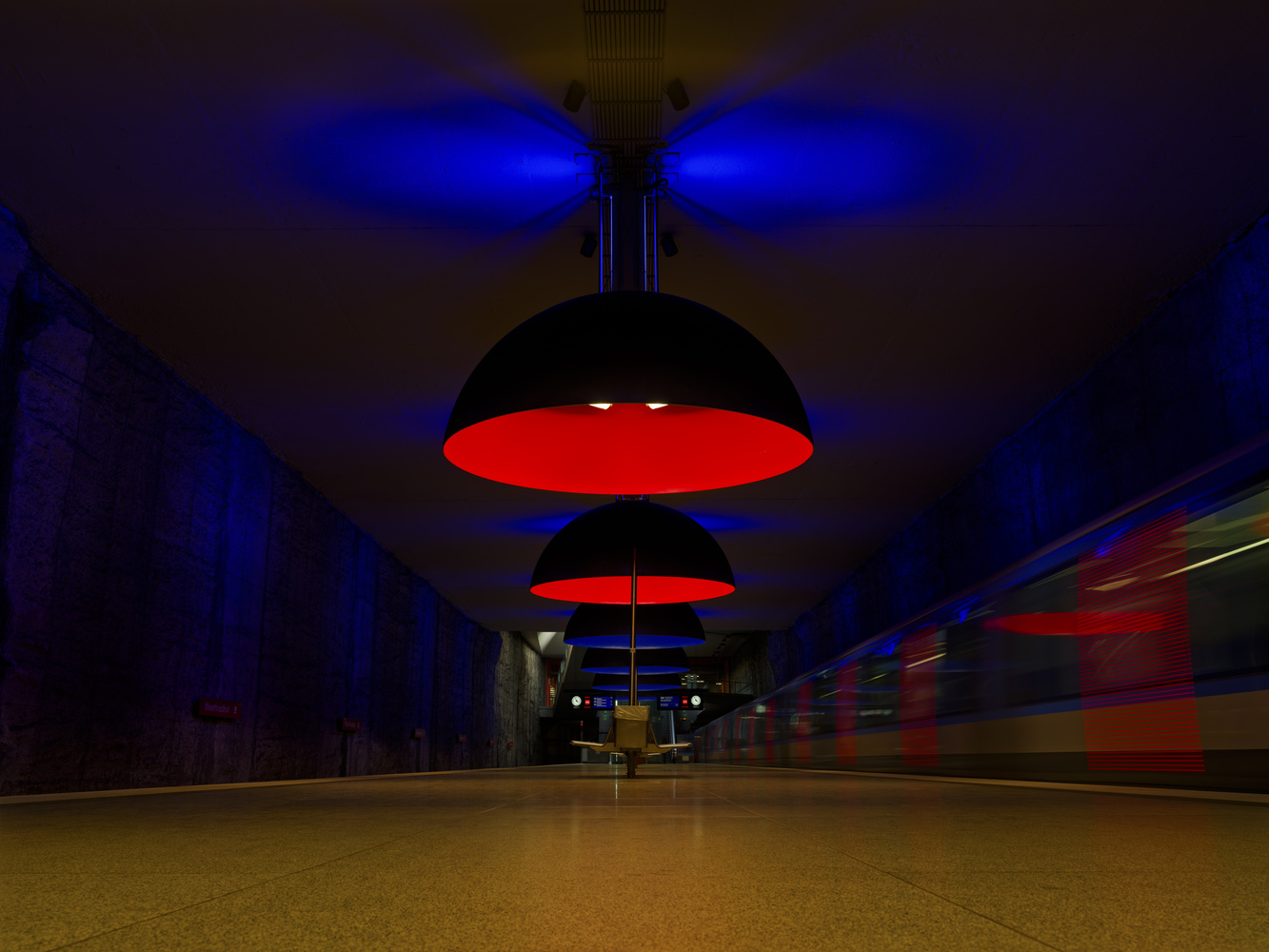
There is a particular kind of silence that exists in public spaces designed for crowds. Underground stations, built to channel thousands of people each day, reveal an entirely different character when emptied of human presence. It is in those rare, fleeting moments that their true architecture emerges — the geometry, the light, the deliberate design choices that go unnoticed in the daily rush.
This photograph of Westfriedhof station in Munich's U-Bahn network is part of an ongoing series dedicated to capturing metropolitan metro stations in that precise state of absence. Each image requires patience — sometimes hours of waiting for a platform to clear — to capture a space that is, by its very nature, never meant to be empty.
The Westfriedhof station, designed by architect Alexander von Branca and opened in 1998, is among the most visually distinctive stops on the Munich network. Its defining feature is the interplay between the large black hemispherical pendant lamps — their interiors lit in deep red — and the intense blue ambient light that washes over the vaulted concrete ceiling and walls.
This photograph was made during a brief window when a departing train had cleared the platform. The motion blur of the train visible on the right edge was preserved intentionally: it serves as the sole trace of the human and mechanical activity that defines this space for all but these few seconds. It is a ghost of function, caught at the threshold of stillness.
Click on the thumbnails below to comment and rate each image.
Click here to learn about the Fstoppers rating system and what each star value means.
No comments yet