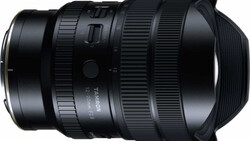
A 12 to 20mm zoom range on a full frame camera pulls in a field of view most lenses can only dream of, and pairing that with a constant f/2.8 aperture opens doors for astrophotography and low-light work. Tamron built its new 12-20mm f/2.8 around exactly that combination, and it arrives with a shorter name and a longer feature list than the brand's older lenses.
Testing the lens on the 61-megapixel Sony a7CR, Christopher Frost walks through why this release marks a shift in how Tamron thinks about its glass. The lens carries the company's VXD autofocus motor, which Frost found fantastically quick, silent, and accurate in both single-shot and continuous modes. Priced at $1,700, this sits firmly on the premium end. At 570 g, it stays light, with a metal rear mount, a weather-sealing gasket, a slot for rear gel ND filters, and a USB-C port for firmware updates. Frost does note the new dark, shiny finish feels a little plasticky, though that's purely a matter of looks.
The control layout is where this lens breaks from Tamron's simpler past. There's an aperture ring that switches between smooth and clicked operation and locks in or out of camera-controlled mode, a zoom lock for the 12 and 20mm positions, a manual focus lock, a custom switch you can program through the Tamron Lens Utility app, and two customizable focus hold buttons. The front control ring can toggle between focus and aperture, and video shooters can set focus limits and pull sequences. Frost found the zoom ring turns beautifully smoothly with barely any stickiness. On image quality, 12mm is the headline: razor sharp in the middle with excellent contrast, and corners that hold up well from f/2.8 onward, reaching excellent even at the farthest edges by f/5.6 and f/8. He was candid that 20mm corners stay softer at the brightest apertures and want f/4 or more to firm up.
Ultra-wide zooms like this one land in a specific and growing corner of photography. As more shooters chase the Milky Way and night skies with fast full frame bodies, the demand for wide, bright glass with clean coma performance has climbed, and Frost confirmed he couldn't really see any coma smearing even wide open at f/2.8. That's the single spec astro shooters check before anything else, since coma turns pinpoint stars into smeared blobs at the edges of the frame. The 12mm end also rewards a technique worth practicing: getting extremely close to a foreground subject. With a minimum focus distance of 18 cm and that stretched field of view, you can plant a rock, a flower, or a person right at the front element and still keep the whole sweeping background in play. Sun stars emerge around f/8 and get genuinely impressive by f/11 and f/16, which gives landscape shooters a reason to stop down rather than chase the widest aperture. Anyone weighing this lens should know it fits astrophotographers and video shooters most naturally, and stills work at 12mm sits comfortably in that same bright spot.
Distortion behaves about as you'd expect across the range. There's some barrel distortion at 12mm, though not as heavy as Frost anticipated, and it straightens out around 16mm before flipping to pincushion at 20mm. Vignetting runs very strong at f/2.8 and brightens at f/4 and f/5.6 once corrections are off. The curved front element and built-in plastic hood mean you can't fit standard front filters without special gear, and there's no image stabilization. Close-up results at 12mm come in okay at f/2.8 with low contrast, then sharpen up nicely at f/4, while 20mm close-ups need f/5.6 to reach excellent sharpness. Frost's one real hesitation lands on value, since competing ultra-wides sell for less and stay sharp, but he still recommends the lens for anyone drawn to that extra bit of width.
Watch the full breakdown in the video above to see the corner sharpness tests, coma results, and sun star performance for yourself before deciding whether the price fits your work.



Join the Fstoppers community for free
-
Post comments and join in the discussions
-
Browse the site ad-free
-
Share your work and get featured in the community
-
Compete in the photo contests for fun and prizes
No comments yet