Infrared photography turns familiar landscapes into something almost otherworldly, with blown-out white foliage, dark skies, and a contrast you simply can't replicate in post.
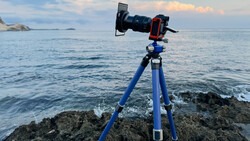
Coming to you from Chris Baitson, this candid video follows an evening photo walk through a churchyard and along a riverbank using a full-spectrum modified Olympus PEN E-P1 paired with a 720nm infrared filter and a single Olympus 25mm f/1.8 lens. The full-spectrum modification means the factory UV/IR-cut filter has been removed and replaced with clear glass, so the sensor receives the full range of light. Without any filter on the front, you'd get a heavy red cast; the 720nm filter narrows that down to give the classic high-contrast black-and-white infrared look while still letting through just enough visible light to open up false-color processing if you want it. Baitson shoots at f/5, base ISO 100, and still pulls 1/800 sec in aperture priority at half past six in the evening, which tells you a lot about how much light that sensor is soaking in across the spectrum.
One practical limitation shapes almost every shot in the video: the 720nm filter only fits one lens, the Olympus 25mm f/1.8, which gives a 50mm equivalent field of view on the Micro Four Thirds sensor. Baitson is upfront that it isn't always the right focal length for what he's trying to do, and you can see him working around it constantly, moving his feet to adjust composition in ways a zoom would handle in seconds. There's also a broken image stabilization system that has shifted the sensor slightly to one side, creating a half-vignette on one edge of every frame. His solution is straightforward: shoot square and crop it away.
What makes the video genuinely useful is the section on hotspots, a problem specific to infrared shooting that doesn't get nearly enough attention. A hotspot looks like a combination of overexposure and lens flare, usually centered in the frame, and it's caused by certain lenses reflecting infrared light internally in ways they weren't designed to handle. Baitson explains that keeping the light source behind you, just as you would to avoid flare in visible-light shooting, largely eliminates the problem. The Olympus 25mm f/1.8 doesn't seem to suffer from it badly, but he actually captures a hotspot on camera near the end of the video when the light catches the lighthouse at a bad angle, so you get to see exactly what one looks like in a real shot. He also walks through the camera's one-touch white balance system, pointing it at green grass to shift the infrared rendering toward white, which is the kind of quick practical detail that's easy to overlook when you're new to this type of camera. Check out the video above for the full rundown from Baitson, including the portrait experiment that shows exactly why infrared and skin tones make for a strange combination.




Join the Fstoppers community for free
-
Post comments and join in the discussions
-
Browse the site ad-free
-
Share your work and get featured in the community
-
Compete in the photo contests for fun and prizes
No comments yet