
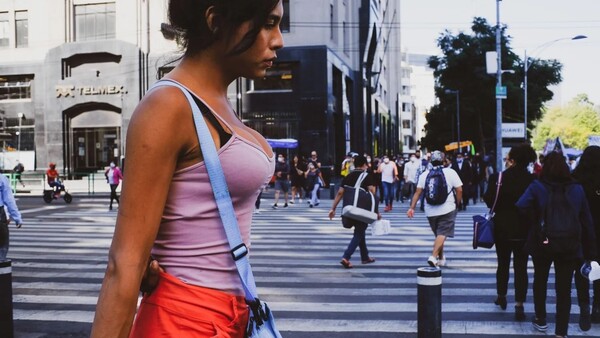
A comment on an old post accused me of photographing only women, and rather than let it sit, I want to take it apart, because the accusation says far more about how people look at images than about how I make them. What follows is less a defense than an explanation of what I am actually doing when I raise the camera, and why the subject is rarely the point.
To provide context and for the sake of truth, I'm sharing the link to the article in question: 5 Reasons Why 35mm...
This article was published on October 14, 2021, on my official blog. The photos were taken during the pandemic, when taking photos was quite complicated and finding a soul, possibly without a mask, was quite difficult. It's worth noting that the post in question is nearly five years old and sits among hundreds of others.
Every now and then, a comment reveals much more than it seems. Not so much about the object being observed, but about the observer. This often happens in photography, because the image is an imperfect mirror: it reflects something, but it filters that something through the gaze of the viewer.
When someone claims that a photographer "only photographs women," it's worth asking what that claim is actually built on. Usually it's a partial reading: one post, one gallery, one afternoon's worth of frames. At best, it's a superficial reading. At worst, it's a shortcut for dismissing 20 years of work without engaging with any of it.
The error stems from a profoundly flawed idea: that photography should represent a sort of statistical balance, an arithmetic parity between subjects, as if each project were a census and not the result of context, time, chance, and authorial choice. Photography, especially documentary or street photography, doesn't work that way. It never has. A body of work is not a ledger to be audited for proportional representation, and reading it as one misunderstands what the work is.
Scrolling through a single post, or worse still, finding a single piece of content among hundreds and using it to construct an accusatory narrative, is a fragile operation. A single post is a sample of one. It can tell you what I photographed on a given day, in a given place, under the conditions of that day. It cannot tell you what I photograph.
There's another, more interesting aspect. Observations like this one rarely turn back on the viewer's own gaze. Why do you see "only women" in a frame where a woman occupies a fraction of the composition? What draws the eye there and holds it? That question is at least as interesting as anything you could ask me, and it goes unasked because the problem is always shifted to the author, never the reader. And it matters here, because as those familiar with my photography know by now, in my compositions it's never just the subject, but also the entire context, which is often more relevant than the subject itself. I'm a photographer who works a lot with space, as I've often emphasized in the writings shared on this blog.
Photography is not neutral, but neither is the viewer. When a complex body of work is sorted into simplified categories, what gets lost isn't the photographer's reputation. It's the work itself.
It makes little difference whether behind certain interventions there's simply a misperception or, rather, the desire to provoke. In both cases, the result is the same: a discussion that's no longer about photography, but about something else.
Photography, on the other hand, requires time, attention, and honesty. Even from the viewer.
My Gaze, Before the Subject
My photography almost always begins before the subject.
It stems from a perception.
I don't go out into the street looking for people, categories, or roles. I go out looking for a certain tension in the air, an atmosphere, a vibration, a particular energy that's difficult to define but immediately recognizable when it manifests. It's something that has more to do with a state of mind than with what's visible. A space charged with meaning, a moment that seems to hold its breath.
Street photography, as I experience it, is a stream of consciousness. There's no rigid pattern, no preconceived idea of what should happen. There's a constant listening to the world, and to myself within that world. I walk, I observe, I absorb. Sometimes for hours without shooting. Then, suddenly, everything falls into place.
When I shoot, I'm often not photographing a person, but the energy that flows through that person in relation to the space, the light, the context. The subject becomes an element among other elements. It's never isolated, never placed on a pedestal. It's part of an invisible construction that happens before the shot is taken.
In this sense, my work as a street photographer is deeply connected to my experience as a portrait photographer. Even in portraiture, I never seek a pose, but a suspension. A moment when the mask loosens and something more authentic emerges. The context changes, the degree of control changes, but the intention remains the same. On the street, control is minimal; in portraiture, it's shared. In both cases, what interests me is what happens between me and the other person, not the other person alone.
There's also a metaphysical dimension that runs through many of my images, especially when the landscape comes into play. Urban spaces, architecture, voids, margins. Places that seem to await something or someone. It is in contemplation that these images find fulfillment. They don't demand an immediate reading; they demand time. Silence. Presence.
Perhaps this is also why my gaze is sometimes misunderstood. Because it's not descriptive, it's not didactic, it's not reassuring. It doesn't rely on visual or narrative clichés. It's a gaze born from living photography as an existential experience, not as a formal exercise.
I photograph as I live. With attention, with respect, but also with a certain restlessness. And I believe that this, ultimately, is what you truly see in my images. Not who's inside, but how the world, for a moment, decided to show itself.
Mine is neither snobbery nor arrogance. What I read and what I watch end up in the frame whether I intend them to or not, and I'd say the same of any photographer. If you want to understand a body of work, study the photographer alongside it. Look at what they photograph, but also at how they write and how they talk about what they've made. In more than two decades in this profession, I've met photographers whose reading and thinking inform every frame they make, and others who have never asked themselves why they photograph at all. The difference shows in the work.
The dimensions of communication aren't compartmentalized; they're intertwined. A photographer who can't articulate what a body of work is doing, in writing or in conversation, is working with one hand tied. Try reading a work synopsis carefully. A solid cultural foundation should help you understand the value of a work, and this applies both to the photographer, as an author, and to the viewer of the visual experience.


Join the Fstoppers community for free
-
Post comments and join in the discussions
-
Browse the site ad-free
-
Share your work and get featured in the community
-
Compete in the photo contests for fun and prizes
43 Comments
Not really helping your case with a photo of a woman where the main focus is her tits. It's not some profound spiritual bullshit you're making it out to be with the 'metaphysical dimension' drivel . It looks creepy, and judging from the other photos in that blog post, with the second photo looking like a hip shot at yet another pair of a woman's tits, they are right on the mark of their assertion.
Uhm, OK. Thanks for your time here.
ugh
This is, so far, the stupidest piece of writing I've seen on this site. I'm NOT surprised to see it used in defense of street trash snapshots (the correct term for the mis-named "street photography").
You repeatedly appeal to this thing you call "energy". What kind of energy is it? How is it measured? How did you detect it?
You write: "I go out looking for a certain tension in the air, an atmosphere, a vibration, a particular energy that's difficult to define but immediately recognizable when it manifests."
Oh really, the energy "vibrates"? At how many cycles per second? I notice you call it "difficult to define" but you still waste so many words trying, and failing, to do exactly that.
You write: "I'm often not photographing a person, but the energy that flows through that person in relation to the space, the light, the context."
Oh really, the energy "flows"? At how many cubic meters per second?
You write: "[My photography] doesn't rely on visual or narrative clichés."
I hate to break it to you, but you're a street trash snapshotter. When what you do is not cliché and kitsch, it's intrusive, non-consensual, and voyeuristic.
I read your vague garbage as being incredibly defensive. I think what would be more instructive is a careful examination of your photos in which women are the subject, and then find commonalities among those women to see what is making you "vibrate" and "flow".
Human energy is measured with electromagnetic fields, frequencies and wavelengths. Human emotions can be measured with electrical impulses (EEG) tests. And a heartbeat, for example, is detectable quite a distance outside the body.
On a more fundamental level, have you never had the experience of a person coming into a room and changing the mood of the whole room, just because that one person was so sad or angry? They don't have to say anything... their emotions are simply felt across the room. The connection between people might not be measured directly, but the impact upon other people's brain waves can be measured. There is a connection among all living things throughout the universe which we're just beginning to understand. Take a quick look at quantum mechanics.
On another street level, we can all feel a "tension in the air" when, say, we're caught up in some type of street confrontation where police and demonstrators are facing off. We sense danger. We experience fear. Some people are better at anticipating it than others. Some people can feel small things changing in the air, without necessarily needing an all-out riot on the streets to have that experience. Some people are more "in tune" with their environment than others. Alex appears to be one of those people.
You are entitled to your opinions of a photograph (although your opinions are becoming redundant and wearisome), but your mocking another person because of their acting simply like, well, a human, is offensive. Yes, human energy vibrates, or we would all be dead.
You write: "Human energy is measured with electromagnetic fields, frequencies and wavelengths."
Demonstrate it. Don't give me words. Demonstrate it.
You write: "have you never had the experience of a person coming into a room and changing the mood of the whole room, just because that one person was so sad or angry?"
Yes, it's called "fear".
You write: "we can all feel a "tension in the air" when, say, we're caught up in some type of street confrontation where police and demonstrators are facing off. We sense danger."
Yes, it's called "fear". Why are you pretending like this is profound?
You write: "You are entitled to your opinions of a photograph (although your opinions are becoming redundant and wearisome), but your mocking another person because of their acting simply like, well, a human, is offensive."
I don't care how offended you are. You have to learn to accept that not everyone is going to agree with you and be okay with that, or else you will continue to be miserable. And I'm not mocking Alex as much as I am excoriating him. Alex is a hypocrite who likes to non-consensually take photos of hot girls, and he has the chutzpah to call it "photography".
By the way, I like your photographs. You're one of the more talented photographers I've seen on this site.
My point is that emotions are what motivate someone to take a picture. Whether it's fear or love, or the sheer wonder and excitement of the landscape, people are inspired to capture those emotions through a photograph. Whether it's a profound statement or not depends on who's reading it. Haven't you ever heard photographers say that they wish for the viewer to feel the same emotions looking at their image, as they felt when taking the picture? Of course that's old news, but it seems like you fail to connect emotions and purpose in photography.
I can't make any better demonstration of that idea than what words will allow. This is a forum as an exchange of ideas, not a laboratory class in college. What more do you expect?
Oh, and by the way... I am the least miserable person of anyone I know. Don't confuse offensive with misery. I assure you that I won't lose any sleep if someone disagrees with me, but I do think respect for one another, in the manner of the tone and language we use, is worth a lot.
Our difference seems to be philosophical. You seem to be approaching photography from a Rosseauian perspective: you see feelings as the most important aspect of photography. It's what drives your question, "Haven't you ever heard photographers say that they wish for the viewer to feel the same emotions looking at their image, as they felt when taking the picture?"
No, I have never heard another photographer say that, and I am a member of several photography clubs. Furthermore, if a photographer gushed that maudlin question to me, then I would avoid and exclude that person.
I do not approach photography, or anything, from the "muh feelings!" perspective. Instead, I approach it from the perspective that I always have room to improve, my camera is my gateway into a new perspective, the techniques I use can create more impact, and my intention and good decisions will yield better results. It's not my feelings that drive photography, it's my reasoning. I'm not saying I don't have feelings. I'm saying they're far subordinate to my reasoning.
Why is that? Because feelings are automatic and we have no control over them. Jeffrey Dahmer had feelings. What was more important? His feelings, or his choices? Consequently, it's not my feelings that make a good photograph. It's my informed decisions (i.e., skill) that make a good photograph. (That, and good fortune.) I have heard an excellent photographer critique a series of photographs and not once did he talk about his feelings. Instead, he talked about the bad decisions in the photographs (mis-naming, too much clutter, what should be cropped) that led to a loss of impact. He was the most helpful and informative photographer I've ever heard. The photographer going on and on about his feelings would be immediately ignored.
If you are "feelings over all" kind of person in general, then I can see why you found Alex's words to be so meaningful: he's just gushing about his feelings (while avoiding the fact that he likes to take non-consensual photographs of hot girls). Florid prose about your automatic feelings is the realm of adolescent poetry, not photography.
And there's nothing wrong with choosing to view photography through the lens of being a slave to your automatic feelings. But don't try to tell me it's more thoughtful and intentional than the way I do it. To view photography through the lens of "I'm just going to follow my feelings and not put any thought into it" is stupid by definition. When I frame your words in that extreme, I suspect you're going to pull away from "feelings over all" and admit that you actually have some agency in your photography. (It certainly appears that you do!)
Regarding the demonstration: I was once told by a person online that "smaller pixel size yields more noise" and "it is a mathematical fact". I was skeptical of his claim, and I asked him to demonstrate it. He showed me a YouTube video where a photographer took two Canon cameras with the same sensor size but different resolution (meaning, one had smaller pixels), and showed that, at high ISO values, the camera with smaller pixels did have more noise. I was then partially confident that his claim was true, since his claim would only hold true at high ISO values.
So if you wanted to demonstrate that "human energy" was something measurable, then one way you could do it would show me some videos on YouTube where people have used a machine to measure "human energy", and they describe how the machine works, and demonstrate it working. Until then, I remain skeptical.
I'm glad to hear you are happy. I am, too. Keep working on choosing to be less offended when people disagree with you.
I had to smile when you said: "I don't go out into the street looking for people, categories, or roles. I go out looking for a certain tension in the air, an atmosphere, a vibration, a particular energy that's difficult to define but immediately recognizable when it manifests."
You might be waiting from now to eternity for some sort of energy to manifest in the town where I live. The most tension we seem to have is the "Men in High Heels" charity race. I suspect that you can find street tension a lot easier in Mexico City than somewhere such as Cozad, Nebraska. Seriously, I suspect that's why so much historical street photography we see is of New York City in the 1950s... a time and place exploding with energy (and 35mm cameras).
I never thought much about the tension aspect of walking about downtown. I tend to avoid those sort of vibrations rather than move toward them. Whether it's drugs or mental illness can be hard to tell, but we have some really weird people walking around the streets. And they seem to always find me. People are certainly a peculiar species.
Nothing like an article about street photography to get people's blood boiling. This one is certainly no exception!
It's called street trash snapshots. Calling this non-consensual, kitschy snapshotting of urban decay "photography" is an insult to the rest of us.
I'm not a street photographer, so that label doesn't really apply to me. What stands out here, it's the amount of trash talking you're doing. Since you're so confident, why not enlighten everyone and give us your definition of street photography? What exactly qualifies you as an authority? Are you the street photography morality police?
The way you're talking suggests a fundamental misunderstanding of how photography works. Photography, like any art form, is subjective. Different approaches, styles, and intentions can coexist without needing your approval. Telling people there's only one valid way to make photographs is about as sensible as claiming everyone should eat nothing but cabbage and potatoes because it's your preferred meal.
Instead of trash talking what other people create, why not show us your own work? If you're going to lecture photographers about what is trash and kitschy, it seems reasonable to let people see the portfolio behind the criticism.
Sure, taste is personal. But I think I can say a book is trash and kitschy, without letting you read the book I wrote myself?
I know I am a bad writer, but if I publish something anyway and get trashed....I do believe Levin could have been a bit more polite though 😬
You wrote: "What exactly qualifies you as an authority? Are you the street photography morality police?"
I'm a person with an opinion. I'm not obligated to be an "authority" to have an opinion. You are not obligated to agree with my opinion.
You wrote: "The way you're talking suggests a fundamental misunderstanding of how photography works."
It sounds like when I give my opinion on photography, then you insinuate that I "lack authority". However, when you give YOUR opinion on photography, then you feel entitled to instruct me about how I "lack a fundamental understanding about how photography works". You hypocrite.
You wrote: "Telling people there's only one valid way to make photographs..."
I never claimed this.
THIS is my claim about street trash snapshots. Every street trash snapshotter is this:
1. "I live in a city"
2. "I feel superior and arrogant because I live in this city."
3. "I am going to take snapshots of this city and post them to social media for dopamine hits"
You wrote: "Instead of trash talking what other people create, why not show us your own work?"
Hard pass. I'm not interested in social media likes. Furthermore, after reading your hypocritical personal attacks, I definitely have no interest in your opinion. I don't trust you, and I strongly suspect you're going to find fault with my work out of vindictive spite.
As an alternative, how about you look at Alex Coghe's portfolio and see if you agree with my opinion about his snapshots of a boring, ugly city that look like hundreds of other boring, ugly cities? You know hundreds of snapshots of, big, ugly gray buildings with people disinterestedly walking around, with the occasional snapshot of a hot girl who did NOT consent to having her photo taken? At least then you would be able to know if my "trash talking" had any merit.
I like your work, by the way. You are a skilled photographer.
Once more, a snapshot with a huge story behind it, trying to make up for the photo. Why not just focus on the photography instead of trying to see something that's not really there? No 2-page manifest will change how we perceive the image.
And I don't have anything against snapshots, that's the beauty of street photography. You can take anything you want, it doesn't really matter. The issue here is trying to make so much fuss about nothing, yes look i am an artist, a journalist, a take pictures of garbage cans and people passing by.
"And I don't have anything against snapshots, that's the beauty of street photography."
That's a sick burn. I like it.
I'm getting tired of these whiney, defensive articles. Editors, can you move away from self-serving ego pieces and focus on posts about photography that benefit the reader, please? I subscribe to a number of photog feeds and fstoppers is fast becoming the one I consistently swipe away from.
You certainly have a point that this article originates from a defensive position, and it's also reasonable that one can grow tired of that. Would it not also be fair, however, that instead of asking editors to censor articles from any particular point of view, that readers such as you and I simply pass over the ones of known authors or subjects that we dislike?
I understand how readers can reduce this article to objectifying women, simply from the lead picture and opening paragraph. But there's more to the story. At least Levin, for what it's worth, attacked the article on the premise of an energy that guides a photographer toward making a picture. I don't care for the framework from which he writes either, but he makes objections that are a reasonable subject for discussion... if you separate the question from the rhetoric. As I replied in my comment, energy is an interesting subject. Yet the comments, instead of veering into science, go off into personal attacks.
If anything really annoys me about Fstoppers, it's the cheap, easy, mindless down votes that people seem to think communicate something. If anyone has an opinion, I wish they would articulate why they disagree with something. I know that's asking a lot, because most people just react rather than think. The names are greyed out so I can't even see who's casting the vote. That's my beef with this place... not the content of the articles.
There are numerous articles which don't interest me in the slightest. For instance, the majority of product reviews like the one today: 'DJI Osmo Pocket 4P Review." I have no interest whatsoever in the problems of content creators, much as less a device that I would never buy in a million years. But I'm sure with the diversity of Fstoppers members that there's an audience for that article somewhere. So it's my choice to ignore the article rather than expect editors to remove it.
While I agree in principle that editors should never be allowed to censor articles, I view your underlying premise as inapplicable to this case. This is not an article, this is a defense statement against comments posted by readers on another article that the same author wrote. He had and has every opportunity to react to those comments by responding there himself.
I view it as one-sided, not to say inappropriate, however, for editors to allow Alex Coughe, who drew a lot of flak with his original article, to put yet another one on top that needlessly triggered even more flak, IMO rightfully so. If the editors intended to nurture a meaningful discussion, it would have been far more appropriate and fair to invite someone with an opposing view to explain (thoughtfully, not hatefully) their position in a new article. As is, the editors side with the writer, where most of the readers apparently do not.
This article is written in two parts. If you were to ignore the first part, and begin reading at "My Gaze, Before the Subject" I think you would draw a different conclusion about the intention and overall reason for writing the article.
The second part deals with intention, thoughts and purpose in the mind of the photographer which attracts him toward the subject of a picture. It could be a person or something else. What causes you to raise the camera and click the shutter, or bypass taking another picture? Readers don't seem to get that far. That concept seems fair enough to address as a topic for an Fstoppers article. And that's the underlying premise that I believe puts the first part about photographing women in context. Just because someone is vilified for a picture doesn't always mean the photographer's intentions are bad or immoral. That is especially true across cultures.
And as far as Fstoppers editorial policy, I think it would be nice if they jumped into the conversation, since they're the ones taking a lot of the criticism. I don't think the "original" article that caused Alex to write this one was an Fstoppers article. I thought it was something he had published in his own personal blog, but the link provided in the first part of this article is something about 35mm, with no reader comments. So it's unclear to me what was being discussed in the so-called first article. It just does not appear to be an Fstoppers original article.
I read the original article and found it to be, if anything, even more evidence to consider Alex Coughe's position and argumentation dubious, at best. In that sense, his defensive statements we're discussing here should not be be taken in isolation, and it is more than unfortunate that the original article is no longer available.
Be that as it may: I disagree with several of your points. You argued, in a different post in this thread, that 'Human energy is measured with electromagnetic fields, frequencies and wavelengths. Human emotions can be measured with electrical impulses (EEG) tests. And a heartbeat, for example, is detectable quite a distance outside the body.'
The first sentence strikes me largely as vodoo, since I am not aware of any scientific research substantiating it at a more than microscopic level. That's a moot point anyway, since none of your three points have anything to do with the photographer. A street photographer neither measures human energy not human emotions nor a heartbeat, and any statements to the contrary reflect subjective belief, not objective facts.
Subjective belief or, if you prefer, perception, are perfectly fine as motivations for taking a picture. That, in a nutshell, is also Coughe's defense. He considers the shot artistic and claims that as a free-for-all: If your intention is an artistic one, how dare others criticize that?
That's not how life works, though. What is considered acceptable and unacceptable is admittedly subject to many influences, from culture to the legal framework to political preferences to zeitgeist. But nobody has the right to ignore those influences solely because they claim that their artistic freedom should indemnify them. Photographing nude children has become illegal in many countries, and for very good reasons. Photographing women in poses commonly considered sexist is not yet illegal, though several countries are starting to address aspects of it in their legislation. But the notion that this is not ok to do is gaining substantial traction around the world, even in traditional macho societies, and has become a widely accepted position in many of them.
From that perspective, I honestly don't care about the photographer's intention when the outcome becomes intolerable to many. If the photos primarily expose women as sexual objects, artistic intention at some point becomes little more than a lame excuse.
The quickest and easiest way for the FStoppers editors to stop these self-serving ego pieces would be for them to terminate Alex Coghe's employment. I wrote in to FStoppers to ask for specifically that.
The link back to your original post is broken.
Probably for a reason.
Truth takes only a few words to exist, lie on the other side demands a mountain of mental gymnastics to justify it's existence.
And the pictures used in this article speak volumes without need any word of explanation.
Fstoppers is going to lose it's credibility by employing such dishonest authors, and it's a shame.
Posting pictures of women, then writing a manifesto defending yourself..
Truth is always simple, mental gymnastics are reserved for something else.
I think that Fstoppers should consider what authors they are planning to cooperate with, because it becomes tiresome reading proclamations and manifests that should belong somewhere else, not on a page dedicated to photography.
Can't wait for this author to publish a piece about racial/economic/gender tensions, using mediocre photographs as an excuse to bring politics and ideology here.
Alex did publish just such a piece!
https://fstoppers.com/opinion/exoticism-and-colonialism-photography-cri…
He's trying to change the subject!
Honestly, I'm not surprised. I hope Fstoppers reads comments, it might help them save audience if they do.
It seems that there's always an asshole that insists on his/her right to be an asshole, and in doing so, makes the case for being an asshole even more convincingly. What a waste of page space!
WTF is the point of this? Why is fstoppers publishing this crap? You're helping some dude "defend" his personal blog posts by publishing his content here? Fstoppers and this author need to get their collective heads out of their arses.
What was it that made you take this picture?
The subject is clearly the women's breasts elevated by a push up bra.
Sure it is a shot that is eye grabbing, unlike most street photography that are mainly poor pictures of poor people.
My 17 cents ( 2 cents adjusted for inflation)
Scrolling through the email my eye caught the red shorts then the breasts then what appeared to a human with bush for a head. After studying the pic for minute I couldn’t understand why it was taken other than big breasts.
I proceeded to read the article and still couldn’t understand what is the connection.
I then realized what just happened. The red shorts, big breasts caused me to read the article and create this post. I then assumed my actions created clic’s for marketing/income reasons.
I'm going to have to go with the terrible article people and fault the fstoppers' editors on this one. Yeah, it's a defensive article about a blog post from Oct. 4, 2021 (REALLY??? Plus, it's very hard to find with a search. Is it even available?) Then, there's ".... and why the subject is rarely the point." What does Alex mean by that? Yes, the subject IS the point of a photograph! An incredibly unthoughtful statement. Then there a mediocre photo where the subject is a woman's large breasts is the subject of the photograph.
Then he goes on and describes his attitude about how he approaches photography which is fine.
But then he says that a photographer should be able to put in words what they are doing. Why? It's not necessary.
Sorry to both fstoppers and Alex, a well below average post. Seems like no one gave any feedback before this was put out. Weak.
I thought photographers for the most part had good vision. That's not a photo of a woman. It's a dude with a fake silicon rack. Doesn't anybody see it.??
Alex: just checked the link to the original article, and you seem to have changed it. Is that right, and if so: can you explain why you decided to do this? Thanks.
This site is nothing more than pulp and adds. Shame.
Articles about street photography should be the domain of those who possess a modicum of skill in the craft. This is nonsense.
I didn't even finish reading the article. Why? Because you do you, no explanation necessary.
What I find ironic is how often the self-appointed morality police in photography ignore the behavior happening right in front of them. The truly creepy guys aren't the ones posting glamour photos online or street photography boobs. The real creeps are the ones who show up to a so-called networking event with their buddy(s), who need their buddy to explain how to use their camera, and then immediately start asking a model if she'll take her bra off.
I always get a laugh out of photographers who criticize someone for photographing large-busted models/people/subjects while their own portfolio is 98% women. The hypocrisy is hard to miss.
Street photography isn't really my thing, but if someone interesting walks right in front of me, I'm taking the photo. Big boobs, small boobs, whatever, if it's an interesting shot, it's an interesting shot. I usually let them know I took the photo if it is close up. Most of the time the reaction is, "That's cool, can I get a copy?"
For Ed. I see you left. As this was more your place then mine, I decided to write one more comment. You can come back after this one, and I'll leave.
I only want to say something in general. I see people buying a camera and instantly calling themselves a photographer, talk about 'their work', intentions...ending sometimes in ego-documents like this article from Alex. Sometimes a photo is just that, be modest. Just enjoy your little hobby. Important stuff is something like people dying in the sea near Ceuta this past weekend, just looking for a decent life. These people can't spend thousands on gear, use their time putting on a beanie, making deeply felt, oh so important photo's.......you get it.
Remember this kiddo? https://en.wikipedia.org/wiki/Death_of_Alan_Kurdi
I am afraid a lot of the people calling themselves a photographer don't want to skip one of their 3 yearly photography trips, and invest the money saved into a fairer distribution of wealth. Modesty is a virtue.