
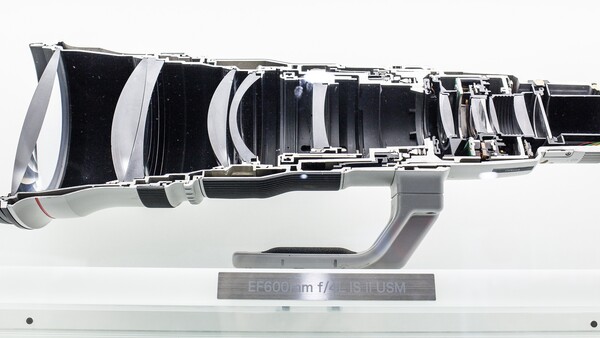
In March 1967, Canon researchers pulled the company's first synthetic fluorite crystals out of an electric furnace. Two years later, those crystals shipped inside a camera lens, the FL-F300mm f/5.6, which went on sale in May 1969 with two elements of grown calcium fluoride sitting where glass would normally be. Canon has never stopped growing the material, because long lenses carry a specific color error that ordinary optical glass cannot remove.
What an Achromatic Doublet Leaves Behind
Glass bends short wavelengths harder than long ones. A single positive element therefore focuses blue light closer to the lens than red light, and the gap between those focal points is what you see as colored fringing on a high-contrast edge. The fix is two centuries old. Cement a positive crown element to a negative flint element, choose the two glasses so their dispersions oppose each other, and you can drag two separated wavelengths back onto a common focus. That doublet is an achromat, and nearly every camera lens made since has some version of it inside.
An achromat corrects two wavelengths. Everything between them and outside them still misses. In a typical red-and-blue-corrected doublet, green converges somewhere else entirely, usually short of the other two. Canon's own materials call the leftover the secondary spectrum, or secondary chromatic aberration, and describe it as the residue that survives after the conventional correction has done its work. On the sensor, it reads as a soft violet or green halo hugging bright edges, a mild veiling haze that drags contrast down, or the purple ring around a bright star that shows up the moment you start shooting the night sky seriously.
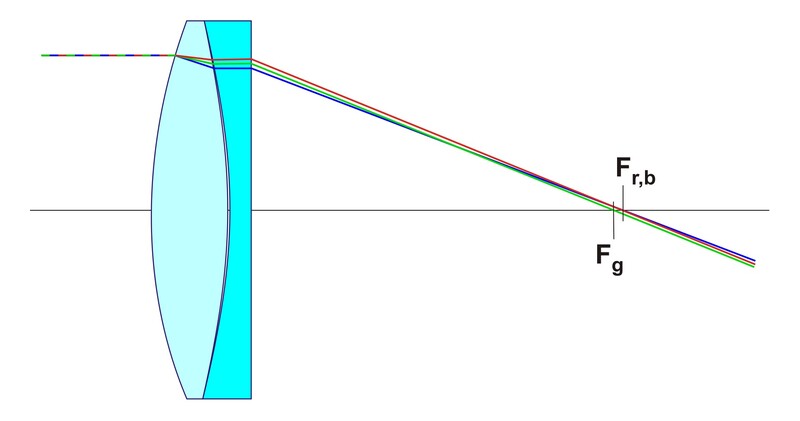
The size of that residue is set by the glasses you picked and by the focal length. For a cemented doublet, the longitudinal secondary spectrum works out to the focal length multiplied by the difference in relative partial dispersion between the two glasses, divided by the difference in their Abbe numbers. Focal length sits in that expression as a straight multiplier. Double the focal length using the same pair of glasses and you double the leftover defocus. What lands on the sensor scales with the diameter of the entrance pupil, so a 600mm f/4 with its 150mm pupil spreads secondary spectrum over a blur roughly four times as wide as a 50mm f/1.4 does. Nikon's own materials-technology pages make the same point from the design side, stating that the longer the focal length, the more difficult chromatic aberration is to correct.
This is why the problem belongs to telephotos. At 35mm, nobody is losing sleep over the secondary spectrum. At 400mm and 600mm, it is the aberration that decides whether the lens looks sharp. Stopping down does shrink the blur, but nobody buys a 600mm f/4 in order to shoot it at f/11, and the correction has to hold wide open where the lens earns its keep.
Why Fluorite Does What Ordinary Glass Cannot
Plot relative partial dispersion against Abbe number for the optical glasses in a catalog, and almost all of them land on a nearly straight line. Two glasses drawn from that line can be combined to null two wavelengths, but the third one lands off-target, because the relationship between how much a glass disperses and how it distributes that dispersion across the spectrum barely varies from one glass to the next.
Fluorite sits well off the line. Optical-grade calcium fluoride has a refractive index of about 1.4338 at the d line and an Abbe number near 95. Compare that to N-BK7, the workhorse borosilicate crown, at roughly 1.5168 and 64. The low index and the weak dispersion both help. The property that does the real work is what Canon calls extraordinary partial dispersion: from red through green, fluorite disperses light in much the same proportion glass does, and from green through blue it behaves differently. That deviation is the free parameter a designer needs. Pair a positive fluorite element with a high-dispersion glass negative, and a third wavelength can be brought onto the same focus as the first two. A lens corrected for three wavelengths is an apochromat, and that is the whole point of the exercise.
Fluorite entered optics long before Canon. Zeiss shipped the first apochromatic microscope objective in 1886, calculated by Ernst Abbe and corrected for three wavelengths, and natural fluorite was part of how that class of objective was built. Canon's own history of the material notes that natural fluorite occurs in sizes suitable only for small optical equipment such as microscope objectives. Microscopists still call one whole tier of objectives "fluorites." Canon's priority claim is narrower than the popular version of the story. The company describes the FL-F300mm f/5.6 as the world's first lens for interchangeable-lens cameras aimed at ordinary consumers to employ synthetic fluorite. The claim covers a manufactured crystal reaching a consumer camera lens, and it stops well short of inventing fluorite optics.
The F Plan and a Crucible at 1,400 Degrees
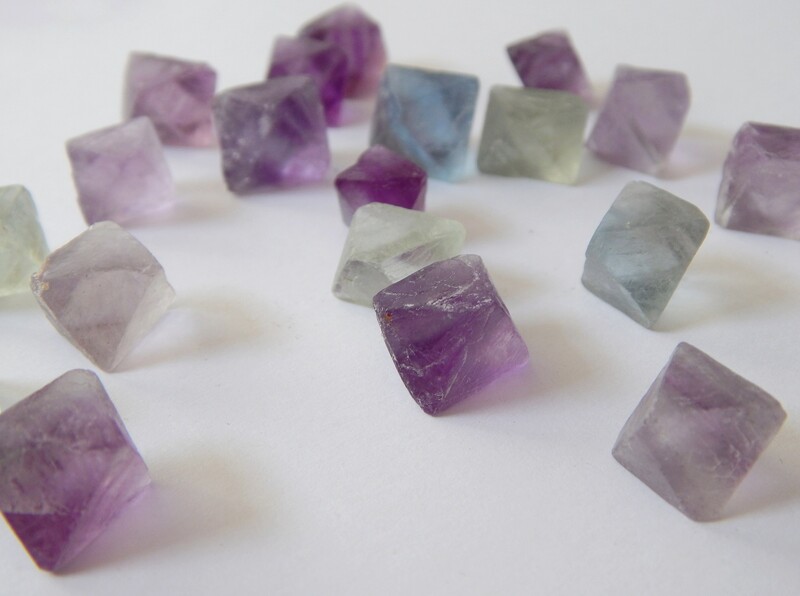
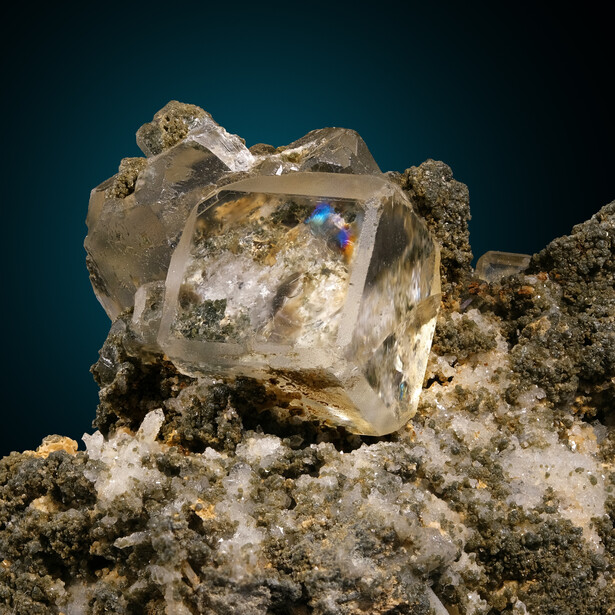
Natural fluorite crystals are small, and the impurities that give them their green and purple color are exactly the things that ruin them optically. They were fine for a microscope objective a few millimeters across. They were useless for an element large enough to sit inside a 300mm lens covering a 35mm frame. Canon's route around that was to grow its own.
The program started in August 1966 under the name the F Plan, and by Canon's own account, the first crystals came out of an electric furnace in March 1967. Production technology, the part that turns a laboratory result into elements you can build a product line on, was established in February 1968. Natural fluorite ore is crushed and refined to remove impurities, poured into a graphite crucible, placed in a crystal-growing apparatus with the heater above it, and taken to 1,400 degrees Celsius in a vacuum environment. The crucible is then lowered slowly, so the melt crystallizes from the bottom upward as it leaves the hot zone. What comes out gets annealed over a period of several weeks, held at a high temperature short of melting and then cooled back to room temperature slowly enough that internal strain does not crack it.
The FL-F300mm f/5.6 arrived in May 1969: seven elements in six groups, two of them fluorite, eight aperture blades, 3.5m minimum focus, a 58mm filter thread, 75 x 168mm, and 850 g. It listed at 100,000 yen with its case. Canon put a green ring on the barrel to signal what was inside, chosen to echo the glow that gives fluorite its Japanese name, hotaru ishi, or firefly stone. The FL-F500mm f/5.6 followed in June 1969 at 192,000 yen with one fluorite element, and Canon claimed 100 lines per millimeter for it even at the edge of the frame. In December 1974, Canon spun the crystal-growing operation out as Optron Inc., now Canon Optron, which still grows the material.
What the Crystal Costs You
Fluorite is a 4 on the Mohs scale, which puts it below apatite and well below quartz. In Knoop terms, calcium fluoride comes in around 158 kg/mm2 against roughly 610 for N-BK7. It scratches if you look at it wrong, and it is brittle in a specific way, because it is a cubic crystal that cleaves cleanly along its (111) planes. A knock that would chip a glass element can split a fluorite one along a plane.
Temperature is the sharper problem. Calcium fluoride has a linear thermal expansion coefficient around 18.9 x 10⁻⁶ per Kelvin, against about 7.1 for N-BK7 over a comparable range, so a fluorite element changes size well over twice as fast as the glass around it as the lens warms. Its refractive index also moves with temperature, and it moves in the negative direction, which is not how most optical glasses behave. The practical consequence is focus shift: a supertelephoto that has been sitting in the sun on a sideline is not focusing at quite the same plane it was in the shade, and a design with large fluorite elements has to be engineered so that shift stays inside tolerance. The material also dislikes thermal shock, which is why moving a big white lens from an air-conditioned car into August humidity is a slow operation.
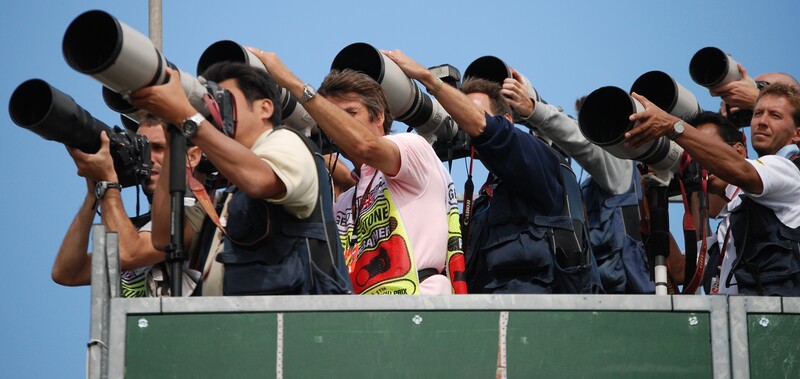
Canon paints its big telephotos white for thermal reasons, since a barrel that reflects sunlight rather than absorbing it holds the optics closer to a stable temperature, and a lens carrying large fluorite elements has more reason than most to care how hot it gets in the sun.
Then there is the machining. Fluorite cannot be ground and polished on a glass process, and Canon says it had to develop a dedicated method that takes up to four times as long as polishing ordinary optical glass. Add the crucible growth, the multi-week anneal, the yield losses from strain and inclusions, and the interferometer inspection at the end, and you have a supply chain that produces elements at a fundamentally different rate and cost than a glass melt does. When people ask why a 600mm f/4 costs what a used car costs, the fluorite is one real line item among several. The RF 1200mm f/8L IS USM, which carries large-diameter fluorite elements alongside Super UD and UD glass, launched in May 2022.
The Glasses That Chase the Same Result
Canon also developed ultra-low dispersion glass, which puts fluorite-like correction into more lenses than a crystal-growing operation could realistically feed. Canon's Super UD glass appears as early as May 1993, in the EF 400mm f/5.6L USM, whose museum entry credits its single Super UD element with "an optical effect similar to fluorite" and describes that element and one UD element as together "comprehensively eliminating the secondary spectrum." Canon's technology pages go further than the museum entry does, saying UD glass makes "possible performance similar to fluorite when multiple lens elements are combined," and that "Super UD lenses have nearly the same characteristics as fluorite and are functionally equivalent to using two standard UD lenses." What these glasses share with the crystal is where they sit on that plot of partial dispersion against Abbe number. Both are ways off the straight line, one grown and one melted. Neither glass is fluorite, and both are considerably easier to build a business around.
Nikon went at the same aberration with glass first. It developed its PC102 ED glass in December 1971, one month before the lens below, and adopted it across its 300mm and longer telephotos and zooms through the rest of the decade. Nikon's own account of the NIKKOR-H 300mm f/2.8 is unusually candid: the lens was released in January 1972 for press use only, the total run came to a hundred and some units, it never appeared in a catalog, and the early examples used Schott glass because Nikon's own ED material was not ready in time. The lens did not even carry the ED badge. Nikon later added a protective glass filter at the front specifically to shield the ED element. Nikon's own description of ED glass frames the problem in the same terms used here, noting that an achromat can match focal lengths for only two wavelengths and that ED glass, combined with other glasses, reduces the resulting secondary spectrum to a very small value. Super ED glass pushes the same idea further.
Nikon also uses fluorite. The FL in the AF-S NIKKOR 800mm f/5.6E FL ED VR and the AF-S NIKKOR 400mm f/2.8E FL ED VR marks exactly that, and the material is still in the current line, where Nikon's fluorite page names the NIKKOR Z 400mm f/2.8 TC VR S. Nikon's stated reason runs alongside Canon's, with one addition, since fluorite has a lower specific gravity than optical glass of equivalent optical properties, which matters in a lens this heavy. The two companies arrived at the same material from different directions and on very different timelines.
Diffraction as a Different Answer
Canon's diffractive optics line attacks the same problem with different physics. A DO element carries concentric saw-tooth rings, and it bends light by diffraction rather than refraction. Its dispersion runs backwards. A conventional convex element focuses blue, then green, then red; a diffractive element does it in the opposite order. Put the two together, and each cancels the other's chromatic aberration, which lets a designer hold the correction while cutting length and weight.
The EF400mm f/4 DO IS USM shipped in December 2001 at 770,000 yen, 17 elements in 13 groups, 1,940 g, and Canon claimed a 26% reduction in length and a 36% reduction in weight against a comparable all-refractive design. That lens also carries a fluorite element, and Canon lists it among its fluorite lenses. DO served as another lever on the same problem, and Canon pulled both at once. The idea survives in the current lineup as the compact, inexpensive RF 800mm f/11 IS STM and its 600mm sibling, which use dual-layer diffractive optics to put 800mm of reach into a 1,260 g lens and 600mm into a 930 g one, at a fraction of the price of the L-series glass.
Canon's own published tally, as of May 2021, came to 40 lenses using fluorite elements, the FL-F300mm plus 39 more. Several of Canon's current supertelephotos extend that list, and plenty do not. The two f/11 lenses above are supertelephotos by Canon's own classification and reach the same goal with diffractive optics, and the RF 100-500mm f/4.5-7.1L IS USM is an L-series supertelephoto zoom that corrects with one Super UD element and six UD elements and no fluorite at all. The RF 400mm f/2.8L IS USM and RF 600mm f/4L IS USM each run two fluorite elements in a 17-element, 13-group design alongside a Super UD element. The RF 800mm f/5.6L IS USM and the RF 1200mm f/8L IS USM each pack 26 elements in 18 groups, with fluorite, Super UD, and UD elements among them. Even the RF 100-300mm f/2.8L IS USM, a zoom rather than a prime, carries one fluorite element and four UD elements across 23 elements in 18 groups.
Nearly six decades after the F Plan, one of the premium answers to secondary spectrum in a long lens is still to grow a crystal in a crucible, cool it for weeks, and spend up to four times as long polishing it as you would spend on glass. UD and Super UD exist because that is an expensive way to solve the problem, Canon saying outright that fluorite's high production cost makes it unsuitable for more widespread use, and either can carry a long lens with no fluorite in it. DO came from a different motive, cancelling chromatic aberration while cutting length and weight, which is why Canon's first DO lens carried a fluorite element as well. Canon keeps reaching for the crystal at the top of the line anyway, and the material sitting inside a 2026 supertelephoto is the same calcium fluoride that came out of a furnace in Japan in March 1967.
Lead image: a cutaway Canon EF 600mm f/4L IS II USM displayed at photokina 2014, with the full element stack of a supertelephoto laid open. Photo by GodeNehler, CC BY-SA 4.0. Source.








Join the Fstoppers community for free
-
Post comments and join in the discussions
-
Browse the site ad-free
-
Share your work and get featured in the community
-
Compete in the photo contests for fun and prizes
3 Comments
My goodness. it's late on Friday night, and I'm just browsing photo sites, and I come across this article.
Now I have to study (just in case there's a test).
Thank you. A nicely written deep technical dive. I already understood the very basic fundamentals and this was a nice elaboration to the next step, combined with some flourishes of history.
I enjoy reading more than a straight up YouTube video. Again, thanks for your effort.
Thanks for the interesting article. Another solution to this problem is catadioptric (mirror) lenses. They are not very popular among professionals due to their characteristic "doughnut-shaped" bokeh, but are valued by enthusiasts for their affordability.