Ask a room full of people to name the best portrait lens, and most will point to something like the Canon RF 85mm f/1.2L USM, with its reputation for sharpness, flattering perspective on faces, and heavy background blur. If you're about to spend serious money on portrait glass, ask whether that reputation fits the rooms you work in and the apertures you actually use.
John Gress keeps a different lens on his camera most days: the Canon RF 70-200mm f/4L IS USM. His reasoning starts with history. Back in the DSLR years, primes really were sharper than zooms, and a lot of the advice still circulating comes from that era. After moving to Canon mirrorless about five years ago, Gress tested the zoom against the Canon RF 85mm f/1.2L USM and found the gap negligible once both were stopped down to f/5.6 or f/8, with the zoom possibly a touch sharper at f/8. He bought the f/4 version expecting to use it only occasionally, and his comparison against the Canon RF 70-200mm f/2.8L IS USM showed differences you'd only spot by zooming way in on a side-by-side test nobody runs in real life.
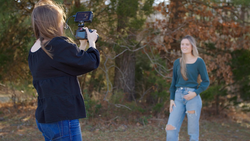
Space decides most of his choices. His Chicago studio is about 30 feet from wall to wall. Once he pulls the backdrop off one wall and steps away from the other, he doesn't have enough distance to photograph a standing man head to toe at 85mm. Tall models and heels push women out of the frame too, so he'd start with the prime and end up switching anyway, until he simply started grabbing the zoom first. On location in offices, or in unfamiliar studios, he rarely knows the room size in advance. Packing both lenses eats a big share of his bag and adds weight he'd rather not haul through airports.
The geometry here is easy to work out before you ever pick up a camera. On a full frame sensor, the long side of the frame is 36 mm, and the distance needed to fit a subject top to bottom is roughly the focal length times the subject's height divided by that 36 mm. For a 6-foot person in a vertical frame, that comes to a little over 14 feet at 85mm, before you leave any room above the head or below the feet. At 70mm, the number drops to under 12 feet. Add a few feet between the subject and the backdrop so light falls off and shadows don't land on the paper, then add room behind you to stand comfortably, and a 30-foot space fills up quickly. Run those numbers for your own studio or a client's conference room, and you'll know which focal lengths will work before you arrive. The same math explains why so many working portrait shooters favor a 70-200mm zoom: it lets you trade focal length for distance instead of being stuck with whatever the room allows.
Aperture is the other half of the argument. In the studio, Gress shoots mostly at f/8, partly because it's near the sharpest point for both lenses and partly because he wants the subject, props, set, and backdrop all reasonably crisp. Business headshots get stopped down too, since clients sometimes ask for a new background, and a shot taken at f/2.8 leaves the eyes sharp but the hair soft, which makes a clean cutout much harder. Actors are the exception. For them, he reaches for the 85mm at f/1.2, so casting directors see the kind of shallow, filmic look the person would have on camera. Outdoors, a third lens takes over entirely, and he explains why f/1.2 becomes awkward to use in midday light.
Gress also covers the high-end commercial work where the 85mm still gets the call and which lens he'd suggest if you could only own one, so watch the video above for the full breakdown.
Join the Fstoppers community for free
-
Post comments and join in the discussions
-
Browse the site ad-free
-
Share your work and get featured in the community
-
Compete in the photo contests for fun and prizes
No comments yet