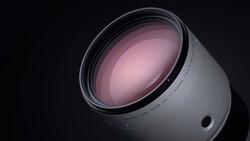
Long telephoto lenses have always made you choose between reach, weight, and money, and wildlife shooting tends to punish whichever one you skimp on. Fujifilm's new XF 400mm f/4.5 R LM OIS WR gives X-mount shooters a 600mm-equivalent prime that tries to ease the first two compromises at once.
Luca Petralia measures the Fujifilm XF 400mm f/4.5 R LM OIS WR against the full frame 600mm f/4 lenses that usually weigh around 3 kg and sell for $13,000 to $15,000. The Fujifilm weighs 1,245 g, roughly 2.7 lb, and Petralia puts the price at about $3,200. He treats f/4.5 as f/4.5 for exposure, while acknowledging that depth of field behaves more like f/6.3 on full frame. He also took the lens on a 3-mile hike with it hanging from his neck and never noticed the weight. Every frame he shows was shot handheld, with no tripod at any point.
Optically, Petralia finds it sharp wide open, with only a small gain from stopping down. You stop down for more depth of field and for nothing else. The bokeh falls off gradually and looks natural. Add the Fujifilm XF 1.4X TC WR and you get a 560mm f/6.3, which works out to about 840mm equivalent. The Fujifilm XF 2X TC WR takes it to 800mm f/9, or roughly 1,200mm equivalent, though he only tested the 1.4x. His rule for the teleconverter is useful: put it on when your reach is already good enough and you just want the subject larger in the frame. Don't reach for it because the animal is too far away. At those focal lengths, heat haze starts to dominate. You can fire a burst that looks perfect in the viewfinder and come home to one sharp frame and 15 mushy ones, and none of it is the autofocus' fault.
Fujifilm isn't alone in shrinking super-telephotos. Nikon's NIKKOR Z 600mm f/6.3 VR S uses a Phase Fresnel element to stay compact, and the Nikon NIKKOR Z 400mm f/4.5 VR S gives up a stop to stay light. Canon took the idea further with its RF 600mm and 800mm f/11 primes. The pattern is clear. Brands are betting that you'd rather walk with a slightly slower lens than wait in one spot with a faster one, and modern sensors handle higher ISO well enough to make that trade workable. The APS-C crop gives Fujifilm users their 600mm-equivalent field of view without the bulk a full frame lens needs to get there. Shooting handheld puts the stabilization load on you as well as the lens. Brace an elbow against your chest or lean on a tree, keep your shutter speed generous, and fire short bursts so you get several chances at a sharp frame. For heat haze, timing helps more than gear. Early morning, before the ground warms, gives you cleaner air. Shooting across cool grass or water helps too, and getting physically closer usually beats adding focal length.
Petralia also compares the 400mm with the Fujifilm XF 150-600mm f/5.6-8 R LM OIS WR and the Fujifilm XF 500mm f/5.6 R LM OIS WR, and he weighs how much a prime's fixed framing can work against you. In one example, a deer fit only in a vertical frame, and he couldn't back up. On the body, the lens has a focus limiter that switches between the full range and 5 m to infinity. It also has a stabilization switch, a preset switch, and an aperture ring that runs from f/4.5 to f/22. He'd like firmer clicks on that ring. The tripod foot is Arca-Swiss compatible, the front element takes 95mm filters, and the hood has a cutout for turning a polarizer. Under the hood sit four function buttons. Petralia sets them to recall a closer focus distance, so when the autofocus locks onto a blurred background, one press pulls focus back to where the camera can find the animal.
Petralia's autofocus and video results on the Fujifilm X-H2S are in the video above.


Join the Fstoppers community for free
-
Post comments and join in the discussions
-
Browse the site ad-free
-
Share your work and get featured in the community
-
Compete in the photo contests for fun and prizes
No comments yet