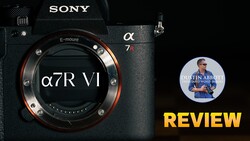
The Sony a7R VI sits at just under $5,000, and it's aimed squarely at shooters who want maximum resolution without sacrificing speed. What makes this camera unusual is that it manages to close the gap between high-resolution and high-speed shooting in ways the Sony a7R V simply couldn't.
Coming to you from Luca Petralia Photography, this detailed first-impressions video covers Petralia's real-world experience with the a7R VI after several shoots across different scenarios. Petralia initially talked himself out of buying it, and the video explains exactly what changed his mind. The biggest shift is the sensor. You go from 61 megapixels to 66.8, which alone wouldn't justify the upgrade, but the stacked sensor architecture makes the electronic shutter genuinely usable, something the a7R V never delivered. You get 30 frames per second with no blackout at full resolution. On the a7R V, you were limited to around 7 fps at full quality with the mechanical shutter.
The battery performance is one of the more surprising results. Petralia shot over 400 frames across a three-hour portrait session using strobes, reviewed images on the camera afterward, and still had 71% battery remaining. The new battery charges fast enough that if you're running two of them in rotation with a fast power delivery source, the first one can be fully recharged before the second runs out. The viewfinder also gets a meaningful upgrade: same resolution on paper as the a7R V, but now HDR-capable, significantly brighter, and it holds full resolution during continuous autofocus without the processing bottleneck that hampered the previous model.
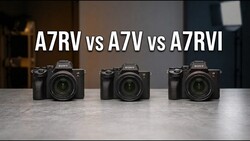
There are real complaints here too. The body dimensions are just slightly different from the a7R V, enough that none of your existing cages or L-plates will fit. Medium raw files, which were a useful option on the a7R V for social media or wedding coverage where 61 megapixels was overkill, are gone entirely on the a7R VI. The only way to reduce file size is to crop into APS-C mode. The rear screen doesn't support HDR despite the camera being capable of it, which feels inconsistent when the viewfinder delivers such a noticeably better image. Petralia also calls out several factory default settings that need to be changed immediately, including focus breathing compensation, the shutter curtain dust protection, and the red frame indicator, all of which ship turned off for no obvious reason. He also uses a Sigma 35mm f/1.4 DG DN Art in the portrait session, and the 100% crops from that combination are sharp enough that image quality clearly isn't a concern with this body.
Check out the video above for the full rundown from Petralia, including stabilization tests, rolling shutter performance, video specs, and his take on where the a7R VI fits in Sony's lineup alongside the a7 V and a1 II.




Join the Fstoppers community for free
-
Post comments and join in the discussions
-
Browse the site ad-free
-
Share your work and get featured in the community
-
Compete in the photo contests for fun and prizes
2 Comments
The shutter down protection also has downsides. When people recommend its use, and that it should be the default, they should also mention the downsides. I never use the shutter down protection on my Sony A7R V or VI.
From a quick Gemini query.
The shutter mechanism is significantly more fragile than the sensor.
The main downsides include:Extreme Fragility: The shutter blades are paper-thin and delicate. Accidentally touching them with a finger or a cleaning tool can easily bend or crease them, requiring an expensive repair. By contrast, the actual sensor is protected by a thick, resilient layer of cover glass.
Trapped Dust: If dust, sand, or debris settles on the closed shutter, it can get trapped between or behind the blades. When the camera powers on and the shutter reopens, this debris can be dumped directly onto the sensor, or worse, into the shutter mechanism causing it to jam.
Wear and Tear: Constantly closing and opening the shutter every time the camera turns off adds extra mechanical cycles to a part that already has a limited lifespan.
Accidental Light Damage: Sony explicitly warns that storing a camera with the shutter closed and without a lens cap in direct sunlight can focus strong light onto the curtain, potentially burning the blades or the sensor.
Slow Workflow: When turning the camera on to grab a quick shot, the shutter must reopen first, causing a slight delay before you can shoot.
I agree these are valid theoretical concerns. But the a7R VI has a shutter life expectancy of 500,000... so you would need to power off the camera 500,000 times to reach that point, or 10x per day for 137 years.
And more anecdotally, I've never heard of someone damaging their shutter when the camera was off. Never heard a single story of someone leaving an uncovered shutter exposed to direct sun. Never heard of a jammed shutter because of dust. And the mechanical shutter can fire at 10FPS, so clearly it takes significantly less than 1/10th of a second to open, which isn't going to slow down anyone's workflow.
But sensor dust from an exposed sensor while changing lenses is a day-to-day, constant problem that can screw up a shoot and lead to hours of extra post-processing.