Classic camera design keeps showing up on new releases, but the vintage look in your photos comes from the glass, not the body. Cheap, older lenses can deliver a character that no retro-styled body will fake for you.
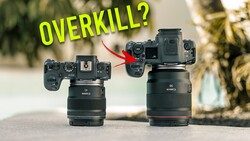
Rather than pay full price for a new retro-styled Canon, Jack Wang bought a lightly used Canon EOS 6D for roughly a tenth of the R8 Mark II's launch price and paired it with three inexpensive EF primes. Wang admits this is his first Canon ever, coming from a background with Nikon and Fuji, and he had always found Canon bodies bulky and a bit plastic. The opening came when Canon's block on third-party RF lenses pushed enough shooters to switch fully to RF, dropping EF prices in the process. For a total of around $650, Wang picked up the 6D and three non-L lenses to chase that soft, glowing, classic look he wants in his personal street work. The 6D itself surprised him with a lockable mode dial, a full-size battery that lasts nearly a week, and build quality that punches above its $200-to-$300 used price.
First up was the Canon EF 40mm f/2.8 STM, a pancake released in 2012 just before the 6D. Wang expected quirks and got sharpness instead, very sharp wide open in the center, with clean control of flare and chromatic aberration. Then came the Canon EF 100mm f/2 USM, a 1991 lens he assumed would show its age. It didn't. Out of hundreds of frames, Wang missed focus on maybe five, and the rendering came back cleaner and more modern than he wanted for this experiment. Both lenses are excellent, sharp, and easy to recommend to beginners, which is exactly the problem when you're hunting for flaws and swirl and glow.
The third lens is where the tension lands. Canon's EF 28mm f/1.8 USM gets called one of Canon's worst primes, and Wang pits it against a lens many consider Nikon's best, the Nikon 28mm f/1.4E on a Nikon D780. The 28mm Canon swings hard the other direction, with wild sharpness variation, heavy aberrations, cat's-eye bokeh, and swirl. Whether that reads as ruined or as character depends entirely on the shooter and the project, and Wang is upfront that a 28mm focal length is tricky to fill for everyday city work.
He set his usual -0.3 exposure compensation and found frames coming back far brighter or darker than expected, which he later traced to a metering mode he'd misread. On his other cameras, the icon he picked would mean matrix or evaluative metering, an average across the whole frame. On the 6D it turned out to be center-weighted average, so his focus-and-recompose habit kept shifting the metered point. That kind of muscle-memory mismatch is common when you move between systems, and it's a reminder to check settings before you blame the sensor. Once he shot raw and worked the files, Wang found Canon's color held up remarkably well under warming, keeping smooth midtone transitions where Nikon or Fuji files might tip orange fast. The 6D's low-light performance also impressed him, clean through ISO 6,400 and usable at 12,800 on its 20-megapixel sensor.
Wang is careful not to talk you out of the R8 Mark II. He simply prefers a fully classic body like the Nikon Zf or a fully modern one, with little appeal in the middle. He also teases the legendary Canon EF 50mm f/1.2L that showed more character than the cheaper non-L glass, plus curiosity about the RF 45mm f/1.2.
Watch the full breakdown in the video above to see which of the three primes finally delivered the glow and how the "worst" Canon lens stacks up against Nikon's best.




Join the Fstoppers community for free
-
Post comments and join in the discussions
-
Browse the site ad-free
-
Share your work and get featured in the community
-
Compete in the photo contests for fun and prizes
1 Comment
The Voigtlander lens I now use with my Sony has way more character than any of the Canon lenses I used with my 6D. The old EF Canon lenses still look too modern next to lenses like Voigtlander.