

Micro-Texture Control: Why Overusing the Mixer Brush Kills Spatial Depth
The optical disconnect between low-frequency smoothing and high-frequency realism.
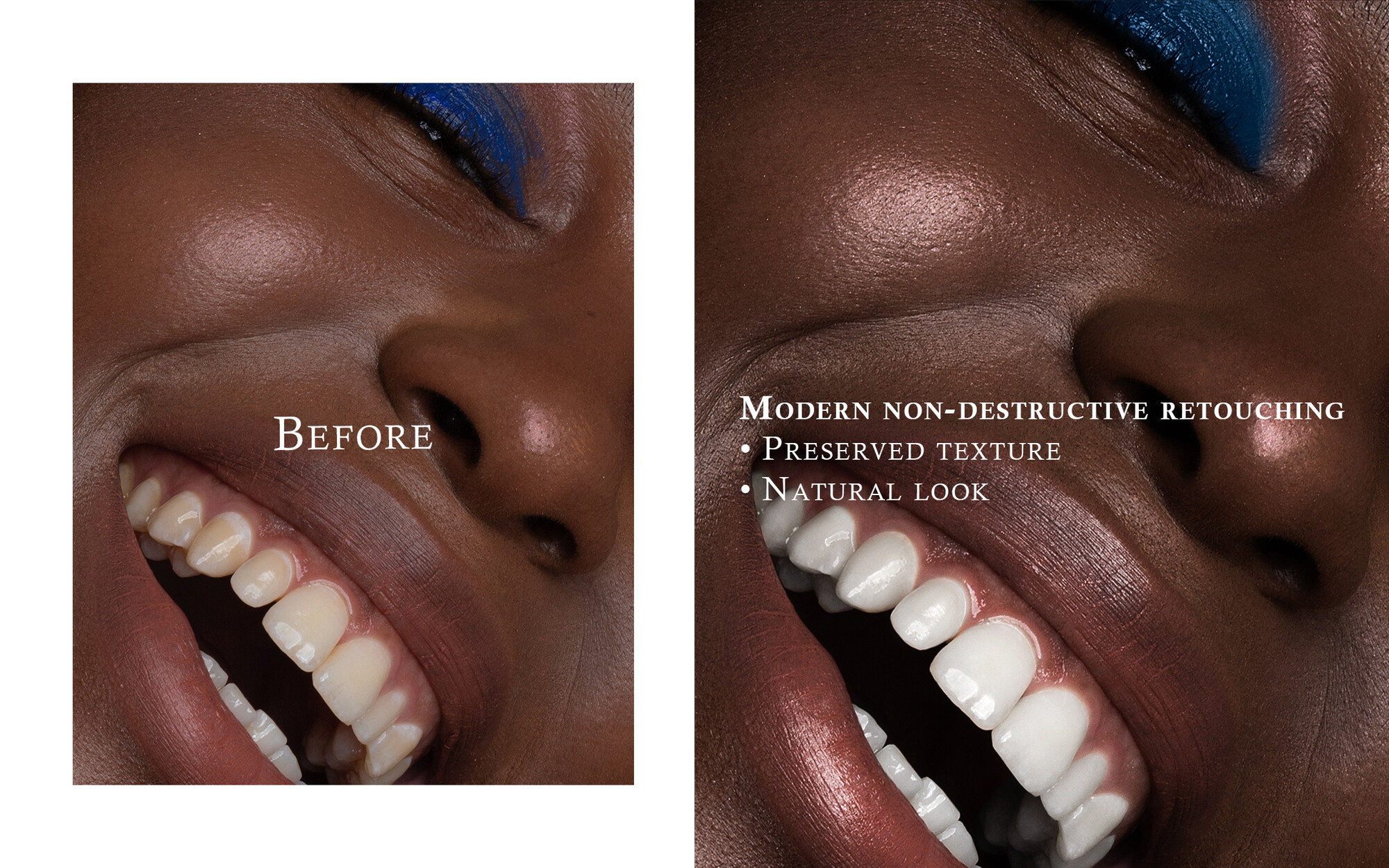
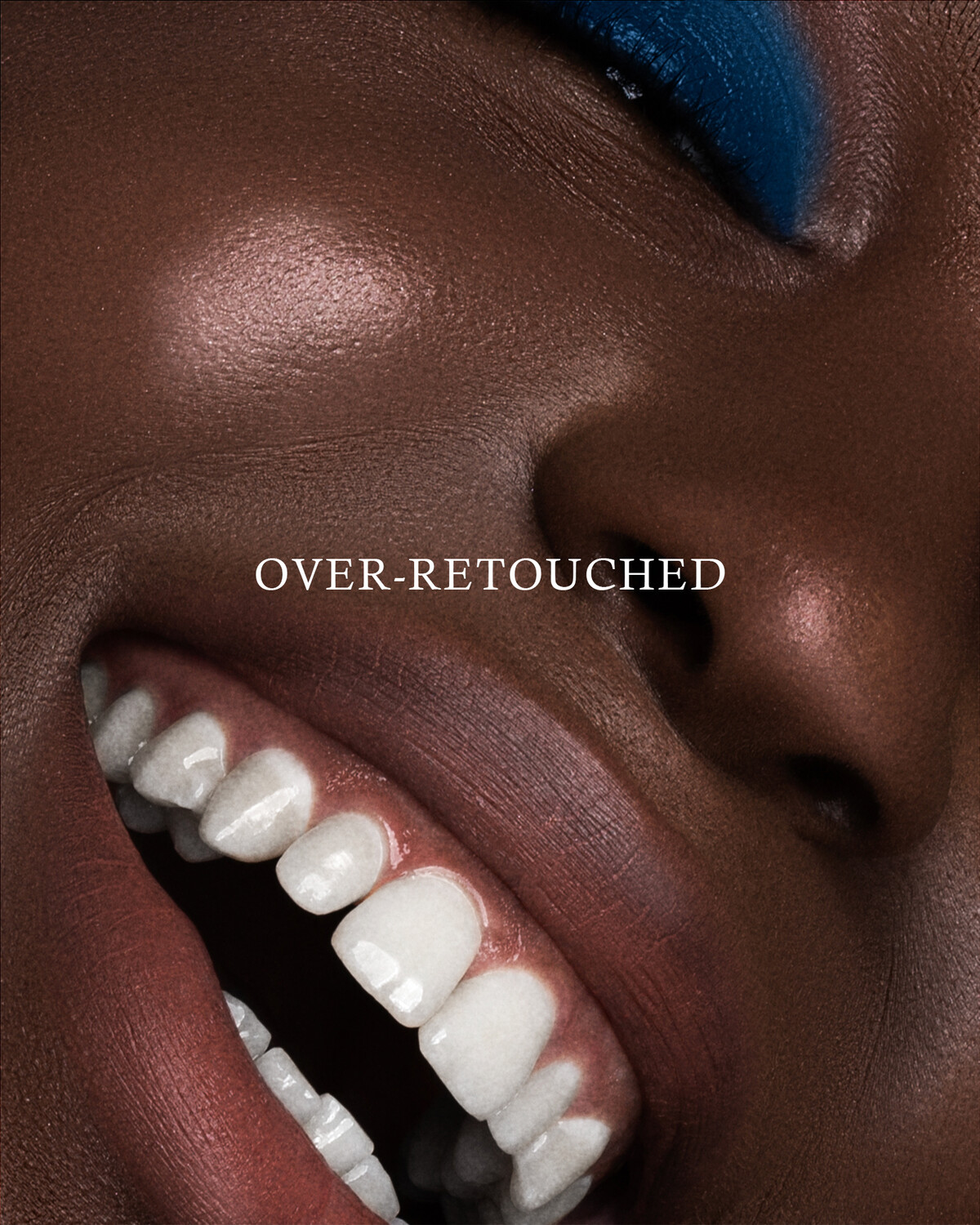
Every retoucher knows the look: skin that somehow has every individual pore intact, yet looks undeniably like melted wax underneath. It is the hallmark of modern commercial retouching gone wrong. The image technically has "detail," but it has completely lost its three-dimensional presence.
The culprit is rarely the high-frequency texture layer itself. It is almost always what happened underneath it on the low-frequency map - specifically, the aggressive use of the Mixer Brush.
The Optical Illusion of Real Texture
To understand why excessive smoothing fails, we have to look at how human vision perceives volume. Pores, fine lines, and microscopic product textures do not exist in a vacuum. They are physical micro-reliefs - tiny valleys and peaks that catch and occlude light based on the macro-lighting of the scene.
A pore on the lit side of a cheek reflects light differently than a pore sitting right along the shadow terminator line. Its visibility and contrast depend entirely on the underlying gradient of light and shadow.
When you split an image using Frequency Separation, you divide spatial frequencies into two distinct bands:
1. Low Frequency (LF): Macro-luminance, color, gradients, and anatomical volume.
2. High Frequency (HF): Micro-relief, fine detail, and pixel-level contrast.
The fatal mistake is treating these layers as independent images rather than complementary halves of a single optical system. When you blast the LF layer with a heavy Mixer Brush, you flatten the tonal transitions that the HF texture relies on for contextual depth. The high-frequency detail stops reading as organic surface relief and begins to look like a sheet of sandpaper or cellophane floating above a flat silhouette.
What Actually Breaks on the Low-Frequency Layer
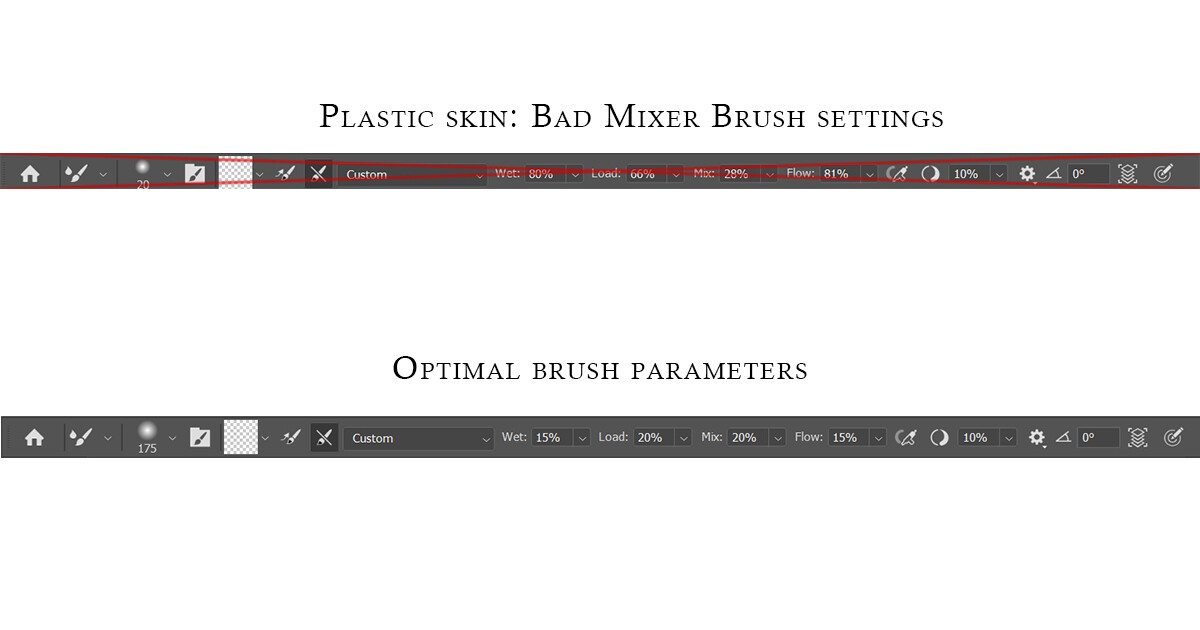
Using the Mixer Brush with high Wet and Mix values on the LF layer introduces three distinct structural failures:
1. Collapse of the Light Map and Surface Planes
Faces and objects are composed of distinct anatomical and geometric planes. When you aggressively blend adjacent tones, you wipe out the micro-gradients between highlights, midtones, and core shadows. The transition becomes linear and dead. Without these subtle shifts in tonal value, the brain stops interpreting the surface as curved or round.
2. Chromatic Mud in the Midtones
The Mixer Brush does not just move luminance - it drags chrominance across pixels. When you blend two distinct skin hues across a boundary, the mathematical averaging often yields a desaturated, grayish middle tone. This destroys the skin’s subsurface scattering effect, leaving behind dirty midtones that no amount of color grading can truly fix.
3. Spatial Decoupling
When micro-texture (HF) has high contrast but sits over a completely uniform, flat tone (LF), the eye detects the contradiction instantly. It breaks the illusion of reality because, in physics, micro-shadows cannot exist without the macro-illumination that creates them.
The Proper Mechanics: Treating the Mixer Brush as a Scalpel
Frequency Separation was never meant to be a fast-track shortcut for blurring skin; it is a surgical separation tool. If you choose to use the Mixer Brush on low frequencies, it must be governed by strict mechanical discipline:
• Keep Parameters Conservative: Never push Wet and Mix into the 30–50% territory. Keep both strictly in the 10–15% range, with Flow low. The goal is to nudge localized pigment irregularities, not to repaint the photographer’s lighting setup.
• Follow the Anatomy, Not the Blemishes: Brush strokes must follow the contours of the underlying bone structure and the direction vectors of the key light. Never scrub in circular or haphazard patterns across structural plane changes.
• Calibrate the Blur Radius with Precision: Choose the absolute minimum Gaussian Blur radius where fine texture disappears. If the radius is set too high, mid-level tonal transitions leak into the HF layer. This leads to severe haloing and phase artifacts the moment you attempt to blend underneath.
The Core Principle: Dodge & Burn First, Mixer Brush Second
The cleanest commercial workflows treat Frequency Separation as a secondary, finishing step - not the primary smoothing engine.
Macro-volume, transition repairs, and structural evening should always be built using local Dodge & Burn on Curves. D&B preserves the underlying color science, maintains natural light decay, and does not destroy the optical relationship between light and skin relief.
Save the Mixer Brush on low frequencies for minor, stubborn color blotches that curves cannot easily resolve. When you respect the relationship between macro-tone and micro-texture, the image retains its dimensional weight, optical realism, and depth.
View the detailed layer breakdown and pricing tiers in my portfolio: https://retouch.photo
Photo by Iulia David







No comments yet