
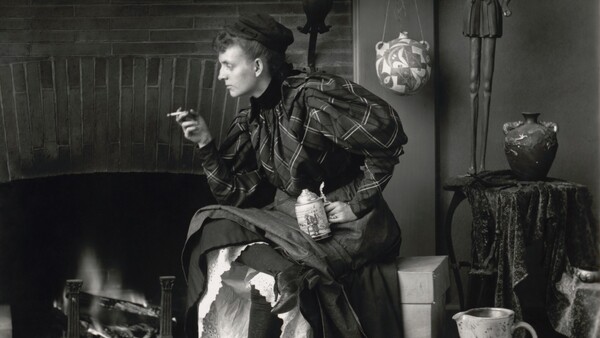
In 1896, a woman settled into a chair in front of the fireplace in her Washington, D.C. studio, hiked her petticoats above the ankle, crossed her legs like a man, and aimed her own camera at herself. One hand held a lit cigarette. The other cradled a stein of beer. Her name was Frances Benjamin Johnston, and across a career of nearly fifty years she talked her way into the White House, boarded a warship in a foreign harbor, and became the first woman in America to earn a living pointing a camera at the news.
Johnston built a career that should not have been possible for a woman in the 1890s, and she built it on nerve, family connections, and a camera. She spent almost fifty years in front of subjects nobody else could reach, and she left the record behind on purpose. More than 20,000 of her prints and roughly 3,700 glass and film negatives now sit in the Library of Congress, arriving by copyright deposit, by gift, and above all by purchase. The Library bought her papers, the Carnegie Survey negatives and some 20,000 photographs from her estate in 1953, the year after she died. She understood that she was building an archive.
A Camera From George Eastman
Johnston was born on January 15, 1864, in Grafton, West Virginia, a year after the Civil War split the state into being. Her family was comfortable and connected. Her mother had worked as a newspaper correspondent in Washington, and the household moved easily in the capital's political circles, which would matter enormously later. Johnston graduated from the Notre Dame of Maryland Collegiate Institute in 1883, then went to Paris to study drawing and painting at the Académie Julian, one of the few serious art schools that admitted women at all. She kept studying after she came home, at the Art Students League in Washington.
She meant to be an illustrator. Photography arrived almost by accident, and it arrived through one of the most consequential names in the medium. George Eastman, a family friend, gave Johnston one of his new roll-film cameras around 1888, right as Kodak was turning the camera from a chemistry set on a tripod into something a person could carry. The original Kodak held enough film for roughly 100 exposures, and when the roll was done you mailed the whole camera back to Rochester and got your prints and a reloaded camera in return. That was the pitch: you press the button, they do the rest. For Johnston, the small camera was a door.
She did not stay an amateur for long. She talked her way into the darkroom of Thomas Smillie, the Smithsonian Institution's first official photographer, and learned the chemistry and the craft properly, the way a professional had to know it. Within a few years she was writing and shooting for magazines, filing illustrated stories on subjects like the U.S. Mint and the Washington bureaucracy. She had found the seam between journalism and the new technology, and she planted herself in it.
The Only Woman Photographer in the City
In 1894, Johnston set up a studio of her own in Washington, on the block of V Street that ran between 13th and 14th. She was, by every contemporary account, the only woman running a professional photographic studio in the city. The studio became a salon as much as a business. She photographed the Washington elite, cabinet wives, society hostesses, visiting writers, and she did it with a portraitist's eye for how a person wanted to be seen.
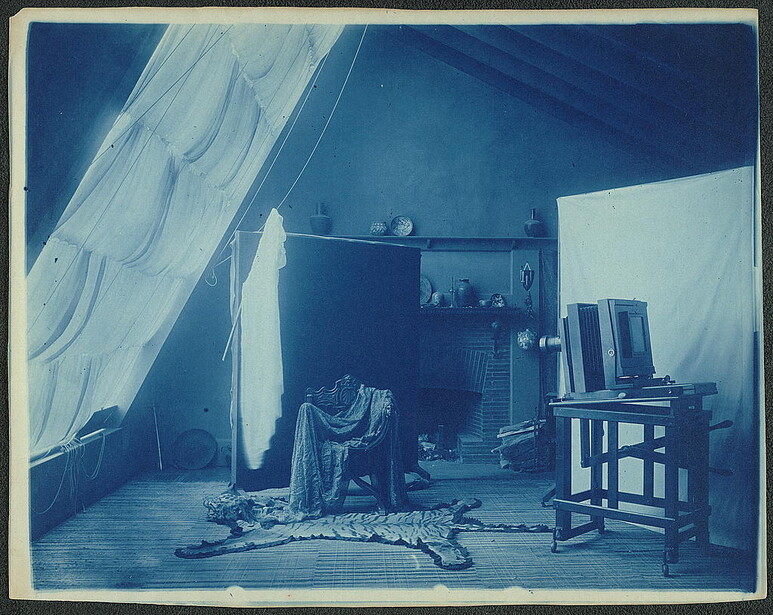
Her connections did the rest. Across the administrations of Benjamin Harrison, Grover Cleveland, William McKinley, Theodore Roosevelt, and William Howard Taft, Johnston had a standing pass into the White House that no other photographer could match. She was the closest thing the era had to an official White House photographer, decades before that job formally existed. She shot the grounds, the interiors, the ceremonies, and the families, and she made portraits of the people around the presidents: Alice Roosevelt, the writer Mark Twain, the suffragist Susan B. Anthony, the educator Booker T. Washington. If you have seen a photograph of a famous American from that turn-of-the-century Washington world, there is a real chance Johnston made it. The studio portrait was its own discipline then, the same one that still rewards patience and control today, the kind of thing a modern shooter learns from a course on perfecting a studio portrait. Johnston had the discipline and the access at the same time.
The New Woman by the Fireplace
The 1896 self-portrait is the image most people know Johnston by, and it was never a candid. It was an argument. She posed herself as the "New Woman" of the 1890s, the independent, cigarette-smoking, beer-drinking figure that polite society found alarming, and she staged it with total control of the frame. Laura Wexler, a professor of American studies at Yale University, has described the picture as a deliberate construction rather than a slice of life. "She would not have actually sat that way and done all of those things at one time," Wexler said. Johnston made several self-portraits that toyed with gender and identity this way, sometimes posing as invented characters, sometimes borrowing masculine dress and posture. For a professional woman in Washington whose business depended on a respectable clientele, publishing a picture of herself with a cigarette in one hand and a stein of beer in the other was a calculated risk, and she took it on purpose.
Her private life ran along the same independent line. Johnston never married. Her longest partnership, personal and professional both, was with the photographer Mattie Edwards Hewitt, and their surviving letters document a romantic bond as well as a working one. Johnston lived, as fully as the era allowed a woman to, exactly as she pleased, and the self-portrait by the fireplace is the clearest thing she ever said about it.
First Over the Wire
The portraits paid the bills. The news photography made her a first. In the 1890s, Johnston shot a series on the women who worked in the New England shoe factories, the cutters and sewers and pasters of Lynn, Massachusetts, going in and out of the plants and bent over their machines. Those images were distributed through an early news-picture syndicate and reproduced widely, and that combination, a working photojournalist whose pictures were syndicated to newspapers around the country, is what earned Johnston the title she is best remembered by: the first female press photographer in America.
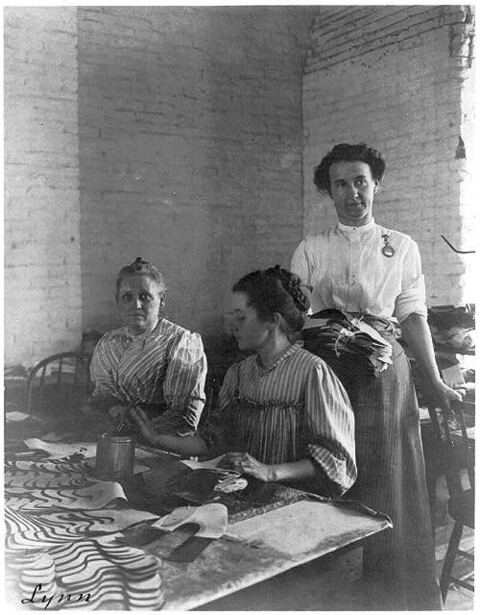
Understand what that meant in practice. Press credentials already existed, and that was the problem rather than their absence. The Senate had empowered a Standing Committee of Correspondents to grant them in 1884, and the machinery was built around male newspaper correspondents. What did not exist was an accreditation system designed with a woman in mind, or any expectation that the person behind the camera at a news event would be female. Johnston went anyway. She photographed coal miners underground and iron works and the great world's fairs. She documented the opening of Congress and the ceremonies of state. She shot for the syndicate run by George Grantham Bain, a pioneer of the news-picture business, and she filed the kind of material that filled the illustrated weeklies. She was doing photojournalism before the industry had a settled name for it, and she was one of the very few women in the country doing it at that level.
The Dewey Scoop
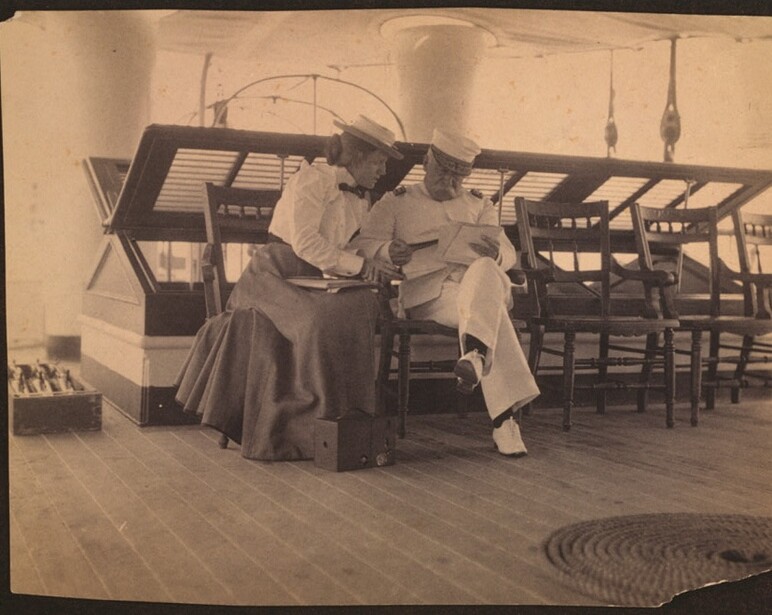
The clearest picture of how Johnston worked is the story of Admiral George Dewey. In 1899, Dewey was the most famous military man in America. He had destroyed the Spanish fleet at the Battle of Manila Bay the year before, and the public wanted pictures of the hero and his flagship, the USS Olympia. The trouble was that Dewey and the Olympia were an ocean away, resting in the harbor at Naples on the long voyage home, and a Navy warship was not a place that let a civilian aboard, let alone a woman with a camera.
Johnston got aboard anyway, carrying a letter of introduction from Theodore Roosevelt. She spent time on the Olympia and came away with an intimate record of the ship: Dewey himself, and the crew at work and at rest, eating, washing clothes, playing with the ship's pets, dealing with harbor peddlers. It ran to more than 200 photographs, a genuine scoop that only she had, and it landed exactly because she could open doors that stayed shut to everyone else. A letter from the right person and the sheer confidence to walk up the gangway. That was the method.
The Last Photographs of a President
Two years later, that same access put Johnston in front of a president in the final hours of his public life. On September 5, 1901, William McKinley delivered a major address at the Pan-American Exposition in Buffalo, New York, to a crowd of tens of thousands. Johnston was there to photograph him, and she made images of McKinley at the exposition that turned out to be among the last taken of him in good health.
The next afternoon, September 6, an anarchist named Leon Czolgosz shot McKinley twice at close range in the exposition's Temple of Music, a revolver hidden under a handkerchief, one bullet grazing the president and the other lodging in his abdomen. The president lingered for eight days and died in the early morning of September 14. Johnston did not stop on the fifth. The Library of Congress holds her photograph of McKinley riding to the Temple of Music on the sixth, in a carriage with John G. Milburn and George B. Cortelyou, catalogued as the last photograph ever taken of him. She had a healthy, waving head of state in her viewfinder the day before he was shot, and again on his way to the room where it happened. Her pictures of that visit became historically loaded overnight, though she did not always get credited for them. She had copyrighted the work, but the images circulated for years without her name attached and without the royalties that should have followed.
The Hampton Album
Johnston's most artistically important body of work has nothing to do with presidents or scoops. In the winter of 1899, she was commissioned to photograph the Hampton Normal and Agricultural Institute in Hampton, Virginia, a school founded in 1868 to educate newly emancipated African Americans, which began admitting Native American students ten years after that. The resulting series, known as the Hampton Album, is a set of composed, luminous platinum prints of students in classrooms, workshops, and laboratories, studying history, building trades, and science.
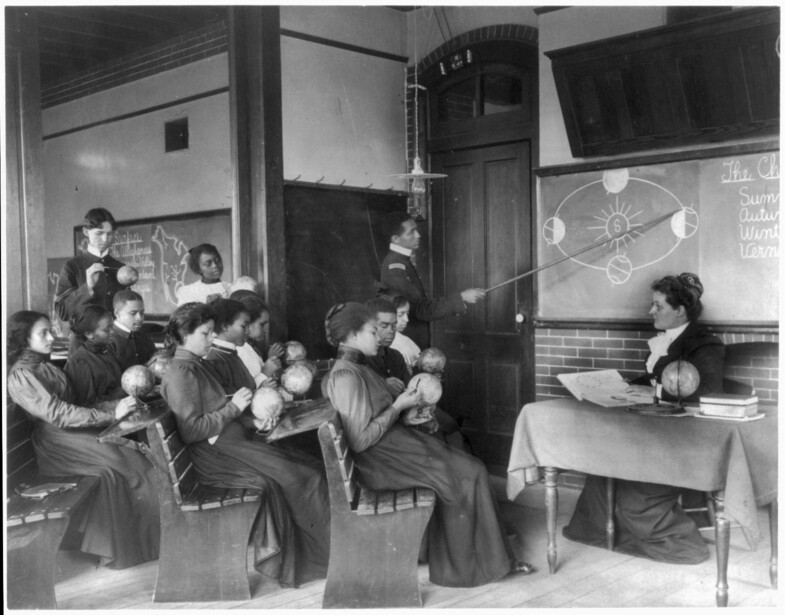
The pictures are deliberate to the point of being staged, every figure placed, every gaze directed, and that is the point. Johnston was building an argument in silver and platinum, a vision of dignity and possibility set against the brutal reality of the post-Reconstruction South. The album debuted at the American Negro Exhibit at the 1900 Exposition Universelle in Paris and won acclaim, then slid into obscurity for decades. It was rescued by accident when the impresario Lincoln Kirstein came across the leather-bound album in a Washington bookshop during World War II. He eventually gave it to the Museum of Modern Art, which published it and put Johnston's Hampton work back into the canon where it belonged. Modern viewers still argue about the pictures, about what they show and what they leave out, and that argument is exactly why they endure.
What a Woman Can Do With a Camera
Johnston did not keep her hard-won ground to herself. In 1897, she published an article in the Ladies' Home Journal with the plain, provocative title "What a Woman Can Do With a Camera," a working guide for other women who wanted to turn a camera into a career. She laid out the training, the economics of running a studio, and the temperament the job demanded. Her description of that temperament still reads like the truest thing anyone has written about the profession. The woman who would make a success of the work, Johnston wrote, needed "as to personal qualities, good common sense, unlimited patience to carry her through endless failures, equally unlimited tact, good taste, a quick eye, a talent for detail, and a genius for hard work."
She backed the sentiment with organization. For the 1900 Paris Exposition, Johnston assembled and curated a landmark showing of American women's photography: 142 prints by 29 photographers, drawn from the East, the Midwest, California and Oregon after she wrote to more than thirty women across the country. Gertrude Käsebier, Amelia van Buren and Zaida Ben-Yusuf were among them. She gathered the prints, corresponded with the photographers, and put the case for women in the field in front of an international audience. She was not just the exception who got in. She was actively holding the door.
Fifty Thousand Miles of Old Buildings
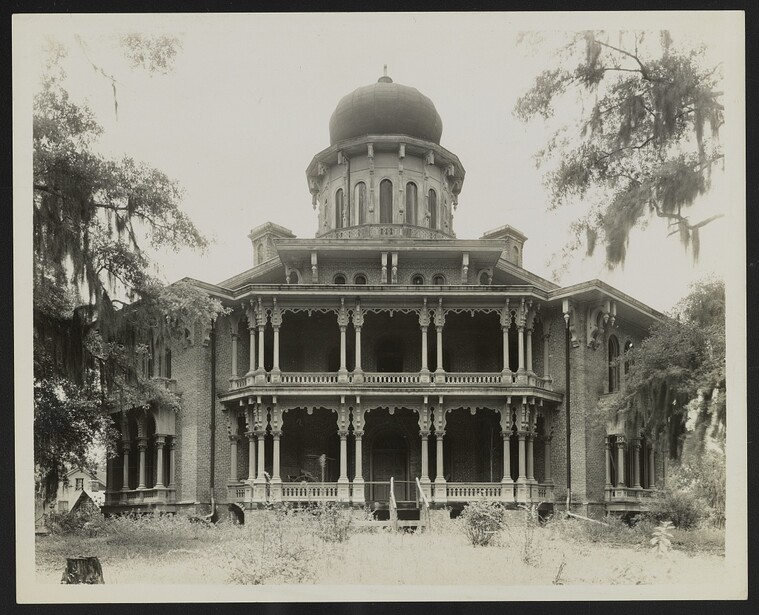
Johnston's last great project was a race against demolition. In the 1910s she had moved into architectural and garden photography, opening a New York studio in 1913 with her partner Mattie Edwards Hewitt, and over the following decades she grew alarmed at how fast the early architecture of the American South was disappearing. In 1933 she won a grant from the Carnegie Corporation, the first of several, to document it systematically before it was gone.
What followed became the Carnegie Survey of the Architecture of the South. Working into her seventies, Johnston drove tens of thousands of miles across the South, photographing plantation houses, churches, courthouses, outbuildings, and gardens, roughly a decade of fieldwork spanning nine Southern states. The images are patient and exact, the record of a photographer who understood that the building would not wait. It is the kind of disciplined architectural documentation that still takes real craft to do well, the sort of thing a photographer today would study in a course on photographing architecture well. The survey earned Johnston an honorary membership in the American Institute of Architects, a rare thing for a photographer and rarer still for a woman, and it remains a primary reference for preservationists working in the region.
Johnston retired to New Orleans, bought a house in the French Quarter, and died there on May 16, 1952, at 88. Her grave lies at Washington's Rock Creek Cemetery. By her own cheerful account, recorded in a later biographical exhibit, she was happy to call herself "the greatest woman photographer in the world," and she had the archive to make the boast hard to argue with. In all, the Library of Congress holds roughly 25,000 items tied to her career, a body of work she deliberately preserved.
The Camera Was Never the Barrier
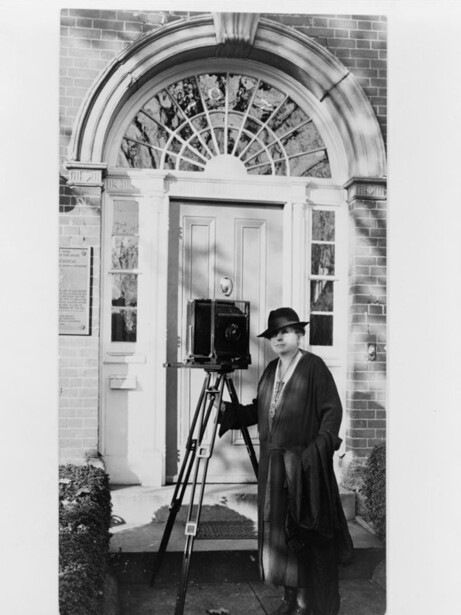
Johnston's whole career runs on one through-line, and it still applies to anyone shooting today, because the tools have changed and the lesson has not. She got everywhere she got on nerve, carrying a camera into rooms that were not built to admit her. The tool changed with the job, the pocketable Kodak that first got her in the door, a large view camera on a tripod for the studio portraits, the Hampton platinum prints, and the architectural survey, but the nerve did not. She photographed underground in coal mines, on the deck of a warship, inside the White House, and along thousands of miles of Southern back roads, and she did it as the one woman in America the profession had no category for. Johnston settled the gear question herself. Writing in the Ladies' Home Journal in 1897, she told readers that "no one lens nor camera will cover the entire field of photographic work," and she worked that way: the Library of Congress still holds her Rochester Optical Universal, the 5x7 wooden view camera she was using by the early 1890s. The Kodak got her started. What got her onto the Olympia was a letter and a willingness to walk up the gangway.
That is still true. The spiritual descendant of Johnston's little Kodak is a camera like the Fujifilm X100VI or the pocketable Ricoh GR III, a body small enough to go unnoticed and good enough to make serious work. The gear was never the barrier for Johnston, and it is even less of one now. What she actually had, the letter of introduction, the willingness to walk up the gangway, the patience to compose a room full of students until it said what she meant it to say, is the part that does not come in a box. She proved that the person who gets the picture is usually just the person who showed up, asked, and refused to be the first one to leave.
Lead image: self-portrait of Frances Benjamin Johnston as the "New Woman," 1896, seated by her studio fireplace with a cigarette and a beer stein. Frances Benjamin Johnston, public domain, Library of Congress. Source.
Join the Fstoppers community for free
-
Post comments and join in the discussions
-
Browse the site ad-free
-
Share your work and get featured in the community
-
Compete in the photo contests for fun and prizes
1 Comment
Interesting article. What are your sources for all of the information presented.