
Wherever you are on your landscape photography journey, there are common myths about how to approach the craft that can hold you back—thoughts that are commonly expressed in online communities that raise doubts and block your progress. Let’s look at three common myths that might be holding you back.
Working to improve your landscape photography can be challenging at times, with a variety of different advice coming at you from online communities, social media, and YouTube videos. While most advice is well-intentioned, sometimes that advice can be interpreted as an ultimatum: you either follow the advice, or your photos will never be impressive.
Let’s look at three common myths about photography that I frequently hear.
You Need Better Gear to Take Better Photos
A landscape photographer does not need to go far to quickly get the feeling that they need better camera gear to take better photos. It is easy to fall into this trap. Though I don’t believe this, you will frequently find me talking about camera gear.
One only needs to spend a little bit of time on social media or in various online communities to hear all sorts of opinions on the latest camera system—either how it is better than the last camera or lens model, or how it doesn’t compare to some other camera option. People will analyze the speed of the autofocus, the dynamic range it has, how many megapixels it has, and so on.
It is easy to see how a photographer can quickly come to believe that gear is the key to better photos when so much talk is about photography gear.
The reality is, gear doesn’t mean you will make better photographs. Photography has been around for a long, long time, and while our technology does improve, photographers have been making fantastic images this whole time. From film cameras to the first digital cameras to hit the market to the entry-level cameras of today, portfolio-worthy images have been generated this entire time.
Today’s cameras are powerhouses by any definition. I used to say that if your camera was purchased within the past ten years, it is not what is holding you back. I think I could change that to the past 15 years. There might be technical considerations to work around, but every opportunity exists to use the camera gear you have to produce great images.
There are more substantial ways to improve your photography than buying the latest camera gear. Learn the camera you have. Become familiar with the options it has, where things are in the menu, and how to configure the controls to make you more efficient in the field. Learn what the camera’s strengths are. Learn what it doesn’t do well, so you can work around those limitations. Work on using the camera you have to develop your creative eye, which will have a bigger impact on your photography than a gear upgrade.
You Must Follow Certain Composition Rules
Rules of composition are a major topic in photography: rule of thirds, leading lines, foreground, midground, and background, and so on. There is a reason that these rules are often talked about and taught. I simply wish they were called guidelines instead of rules. Being familiar with these rules or guidelines can and will help you make more powerful images, as they follow visual theory that has been formulated based on artistic work centuries ago.
However, I often find a photographer who feels they must always follow a certain rule, such as the rule of thirds. Every image they take becomes formulaic, with them using the grid lines on their viewfinder and lining up a tree on one-third of the frame, with no deviation.
When starting out with composition, the rules help put words to what makes an image stronger than another. But the rules of composition should be treated as tools in a toolbox. Just because you have a hammer in your toolbox doesn’t mean you should use it on every single project. Sometimes a screwdriver is the better choice.
Learning composition theory is important. Just remember, the goal isn’t to follow rules simply for the sake of following rules, but rather to use them to help communicate your vision of a scene. Apply the compositional tools in a way that makes the images the strongest, rather than checking off a rule for the purpose of saying you followed the rules.
You Need to Travel for Your Photography
Traveling for landscape photography is an amazing time and experience. Travel does bring excitement, seeing new locations, and makes it much easier to escape the potentially mundane day-to-day in your local area. But thinking you can only take great photos when you travel because your area has no potential is holding you back.
I frequently tell people to practice locally. Learning your camera, practicing the fundamentals of photography, and learning when to bend the rules of photography all contribute to strong images. All of these things can be practiced locally, no matter where you live. Not taking every opportunity to use your camera is stifling your progression as a photographer—both in improving your technical skills and in developing your creative eye.
Beyond just skill improvement, there are great opportunities to make stunning photographs in your local area. As a Midwestern photographer, I feel like if I can make compelling images in my local area, anyone can.
I might not have huge mountain ranges or grand landscapes to photograph, but I have a number of landscape subjects to seek out and photograph. From local waterfalls to woodland scenes to small scenes along creek or lake edges, you can always find something to create photographs of. I get a lot of my small scenes and woodland photography practice locally.
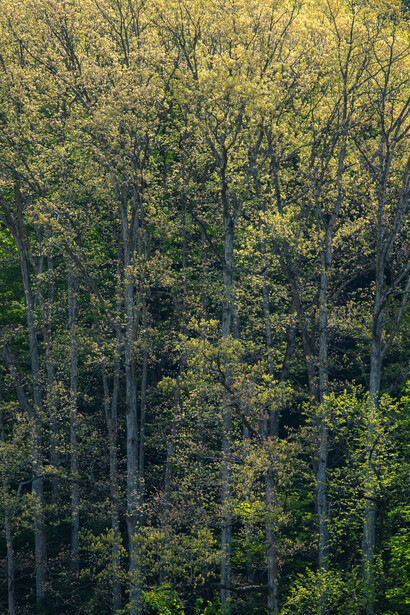
Getting out locally allows you to revisit scenes and see them in different weather conditions. While a scene may not have a lot of potential on a bright, sunny day, find it on a foggy morning, and new opportunities present themselves.
Revisiting lets us approach familiar scenes from different angles or perspectives. We have much more time to study a scene, approach it from different perspectives, and see it in different ways on repeated trips. Even subtle variations of light can turn an old, familiar scene you’ve walked by countless times into one that warrants stopping and composing a photograph.
I have only identified three of the more repeated myths I have seen, but there are many other myths proliferating through photography communities. Anytime you find yourself being told or interpreting something as you must do something this way or that, there is a good chance you’ve come across a landscape photography myth.
What popular myth have you heard in your photography circles?
Join the Fstoppers community for free
-
Post comments and join in the discussions
-
Browse the site ad-free
-
Share your work and get featured in the community
-
Compete in the photo contests for fun and prizes
2 Comments
There are no absolutes, and I don't recall ever having been told that I "must" follow anyone's rules or advice to become a better photographer. But I'm wondering if it could be considered a myth to say that these three so-called myths are actually myths. After all, a photo taken on my Kodak Instamatic camera of a tree in my local park, placed dead center in the frame, probably wouldn't win any contests. Of course, balance and perspective is needed with regard to these issues. It seems fashionable of late to criticize gear, composition and travel as overrated... but they are essential ingredients in photography. The quality of the camera and lens, and creative vision, both combine for superior image making. Following generally accepted compositional rules can be important too, as are cases where breaking them serves a greater purpose. Learning to photograph the ordinary subjects of your own neighborhood is a valuable skill for developing your skills of seeing, but if I lived in the panhandle of Oklahoma, I'd want to travel. My point is that one point of view from these myths should be combined with the opposite point of view for a balanced perspective. We're undoubtedly saying the same thing... I've just come to dislike the word "myth" as it implies something absolute (for or against an idea), and very little about photography is absolute certainty.
For me, it is more about the absolutes that are dangerous. You raise a valid point that there are counters to these myths as well, and if you take these myths as absolute then that can cause problems as well. As a photography friend of mine likes to say with so many things when it comes to photography - "It depends!"
Thanks for the comment!