
Woodland photography is something I have always found difficult. I am primarily a seascape photographer, and while I photograph other types of landscapes, the coast is where I feel most comfortable. When I arrive at a coastal location, I can usually start looking for the elements that might make up the photograph. A rock, a headland, a section of coastline, a wave, or perhaps the way the light is falling across the scene. There is normally something that immediately starts to draw my attention.
Woodland is different.
There can be trees everywhere, branches crossing through the frame, leaves competing for attention, and countless possible compositions all sitting on top of each other. The problem is not necessarily finding something to photograph. The problem is working out what the photograph is actually about.
I know I am not alone in finding this difficult. Woodland photography is often one of those areas where the scene looks much better to the eye than it does when you look through the viewfinder. You can walk into a wood and think there are photographs everywhere, only to take a few images and find that none of them really work.
That has certainly been my experience.
So I decided that rather than continue avoiding woodland photography, I would approach it differently.
Part of that change came from watching another photographer.
I Learned How to See
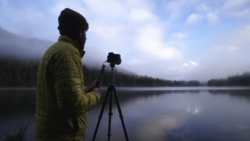
Mali Davies is a very good friend of mine now, but we originally met online many years ago before eventually meeting in person in 2019. We have kept in regular contact since then, and over the years I have watched a lot of his photography and YouTube videos.
https://www.youtube.com/maliphotography
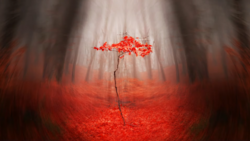
Mali has a very different approach to woodland photography from mine. He really likes trees, and when he is in a woodland, he seems to look for individual characters within it. Rather than trying to photograph the whole woodland, he finds a tree, a group of trees, or a particular shape that stands out from everything around it and builds the photograph around that.
That idea had stayed with me.
I also like the way he approaches the editing of his woodland images. There is often a delicacy to the way he treats the photographs, but what interested me most for this particular shoot was not trying to copy his finished images. It was trying to understand how he was seeing the woodland in the first place.
So I decided to borrow that way of thinking for a morning.
The woodland I chose was not somewhere new. I have walked through it many times with my family, which actually made it a useful place to try this experiment. I already knew the paths and some of the areas within it, but I had never really approached it with the specific intention of finding individual photographic subjects.
The forecast was also helpful.
The sky was clear, which meant the early morning sunlight would be able to make its way between the trees. I would have preferred mist or fog because those conditions can naturally separate trees from their surroundings, but I did not have them. Instead, I decided that I would allow the light to create that separation.
As soon as I arrived, I could see the potential and the problem.
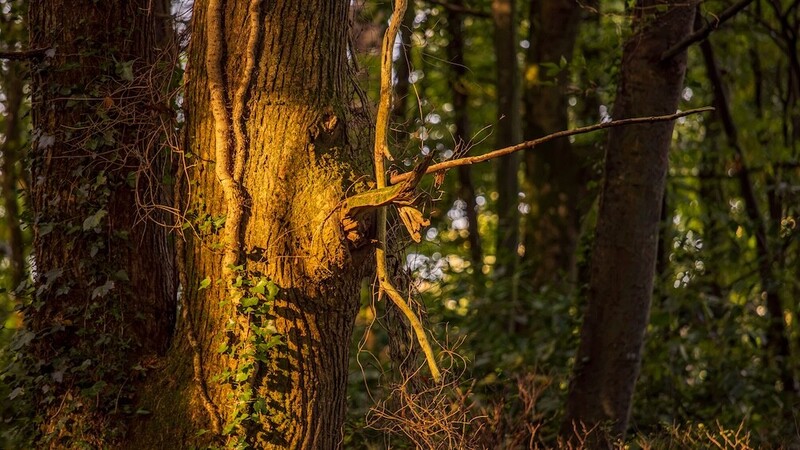
Light was moving through the woodland and hitting individual trunks, branches, and groups of leaves. Some areas were brightly illuminated while others disappeared into shade. Rather than immediately looking for a composition, I started watching the light.
That became one of the most useful changes I made.
But It Still Feels Complicated, Right?
When a woodland feels visually complicated, you do not necessarily need to find a simpler woodland. You can look for the areas where the light has already simplified the scene for you.
A patch of sunlight hitting one tree can separate it from the surrounding trunks. A group of leaves catching the light can become a subject against a darker background. A bright section of bark can draw your eye toward a particular part of the frame.
In other words, I stopped trying to make the whole woodland work and started looking for small areas that were already working.
I was using a telephoto lens for most of the shoot, and this also helped. A longer focal length allowed me to remove much of the unwanted information from the frame. Instead of including ten, twenty, or more trees, I could isolate one or two.
This is something I would recommend if you struggle with woodland photography. Do not assume that woodland photography requires a wide angle lens simply because you are photographing a landscape. Try a telephoto lens and start looking at the woodland in sections.
You might find that there are photographs hidden within the larger scene that you simply cannot see when you are trying to include everything.
I started taking photographs, and then something else became apparent.
I was returning to the same subjects.
At first I thought this meant I had run out of ideas, but the light was changing as I worked. A tree that had been illuminated from one side was later receiving light in a different position. The balance between light and shadow had changed, and suddenly the same subject had become a different photograph.
That is another lesson I took from the morning. Woodland photography does not always need to involve constantly moving from one composition to another.
Sometimes you can find a subject and wait.
The changing light can do some of the work for you.
Looking for Characters
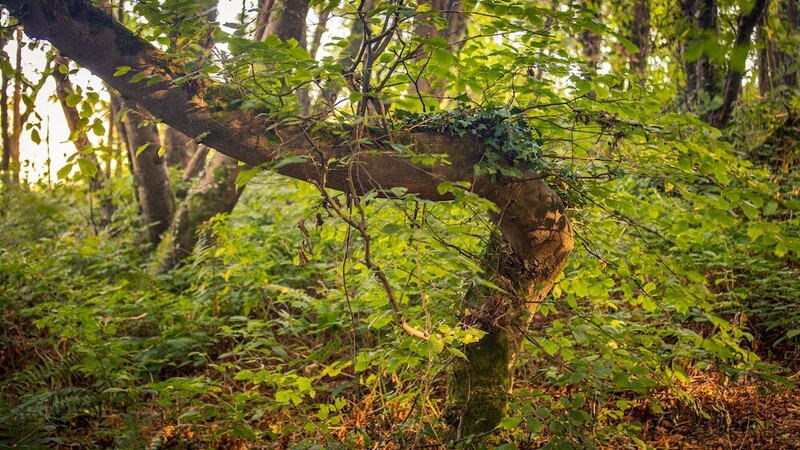
Eventually I found a tree that stood out because it was different from the surrounding trees. Most of the trunks around it were relatively straight and vertical, while this particular tree was crooked.
It was not an extraordinary tree. There was nothing particularly dramatic about it. It simply had a different shape.
That was enough.
This is something I think is worth considering when photographing woodland. Look for things that break a pattern. If most of the trees are straight, find the crooked one. If the scene is mostly dark, look for the area catching the light. If the woodland is filled with vertical lines, look for a horizontal branch or a shape that moves in a different direction.
The subject does not have to be spectacular. It just has to be different enough to give the viewer somewhere to look.
This is where I think woodland photography can become much easier.
Instead of asking, "Where is the photograph?" start asking, "What is different here?"
That small change in question can make you look at the scene differently.
It can also help with composition. Once you have identified the subject, you can start removing everything that does not support it. Move your position. Change your focal length. Look at the edges of the frame. Check for branches crossing the subject. Look for bright areas in the background that might pull the viewer's attention away.
In woodland photography, the edges of the frame can be particularly important because there is so much information available. A small bright patch or an unwanted branch can make an otherwise simple photograph feel much more complicated.
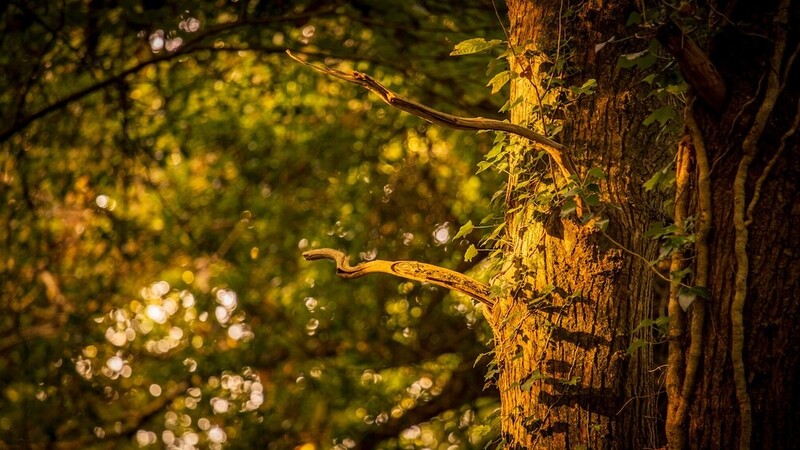
I eventually made my way toward a large path that runs through the woodland. It is normally where we walk when we visit as a family, but I had deliberately stayed away from it earlier because I wanted to work among the trees and concentrate on finding individual subjects.
By this stage, however, I was beginning to feel more comfortable with the approach.
The light was also leading me toward the path, so I followed it.
For this final photograph, I changed from the telephoto lens to a wide angle lens. I wanted to include more of the woodland and work with the sunlight coming through the branches, with the intention of creating a sunstar.
It was a very different type of photograph from the images I had been making earlier, but the basic approach was still the same. I was looking for a subject, watching the light, and deciding what I wanted the viewer to see first.
I came away from the morning feeling that I had made some progress.
I had not suddenly solved woodland photography, and I certainly would not describe myself as a woodland photographer now. What had changed was the way I was looking at the scene.
I had gone into the woodland thinking about Mali's approach, particularly his habit of finding characters within the trees, and that gave me a starting point. It made me slow down and look at individual subjects rather than immediately trying to find a wide composition.
Perhaps the biggest lesson was that I did not need to photograph the woodland.
I needed to photograph something within the woodland.
That sounds like a small difference, but for me it changed the experience completely.
A New Approach
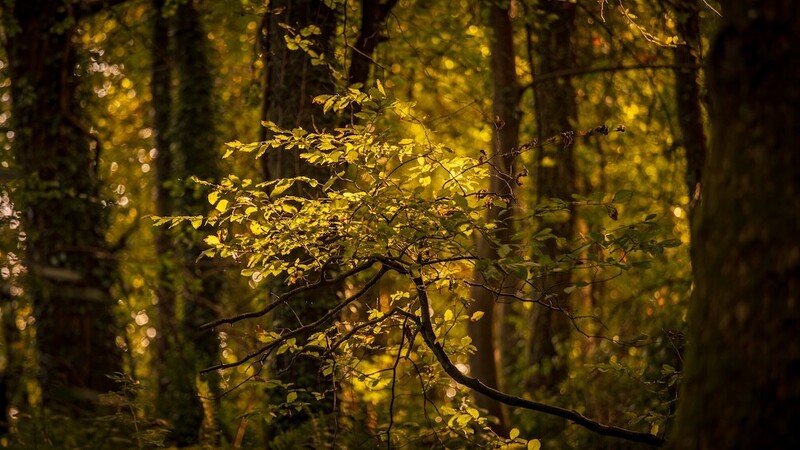
If you also struggle with woodland photography, I would suggest starting with a few simple exercises. Go into a familiar woodland rather than somewhere completely new. Take a telephoto lens and spend some time looking for individual trees or small groups rather than wide scenes. Look for shapes that break the pattern. Watch where the light falls and wait to see how it changes. Once you have found a subject, move around it rather than immediately moving on.
Then try the opposite approach.
Put on a wide angle lens and deliberately look for a composition that includes more of the woodland. Look for leading lines, paths, groups of trunks, and areas where the canopy creates a natural frame. Compare the two approaches and see which one helps you make stronger photographs.
If you want to explore this kind of landscape work in more depth, Photographing the World: Landscape Photography and Post-Processing covers composition, field technique, and post-processing across a range of landscape situations.
Most importantly, do not feel that you need mist or fog before woodland photography becomes worthwhile. Those conditions can certainly help with separation, but they are not essential. Light, shadow, shape, color, texture, and repetition can all be used to create separation if you take the time to look for them.
I think this morning also reminded me why it is useful to watch other photographers.
You do not have to copy their photographs. Sometimes the most useful thing you can take from another photographer is the way they approach a subject. Watching Mali's work had clearly influenced me, but I did not realize how much until I found myself standing among the trees and deliberately trying to see the woodland in a different way.
https://www.youtube.com/maliphotography
That is probably the lesson I needed.
Over to You
So now I want to turn the question over to you.
Do you find woodland photography difficult? If you do, what is the part you struggle with most? And if you are comfortable photographing woodlands, what have you learned that has helped you find better photographs?
Perhaps you have a different approach to finding subjects, working with light, or choosing lenses. Perhaps you have a lesson that took you years to learn but could help someone else who is struggling with the same problem.
Leave your thoughts in the comments. I would be interested to hear how you approach woodland photography and, perhaps, learn something from your experience as well.


Join the Fstoppers community for free
-
Post comments and join in the discussions
-
Browse the site ad-free
-
Share your work and get featured in the community
-
Compete in the photo contests for fun and prizes
No comments yet