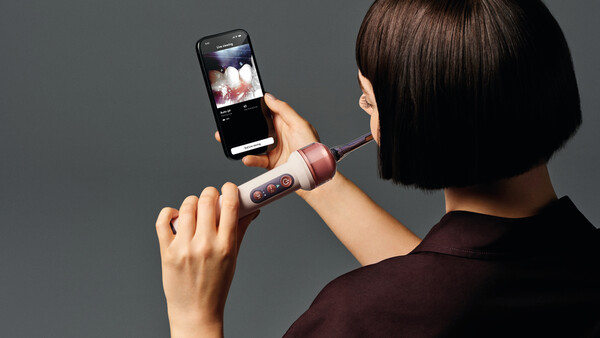
Dyson has built a toothbrush with a working camera inside the head, and it streams a live view of your mouth to a phone app. It went on sale September 1, 2026, at $499.
The launch was announced through a Dyson press release, with founder James Dyson unveiling the device in Paris. The core idea is a camera paired with a water jet. Gap Optical Targeting processes 28 live frames every second to spot and lock onto the spaces between teeth as they happen, setting off a precise burst of mouthrinse right where it's called for. The camera itself is tiny. Coverage of the launch describes it as a 100,000-pixel (0.1 MP) macro camera that scans 28 live images per second, with a machine learning system developed using more than 470,000 dental images. Dyson says the whole thing runs on 16 million lines of code and took six years to build.
The camera does two separate jobs. During brushing, it feeds the targeting system that fires the jet. Separately, you can open the MyDyson app to watch a live endoscope-style view of your own teeth. This makes it essentially an electric toothbrush combined with a flosser that squirts liquid into the gaps between teeth while you brush, with an onboard endoscope camera that records and evaluates 28 images every second as the brush travels across your teeth.
The plumbing is genuinely clever if you set aside the price. Dyson says it uses an "anti-gravity tank with a diaphragm pump and pressure chamber that adapt during use to deliver controlled jets in any orientation." Rather than the thin stream typical of most water flossers, Dyson's engineers label that conventional method a "needle jet," a slim, piercing stream that can come across as harsh yet still leave much of the plaque untouched, whereas Dyson's conical jet releases a burst of microdroplets in a fan-shaped spray that reaches a broader area between teeth while easing the pressure felt on gums. The company says it built its own test material for this, developing a proxy plaque through a five-year collaboration with the National University of Singapore's Faculty of Dentistry. Dyson further asserts that independent lab testing demonstrates the brush clears up to 69% more plaque than top-selling premium electric toothbrushes in areas that are difficult to reach, a number it points out reflects brush-only variable mode.
The resolution is deliberately low, the lens is a fixed macro, and the processing is narrow. But the direction is clear. Cameras are migrating into objects that have never had them, and the imaging conversation is shifting from megapixels toward what a small sensor plus a model can do in real time.
The bigger takeaway is about lock-in, and it is a familiar Dyson pattern. Inside the box, you get a charging dock that tops up the reservoir in three seconds, a travel case, a pair of spare brush heads, and Dyson's own non-foaming toothpaste and mouthrinse, and those consumables are proprietary, with RFID-tracked heads piling recurring costs onto the initial purchase price. The non-foaming formulas are not a marketing quirk either. Dyson developed a non-foaming toothpaste without sodium lauryl sulfate and a low-foaming mouthrinse specifically to keep the camera's field of view clear enough for the targeting system to work.



Join the Fstoppers community for free
-
Post comments and join in the discussions
-
Browse the site ad-free
-
Share your work and get featured in the community
-
Compete in the photo contests for fun and prizes
3 Comments
Seriously, now big tech wants to record and monitor our mouths?? 🤦🏻
£500 for a toothbrush??? Ha ha Ha Ha Ha!
Welcome to technology in the 21st century... all the things we never knew we needed. I can't imagine how I ever survived growing up in the 1950s without a camera and electronic toothbrush crammed inside my mouth to guide my brushing. Actually I do have an answer to that. I had a father who mysteriously seemed to always know when I had cheated on properly brushing my teeth, and made me go back and do it again.