
In my new YouTube video, Shooting Epic Landscapes in Terrible Weather, I take you behind the scenes of one of the most intense stages of my award-winning project ENLIGHTEN. The episode is about a lesson I learned the hard way: how to work with difficult weather and why those conditions often lead to the most powerful images. Here’s the full story behind that shoot.
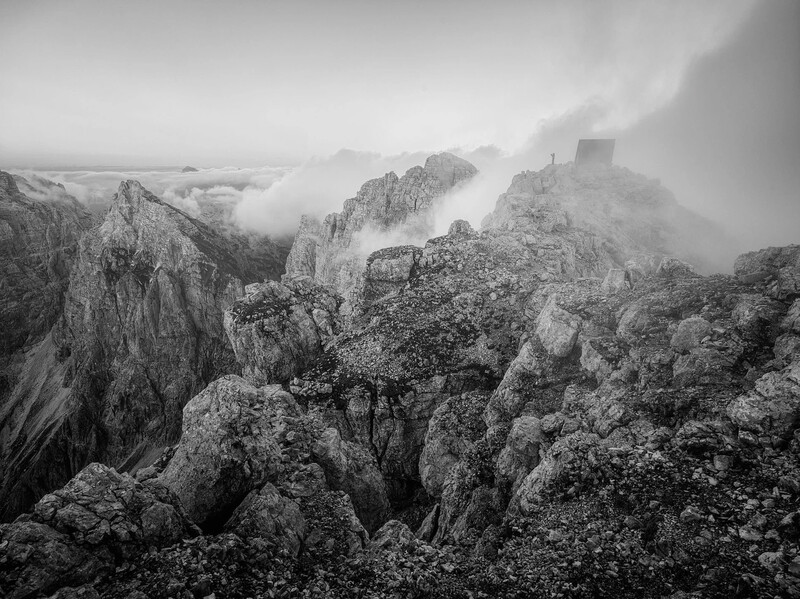
It was the fourth day of production in the Alps. The first night in the Bivak pod Skuto was still in our bones when Marcus and I set off for the next spot: the Bivacco Luca Vuerich, a small hut perched dramatically on the ridge above Sella Nevea. I wasn’t chasing architecture here. What drew me in was the location—staggering cliffs and jagged peaks stretching into Italy.
At the trailhead, things looked promising: blue skies, comfortable temperatures, and the hope of an easy climb. But the moment we glimpsed the summit, our hearts sank. The hut was swallowed by thick cloud.
Part of me wanted to call it. “The location isn’t worth it. The weather isn’t right. We’ve got other spots ahead.” The excuses lined up fast. But years in the mountains have taught me: the weather can turn in minutes. So we shouldered our heavy packs and started through the meadows, cows grazing and chamois watching us from the slopes.
The climb was rough. By the time we reached the rocks, I felt shaky, my steps uncertain. Was it exhaustion? Altitude? The pressure to deliver? The anxiety crept in. Marcus and I slowed down, buying time for my body and the clouds above. Eventually, we pushed onto the plateau, just as the impossible happened.
The clouds tore open. Shafts of light poured across the massif. The fear lifted. I grabbed the Hasselblad X2D, framed the Bivacco Luca Vuerich, and the flow returned. Two chamois sprinted across the ridge. My pulse spiked, the adrenaline rushed in, and suddenly I was gliding over the last rocks with pure euphoria.
At the hut, we scouted positions. The terrain dropped away on three sides, wrapped in fog. Every composition was a test of patience. My Lowepro GearUp Camera Cube paid for itself here—gear organized, hands free, focus on the essentials. In the end, there were only two safe vantage points. That was enough.
The biggest lesson of that day? Preparation is vital, but flexibility wins in the mountains.
Waiting It Out
Blue hour was spectacular: layers of clouds, bursts of color, a scene in motion. Then the fog closed in tight, sealing away every chance of a night shot. We weren’t alone, though. Another hiker shared the hut with us, curious about our gear and amused by our rituals. These moments are part of why I love these tours—no reception, no noise, just soup, tea, and conversations about mountain architecture.
Every 15 minutes, I cracked the wooden hut door, scanning the sky. My tripods were already in place, weighed down with stones against the ridge winds. All I had to do was clip in the X2D. At 9:00 p.m., the temperature dropped, the fog thinned, and the stars came alive. This is a pattern I’ve seen again and again in the mountains: don’t give up too early. After sunset, conditions often shift fast.
The night was brutally cold. We had left in T-shirts, but by now we wore everything we had: fleece, down, shell, gloves, hat. Marcus set up our Aputure MC LEDs, while I positioned myself a meter from the cliff edge with the XCD 21mm. Click. The first exposure began.
But the night had one more promise: at 4:30 a.m., the Milky Way would rise over the hut. We grabbed a few hours of restless sleep before stumbling back out. The sky was clear, streaked with faint clouds. We painted light, bracketed exposures, and tried every angle. But the composition just didn’t work—the hut felt like a block, the depth missing. That, too, is part of photography: sometimes the magic doesn’t happen, and the attempt itself becomes the lesson.
Sunrise Redemption
After another short rest, I stepped out before dawn. This is why I often sleep on location. You save the climb, you gain hours of observation, and you’re already there when the light breaks.
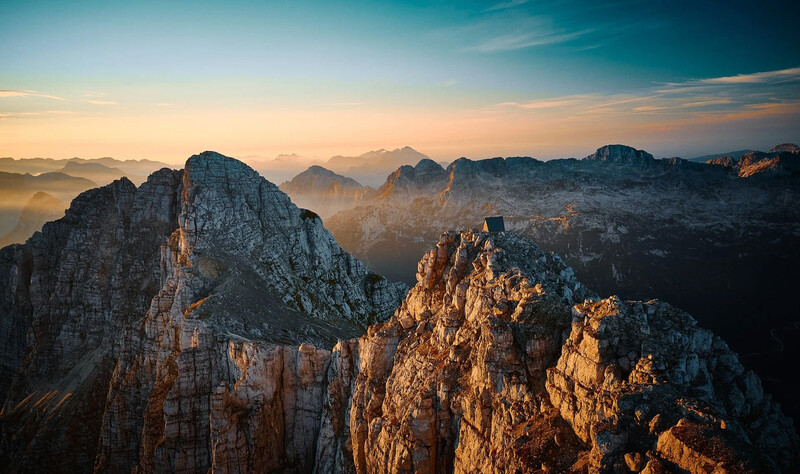
And what a light it was. What had been hidden in fog the day before now burned in reds and oranges. The XCD 90V captured rock textures, shapes, shadows—the mountains revealing themselves with every passing minute.
Then I reached for my “mini-Hasselblad”: the DJI Mavic 2 Pro. At last, I could free myself from the cliffs, send the drone out over the abyss, and frame the hut as I had always imagined—clinging to the edge, dwarfed by the immensity of the Alps.
When the drone batteries died and the last granola bar was gone, we packed up. The Bivacco Luca Vuerich faded behind us, small and unassuming, but with a view and a story that will stay with me forever.
Lessons From the Weather
On the descent, I kept turning it over. Had I gotten the shots I came for? Absolutely. And more than that, I would have regretted it deeply if I had let the clouds convince me to stay in the valley.
It was the bad weather that made the best photos possible. Clouds bring atmosphere, drama, depth. They shape the light, charge the sky with movement, and give images tension. The photographs from that night and morning remain some of my favorites from ENLIGHTEN.
But I need to add this: safety comes first. Always. Fog, storms, cold, rain—these aren’t just inconveniences, they’re real dangers. It’s not heroic to gamble with them; it’s reckless. I wrestle with that balance myself, but I’ve learned that if the risk is manageable, the reward can be extraordinary.
So here’s what I’d like you to take away: don’t let bad weather chase you inside. Prepare properly, respect the mountains, and trust your instincts. Because sometimes, the photograph you’ll remember for the rest of your life is waiting for you in the storm.

Join the Fstoppers community for free
-
Post comments and join in the discussions
-
Browse the site ad-free
-
Share your work and get featured in the community
-
Compete in the photo contests for fun and prizes
9 Comments
"Bad" weather. Huh?
There is no such thing as weather that is essentially good or bad. Whether or not the weather is favorable or unfavorable depends on what one's objective is.
You wrote this:
"At the trailhead, things looked promising: blue skies"
I do not understand that sentence, because just about any landscape photographers I know try to avoid clear skies like they would avoid a deadly disease.
For landscape and scenic photography, stormy, unstable weather is most commonly thought to be "good" and clear sunny days are considered to be "bad" weather. At least this is the way at least 95% of all nature photographers think. Most of the highly successful landscape photographers I know don't even bother to go out shooting if the forecast calls for clear skies. They watch the forecast earnestly, waiting for a storm to come in so they can go shoot. So it seems to me that you kind of mixed up what is generally considered to be good weather and what is considered to be bad weather, for this particular endeavor.
EDIT:
I see in your bio that your primary photographic genre is architecture. What is generally considered to be favorable weather for that type of photography? I would assume that most photographers of such subjects would normally prefer a high, even overcast. But I don't really know because it is a genre in which I have zero experience.
I suspect that you are saying the same thing he is, but with two caveats.... for one, while it's safe enough to set out on a short hike from a vehicle in really bad weather, it's totally another to climb treacherous mountains in those conditions. I'm sure for the other hikers as well as the photographer, they wanted the clearest weather possible to make that climb as the top priority. But the clouds totally encasing the peaks would mean virtually nothing to photograph once getting there.
Awesome image Ed! Actually my goal was to photograph the milky way at night and I needed a clear sky for that. In other scenarios I love moody clouds and storms and that is one of the highlights for me when venturing out to the mountains!
Secondly, there's dramatic bad weather that makes for a good photo and really bad weather where there's essentially nothing much left of the subject to photograph. And that's the point he's making. In the second paragraph of his concluding last section, he says: "It was the bad weather that made the best photos possible." Don't give up just because the weather is one extreme or another. In the mountains, especially, it can change quickly and it's those transitions of clouds and light that create the most dramatic photo opportunities.
Thanks for the photo and the story behind it, Ed.
"By the way, I know you wildlife photographers like zooming in tight to your subjects with super long lenses."
I don't actually like zooming in with a long lens. I would much prefer to get so close to the animals and birds that I could fill the frame with them using a 35mm or 50mm lens. That is what I would actually like. But 99% of the time I can not get as close as I want to get, so I have to settle for zooming in with a super long lens. I suspect that most other wildlife photographers feel this way, too.
there is such weather as good and bad
Cosmo Photo wrote:
"there is such weather as good and bad"
No, not essentially there isn't.
Whether weather is "good" or "bad" is entirely subjective, and based on one's purposes and objectives and preferences.
Weather that is good for photographing woodland habitats is horrible for sunbathing. Weather that is good for picnicking is bad for skiing. Weather that is good for photographing waterfowl in flight is bad for photographing squirrels under the woodland canopy.
So what do you mean when you write what you wrote?
You would be hard pressed to cite one other example besides a photographer who would invert the normal perceptions of good and bad weather... which is that warm and sunny blue skies is good weather, and cold windy rain or snow is bad weather. Maybe there are other professions who twist it around but not many. Okay, the fans attending a Green Bay Packers game might consider ten below zero great weather when the visiting team just got off the plane from Miami. But those examples are rare enough that it's permissible to equate good weather with being warm and sunny.
I grew up in a hunting family, and many of the people that my family knew and associated with were avid hunters. For most types of hunting, clear, sunny skies and warm temperatures are a nightmare because game does not like these conditions and therefore tends to just huddle up in a thicket until "better" conditions blow in. Most game animals like to be out and about when the weather is more overcast and colder, so for most of my life, most of the people I communicated with on a daily basis much preferred cold temperatures, cloudy skies, drizzle, and wind to clear warmth.
Come to think of it, most wildlife people in general do not prefer warm clear weather, because those are conditions that most wild animals are not very active in. I mean people whose lives are all about wildlife, not people who just like to go into nature for a few hours each week.