
There is a particular kind of confidence that only exists on the internet. You have probably encountered it if you've ever published a photograph, written an article, uploaded a YouTube video or, for that matter, dared to have an opinion in public. It belongs to the person who has never shown you a single piece of their own work, yet has absolutely no hesitation in explaining why yours falls short.
I am not naive. Photography has always welcomed criticism. In fact, it depends on it. Every meaningful artistic movement has been shaped by disagreement, and every photographer worth listening to has, at some point, benefited from someone pointing out a weakness they were unable to see themselves. Criticism is not the problem. The problem is that somewhere along the way we started confusing criticism with commentary, and commentary with authority.
The internet has flattened everything. A thoughtful review from someone who has spent thirty years photographing the streets of New York occupies exactly the same amount of screen space as a sarcastic remark left by an account that has no profile picture, no name, no website and no portfolio. They appear one beneath the other as though they carried identical weight, and we have somehow convinced ourselves that they do.
Hey, I am not arguing that anonymous people should be forbidden from expressing an opinion. Quite the opposite. Anyone should be free to say that a photograph doesn't work, that an article is poorly argued or that a video is uninteresting. Freedom of expression loses its value the moment it applies only to people we agree with. But what interests me is something entirely different.
Why have we reached a point where the person exposing their work, their name and their reputation is expected to answer for every creative decision, while the person dismissing that work can remain completely invisible? That imbalance has become so normal that very few people even notice it anymore. And whenever this subject comes up, someone inevitably replies that a person does not need to be a great photographer to recognize a weak photograph. I completely agree. You do not need to be a chef to know when your dinner tastes terrible, nor do you need to direct films before deciding whether one is worth watching. Nobody is suggesting otherwise.
The question, however, has never been whether someone is allowed to dislike a photograph. The interesting question is why we should automatically consider every criticism equally valuable when we know absolutely nothing about the person making it. Experience does not make someone infallible, but it does provide context. If a documentary photographer tells me that one of my images fails because the relationships between the subjects never quite come together, I am naturally curious to see how they solve that problem in their own work. If an architectural photographer disagrees with my use of perspective, I would genuinely like to understand the visual language they have developed over the years. A portfolio is not a trophy cabinet proving superiority. It is simply evidence that someone has invested enough in photography to stand behind their own ideas before dismantling someone else's. Oddly enough, this is considered controversial.
Photographers are constantly asked to show their work before offering advice. Beginners post images specifically because they want feedback from people with more experience. Workshops are built around the idea that students learn from photographers whose work they admire. Nobody finds this strange. Yet the moment you wonder whether an anonymous critic should reveal something, anything, about their own photographic journey, the conversation suddenly shifts to freedom of speech, when these are two completely different issues.
Nobody is asking anonymous accounts to earn the right to speak. The question is whether anonymity should automatically grant the same credibility as accountability. I don't believe it does. In fact, I would argue the opposite.
When someone signs an article with their real name, they are making a small but significant commitment. Every sentence contributes to their reputation. Every photograph becomes part of a body of work that others are free to admire, criticize or ignore. There is something at stake. The same applies to photographers who maintain a public portfolio. They are inviting judgment every single day. Their failures remain visible alongside their successes. And when you are no longer anonymous, you don't use certain statements, or maybe you are more gentle, with a different behavior, and you don't pass as a troll. Anonymous accounts enjoy a luxury that no working photographer has ever had. They never have to demonstrate what they can do. They never have to explain their own choices. They never have to expose themselves to the same scrutiny they demand from others. If tomorrow they disappear, nothing disappears with them. That absence of accountability inevitably changes the nature of the conversation.
It is probably one of the reasons why so many anonymous comments lean on sarcasm instead of analysis. Sarcasm is wonderfully efficient because it creates the illusion of intelligence without requiring the effort of constructing an argument. Declaring that a photograph is "just a snapshot" or dismissing an entire genre in a single sentence may feel satisfying, but it rarely tells us anything useful about the image itself.
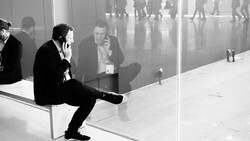
Street photography, perhaps more than any other genre, attracts this kind of reaction and, yes, trolls, a lot of haters. Every street photographer eventually hears that their work is random, cluttered or devoid of meaning. Sometimes those observations are entirely fair. Sometimes the photograph really is weak. The problem is that many critics arrive with conclusions long before they have developed an argument. They are not engaging with the photograph in front of them. They are reacting to an idea they already dislike. That is not criticism. That is prejudice dressed up as criticism.
The irony is that some of the best criticism I have ever received came from people who fundamentally disagreed with me. They questioned my choices, challenged my assumptions and occasionally forced me to rethink my approach. Those conversations were valuable not because the other photographers were famous or because they always turned out to be right, but because they were willing to stand behind what they believed. Their names meant something. Their work was visible. If I disagreed with them, I could at least understand the experiences that had shaped their opinion. Context enriches disagreement. Anonymity often strips it away.
Of course, there are exceptions. Some anonymous people write thoughtful, generous and deeply informed comments. Some photographers with impressive portfolios produce remarkably shallow criticism. Reality is rarely as simple as we would like it to be. Yet exceptions do not invalidate the broader pattern. Spend enough time publishing photographs online and it becomes difficult not to notice where the most dismissive remarks tend to come from.
Perhaps the strangest part of this entire phenomenon is that anonymous critics often demand complete transparency from everyone except themselves. They want photographers to explain every creative decision, justify every composition, defend every edit and respond politely to every accusation, all while revealing absolutely nothing about who they are or why their opinion deserves particular attention. That expectation has always fascinated me.
It is as though photography were the only profession in which invisible people believe visibility is something owed exclusively by others. For that reason I have reached a simple personal conclusion. I will always read criticism. I will continue learning from people who see photography differently than I do, because disagreement has made me a better photographer more than praise ever has. What I am increasingly unwilling to do is invest significant time responding to accounts that ask for openness while offering none themselves. That is not arrogance. It is simply recognizing that time is finite, and meaningful conversations require at least a minimal level of mutual accountability.
If you want to tell me that one of my photographs fails, I am genuinely interested in hearing why. You may even convince me that you are right. But forgive me if I become more interested in the conversation once I know there is an actual photographer on the other side of the screen rather than a username, a blank avatar and an opinion that arrived from nowhere. After all, photographs are made by people. Perhaps criticism should be too. I am sorry, but I stop replying to people with no avatar and no reference to their photographic work here. If you decide to be nothing, I am not talking to nothing.

Join the Fstoppers community for free
-
Post comments and join in the discussions
-
Browse the site ad-free
-
Share your work and get featured in the community
-
Compete in the photo contests for fun and prizes
5 Comments
At least one of your contributors here, with many articles and strong opinions about gear, has laughable work, to put it politely..
You're free to think my work is terrible. That still doesn't answer a single point I made. Resorting to personal attacks instead of addressing the argument is childish.
George is saying "one of the contributors" but not saying whom he is exactly referring to. I equate contributors with Fstoppers writers. It could be you, or it could be someone else.
I clicked on his history of comments and came across a couple old articles written by Ivor Rackham about camera gear, which was a favorite topic for Ivor. In the comments, George insinuated that Ivor's poor quality of photography disqualified him from writing an opinion about gear. Of course, Ivor has long since departed Fstoppers, probably because of all the snarky criticism, but I suppose that's besides the point. Some people hold grudges for a long time.
Sincerely I don't care if was me or others. Point is the controversy and the attacks are childish and it sounds like a kindergarden. I'd like to see more mature attitudes and more cultured people...