
Using images out of context is one thing. Using images that are clearly exploitative as part of your marketing is something else.
Bruce Gilden is a controversial figure in the world of photography, a description that he almost certainly relishes as the notion of being “edgy” helps sell his art. He is renowned for his intrusive, exploitative style, firing a flash in the faces of unsuspecting people as they walk down the street. I’ve argued previously that, as much as these photos document moments of life, each image is a depiction of Gilden’s ego. Legally, he’s entitled; morally, he is obnoxious — something that the art world seems to love.
Later portrait work also leaned into controversy; a regional arts organization in the UK naively commissioned Gilden to shoot a series of images that proved to be so exploitative that no local galleries would exhibit it. Fellow Magnum photographer Martin Parr described the work as “tough but true”; he’s right, but he also forgot to mention crass, exploitative, and entirely void of empathy. Given that Gilden is famed for having once boasted “I have no ethics,” he would probably agree.
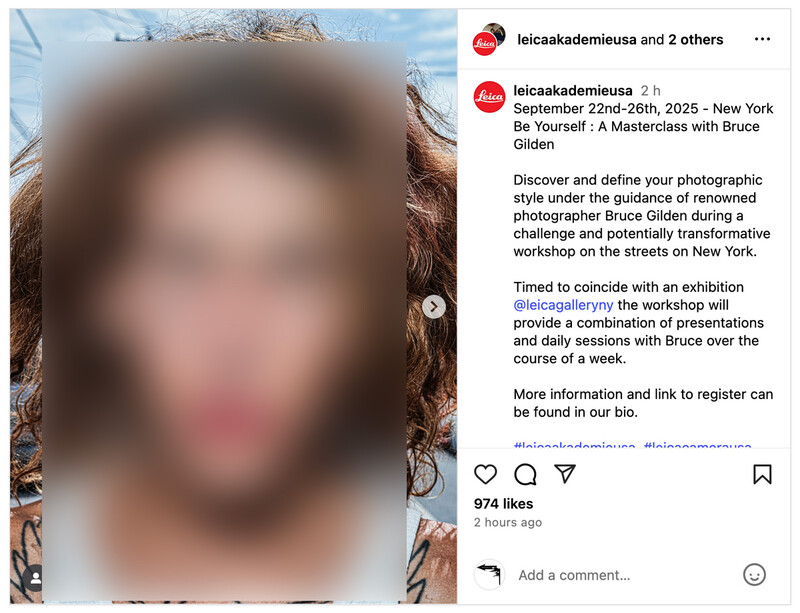
On social media last week, Leica marketed a masterclass with Bruce Gilden, using one of the photographer’s most notorious portraits to help sell the course. “Discover and define your photographic style,” reads the accompanying text, ignoring the fact that the image is of a vulnerable adult who was first exploited for art and profit and is now being used to sell a workshop that costs $2,000.
Exploiting Vulnerable People for Misery Porn
Philadelphia’s Kensington has built a reputation over the last couple of years, with one local media outlet describing it as the East Coast’s largest open-air drug market. As this article (paywall) notes, Kensington “is a failure of our health care system, our cities, and our drug enforcement policies on public display.” And for certain creators, it is also “a content farm, where they turn other people’s misery into engagement and profit.” To this day, there are livestreams of Kensington showing people suffering, with YouTube channels monetising voyeurism. If you wanted to photograph vulnerable adults clearly demonstrating diminished responsibility as part of an “art” project, this is exactly where you would go.
That, potentially, is what Bruce Gilden did back in 2023 in creating his portrait of Amber — the photograph that’s now being used to market his collaboration with Leica. Taking her portrait and parading it as art is exploitation; using her to sell a masterclass is disgraceful and Leica should be ashamed.
Art Should Challenge, But It Shouldn’t Exploit
Gilden’s portraits challenge viewers to confront uncomfortable aspects of modern society, but the style strips the subjects of their context and isolates them from their stories, presenting them as little more than surface. In discussing his portraits, Gilden explains that he "suffered emotionally, and it shows in these pictures,” but that’s not conveyed when these individuals are reduced to nothing more than an image. There’s no story, no depth, no empathy, and no humanity. And if that image is then selling a course that teaches you how to be equally exploitative as part of your search for clicks and validation, I’m not sure you can defend it.




Join the Fstoppers community for free
-
Post comments and join in the discussions
-
Browse the site ad-free
-
Share your work and get featured in the community
-
Compete in the photo contests for fun and prizes
109 Comments
Photography is storytelling, and stories without empathy risk becoming little more than spectacle. When brands like Leica endorse this kind of work as aspirational, it sends the wrong message.
Have you considered the possibility that you are not aware of anything you're talking about? You are making assumptions into assertions.
of course is ethical to show the world. The Good, the bad and the ugly. If you have a camera is your right and your duty to document no matter the style. You can argue then showing the hunger in Gaza is exploitation or showing the immigrants inside concentration camps is not ethics. Self censure is not ethics is censure and when it star it goes both ways!
This thread is quite the distillation of exactly what is wrong with photography and art today. My observation essentially breaks into 2 broad critiques, 1. Arts education, and 2.Politics.
1. There used to be classes in high school focused on how to engage with the arts. The various perspectives and interrogations one can use to understand what art and artists are doing to the individual viewer and culture collectively. A lot of people in this thread could do themselves a service with this kind of education. Yes I mean to condescend, you deserve it.
The assessment of Brice Gilden's work and subsequently his character is wild. This is definitely a case where a flawed (maybe even dishonest) premise will lead to a flawed outcome. I can speak to both the premise and the outcome as someone who has studied his work for more than a decade and as someone who has worked for him. I know something about his character and his practices. Certainly for the more recent work.
I spent a week working with Gilden as a producer on location in Kentucky. We spent that week at the Kentucky State fair, walking the stalls of livestock, hanging out at the carnival rides, combing through the booths with vendors, and visiting the billionaire show riders and barns. Near constant engagement with people, all of them, of every imaginable background. The man works. RELENTLESLY.
The thing I didn’t see coming was his focus and care in shooting children with humor, wit and sensitivity was remarkable. This hard guy that people so readily deride, was the quintessential cool old dude who has a gentle, kind way with kids. He shot a near encyclopedic cross section of real people in a real place. He met them where they were at that moment. He was genuinely charming. He can funnel everyone as who they are, into his vision as an artist. No one is compromised. He’s a master.
Platon shot Putin, Muammar Gaddafi, George Bush, all horrible people. Was he a monster for glorifying monsters or is there something else going on? Gilden shoots us. Actual people who struggle and suffer and have no choice but to wear the damage in front of everyone. You can walk right up to his subjects, but you don’t. He shows us back to ourselves. He’s trying to wake us up. What an asshole!
2. This one is gonna get ugly because it really has nothing to do with Bruce, it has to do with all of you. The petty childish dimwit musings will be the end of us. The copy/paste pontification is transparent. Did any of you have proper parenting? Has anyone ever said “stop it, I know what you’re doing and it isn’t clever?” Because seriously, it isn’t clever. Some of the things I’m reading here are just not even remotely connected to the truth. Not the truth of the work and certainly not the truth of the man. What you all are doing is taking some version of a story you’ve heard about in another context, and you’re just dropping it into another situation without inspection.
YES, there has been a boom of mostly younger (coincidence?) “brotographers” exploiting the homeless population for “the Gram.” What they’re doing bears no resemblance to what Gilden does in any way. They saw his work and like you, spent no time understanding it and have learned all the wrong lessons. I happen to know for a fact that the shooting style I experienced with him is actually his standard method. He spends moments with people. There’s a conversation, actual engagement, he sees them as people. Maybe some of you could give it a try?
This is exhausting and probably a prime TLDR but I had to. This stuff needs to be said and to say it clearly takes a while. I didn’t even get to the whole “Leica” thing. That’s just a whole other mess of “how far from the truth can we go?” Actually it goes all the way back to arts education and the lack thereof.
Oh and yes I know I said “homeless” instead of “unhoused” I’m probably as much an asshole as Bruce.
This discussion has been very interesting and reflects concerns that have grown over recent years around the ethics of street photography practices.
Gilden initially studied sociology and has pointed out that he was bored by the discipline. That tells us something. I’m not an ‘ambassador’ for sociology - my background is social anthropology and archaeology - but it’s a pity Bruce didn’t stick around for the classes on poverty, socio-economics, and media representations, because they may have been helpful in imagining what it’s like to be out on the street with some dude shoving a camera in your face.
Now, those of you on here making a case that Bruce’s street practice represents a paradigm of kindness, empathy and interpersonal responsibility, I would suggest such a position is historically inaccurate, disingenuous and flawed.
Everyone is entitled to their ‘off days’, but I’d suggest people familiarise themselves with some of the, in my view, rather disturbing footage of Bruce’s encounters on the streets where the consequences of those missed sociology classes become abundantly apparent.
It’s not that deep. There is no objectivity in photography or arguably sociology / ethnography. In Bruce’s case it is deeply personal but also like a Neo-political cartoon. This isn’t some social liberal stance and illustration of ideology. It’s drawing (rendering) what you see with a camera.
Someone who comes from the street illustrates the street. Shows what we don’t want to see on the street, but they certainly do. People they talk to, or people they would find interesting in some way (like the uptown photos with flash and an M, business men with no souls deep in thought with dead eyes walking to oblivion, workers working, etc). Then these iconic photos of people “polite society” wants to save or ignore or “fix” rhen the politicians (left or right) do nothing of the sort. The social scientists start committees, and spend grant money in each other’s pockets while people still have to numb their pain with drugs, and sell their bodies in what society causes criminal acts to pay for those drugs to just make life bearable. There’s no therapy that’s gonna help this. So we look away unless someone like the Bruce makes it sharp and crystal clear.
This isn’t some suit pondering behind a desk with colleagues about the plight of humanity and giving some Nat Geo version of deep dive. It’s not a social worker on the ground following the rules so they can continue to get the billion dollar funding while not really engaging with each person individually to find out what they really want or need. It’s not humanist photography’s biggest trope, pseudo empathy. It certainly isn’t everyone’s cup of tea—clearly…
It is work that does exactly what it says it does, unabashed and skillful and some won’t like it. Some will. It’s certainly bolder than most all of photography today.
It’s the same energy that punk had, and maybe he has again. It’s not hiding and taking candids. It’s not asking your permission or mine or anybody’s in some cases and others like the face portraits as asking someone to hold still for a few moments to take a photo have a moment in time deposits a question to the viewer..
Do you care enough? Because this is real. I think we should take this to our ethics boards. What does caring about the real plight of real people really look like?
You know it reminds me of the story that I heard about the ethnographer writer Jamie deAngulo who was recording the stories of the Big Sur Native Americans in the 1930s 40s and 50s. He was visited by a group of Jungian psychologists who wanted to take their social critique and psychology and look at the dying tribe. DeAngulo was their guide. When they moved their big round table to sit at and posture as well as ponder who these people were and what their state of mind was etc. etc. Jime listen for a while., then pull out his bowie knife and got on top of their table and slit his throat ear to ear. He knew they weren’t paying attention. He forced them to do so.
Work like Bruce’s makes you ask yourself, are you paying attention? He is.
I've never seen someone so full of themselves on here, as you. Dude, what are you smoking? And spending all this time arguing your opinion as though it was a fact, is time wasted from being out on the street harassing people in the name of art.
Andy Day, thanks for starting the discussion because it reminded me of why I decided against shooting Leica years ago. The camera/lens choices are amazing (especially Noctilux and Apo-Summicrons) but I can't stand Leica customers. They are actually so annoying that I don't want to be reminded of them. Thankfully, Arca Swiss hasn't yet created any bad memories for me to try and forget :-)
I like the unique street portraits from Bruce Gilden true to his motto, dare to be different...of course there is a lot of daring in his " in your face " flash photography " and I am sure that there were moments when some people responded violently towards him giving him a fat lip or a black eye. His street portraits are to me a fantastic moment in time, and I am sure that in hundreds of years into the future there will be many viewers admiring.his street art...as the saying goes, art is in the eye of the beholder...