
In October 2017, a silver plate about the size of a paperback sold at Sotheby's in New York for $360,500. It is the earliest surviving photograph of anyone who has ever been President of the United States, and the man staring out of it had been out of the office for fourteen years by the time the lens cap came off. The question of who was photographed first is messier than a single plate suggests, and every leading candidate carries an asterisk.
The Plate That Cost $360,500
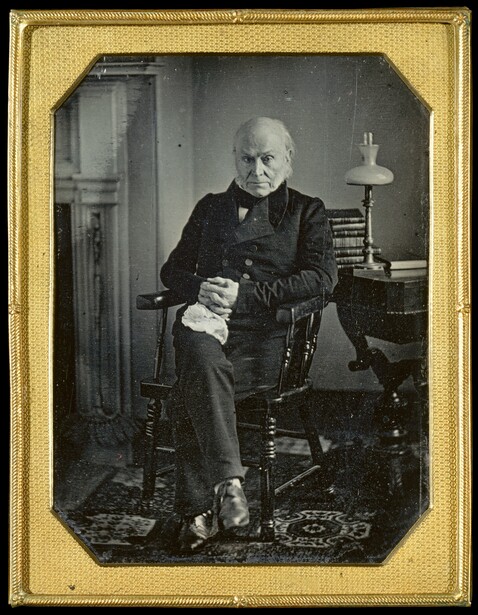
The man in the 2017 plate is John Quincy Adams, the sixth president. The photographer was Philip Haas, a lithographer and daguerreotypist who by his own account had learned the process in Paris in 1839 and kept a studio in Washington. Adams sat for him in March 1843, roughly four years after the daguerreotype was announced to the world and fourteen years after Adams had left the White House. He was 75 years old and still working, serving in the House of Representatives as a congressman from Massachusetts, the only former president to serve in the House.
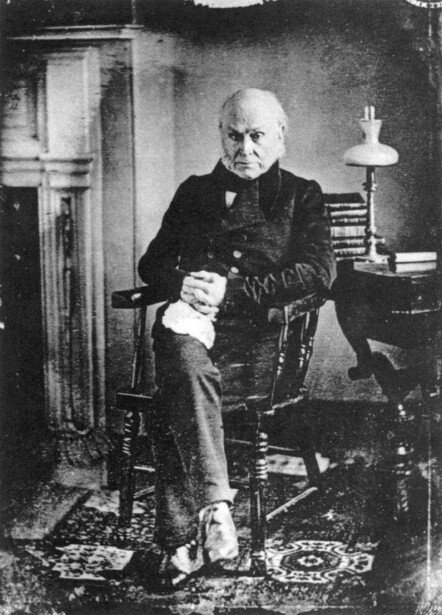
Adams was a compulsive diarist, and he recorded the novelty of the thing with the bafflement of a man watching magic he could not explain. "The operation is performed in half a minute," he wrote, "but is yet altogether incomprehensible to me." He walked to Haas's studio on a bitterly cold morning, hands pinched inside woolen-lined gloves, and sat for a technology that would outlast his politics, his diary, and his century.
That particular plate then vanished into private hands for the better part of two centuries. Adams gave it as a gift to Horace Everett, a Vermont congressman and colleague, and it passed down through the Everett family until a direct descendant consigned it to auction. When it surfaced, the National Portrait Gallery bought it at the Sotheby's sale on October 5, 2017, and put it on view the following year in its "America's Presidents" exhibition. It is now the earliest photograph of a U.S. president that the museum can hang on a wall as an original object.
The Version Historians Knew Was a Copy
Here is where the story bends. For most of the twentieth century, the Adams image people actually looked at was not the Everett plate at all. It was a nearly identical daguerreotype in the Metropolitan Museum of Art, one of sixty-one plates the Met acquired in 1937 from the Boston gallery of Southworth and Hawes. Everyone assumed those plates were the gallery's own work, and the Adams portrait was catalogued that way for years.
The photography historian Beaumont Newhall took it apart. He noticed that the Met's Adams plate was not laterally reversed the way an original daguerreotype has to be. A daguerreotype is a mirror image unless the photographer corrects for it, and a man's coat, cut to button one way, betrays the flip. Adams's coat in the Met plate reads the wrong direction for an original. Newhall then found a Haas daguerreotype of an Ohio congressman named Joseph Ridgway, seated in the very same captain's chair on the same Turkey carpet beside the same oil lamp, signed on the mat "P. Haas, Washington City, 1843." The composition matched Adams exactly. The Met plate also carried the hallmark of the Scovill Manufacturing Company, a name the firm did not adopt until around 1850, two years after Adams died. A plate stamped after his death could not have been the one exposed in front of him. Newhall's conclusion was that the famous Met image is a copy of a Haas original, made by rephotographing the first plate.
Copying daguerreotypes was ordinary work in the 1840s and 1850s. With no negative, the only way to duplicate a one-of-a-kind plate was to point a camera at it and shoot again, and studios did this constantly to sell portraits of celebrities. So the Adams image the public knew for decades was a second-generation plate, a photograph of a photograph. The Everett daguerreotype that sold in 2017 is the first-generation original that had been missing from the record the whole time.
The President Who Was Photographed First, and Lost
Adams holds the title for the earliest surviving photograph of a president, but he was not the first president to sit for a camera. That distinction belongs to William Henry Harrison, and it comes with the largest asterisk of all, because the plate is gone.
Harrison was inaugurated on March 4, 1841, delivered the longest inaugural address in American history at more than 8,000 words, and sometime in the first days of his term sat for a daguerreotype in Washington. The photographers are usually named as Justus Moore and Ward. By one account handed down from the photographer years later, Harrison was delighted with the result, though that recollection surfaced long after the fact and cannot be checked against the plate, because no one has seen it since. Harrison fell ill within weeks and died on April 4, 1841, 31 days into his term, the shortest presidency and the first death in office. Whatever plate was made of the living president disappeared, and no copy of it is known to exist.
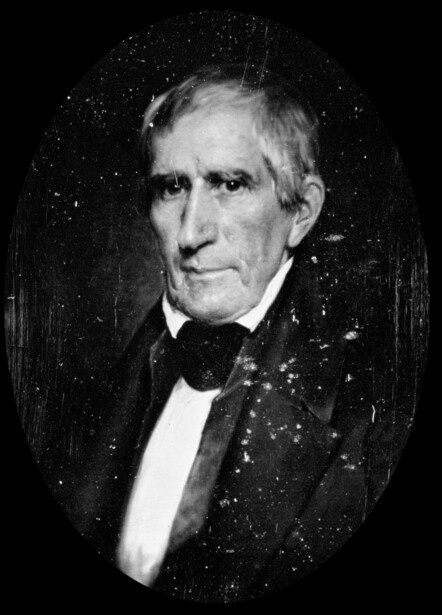
This is where a second confusion took root. Search for a photograph of Harrison and you will find a stern daguerreotype that looks like proof the 1841 sitting survived. It is not. That image is a daguerreotype made around 1850 of an oil painting of Harrison, a portrait done by Albert Gallatin Hoit in 1840, before Harrison was even elected. It is a photograph of a painting of a man, standing in for a lost photograph of the man himself. The record of the first photographed president is a hole with a picture taped over it.
The First Surviving Face of a Sitting President
If Harrison's plate is lost and Adams was out of office when he sat, then the earliest surviving photograph of a president actually in office belongs to a third name, and it is not the one most people would guess. Popular history usually credits Mathew Brady with photographing President James K. Polk in the White House on February 14, 1849, near the end of Polk's term. Brady did make that portrait, and it survives in the Library of Congress. He was beaten by three years.
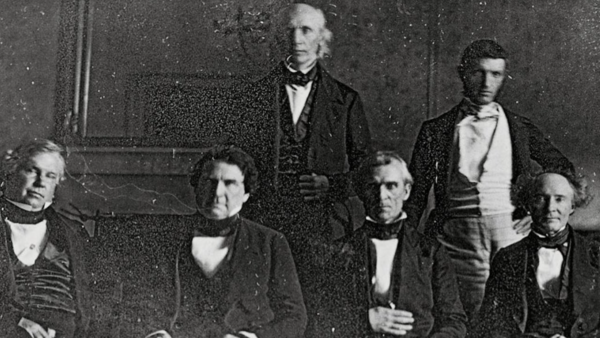
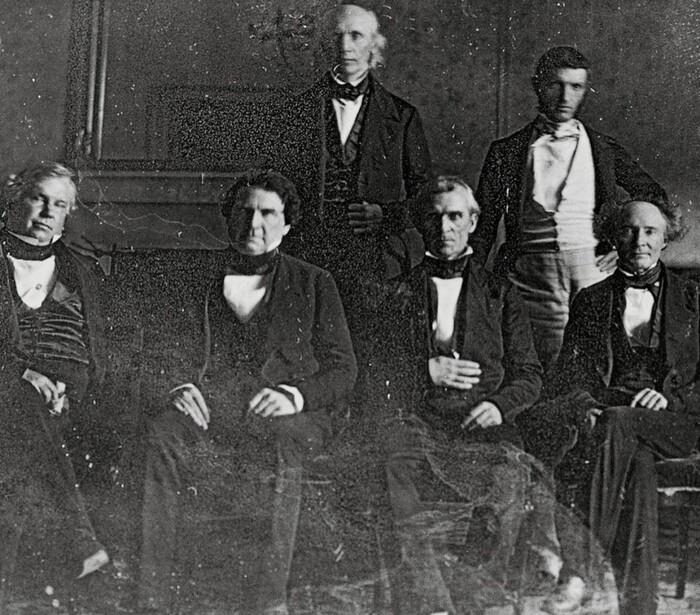
Shortly after Congress declared war on Mexico in May 1846, Polk and several members of his cabinet sat before John Plumbe in the State Dining Room of the White House. Plumbe was a Welsh immigrant and former civil engineer who had been dubbed "the American Daguerre," ran more than a dozen studios around the country, and stamped every plate that left them with his own name, a branding trick Brady would borrow to great effect a decade later. Plumbe's 1846 group portrait of Polk and his cabinet is, according to the White House Historical Association, the earliest surviving photograph of a sitting U.S. president. That same year Plumbe also made the earliest known photograph of the White House itself, part of a set of views that was lost for over a century and turned up at a California flea market in 1972.
So the honor splits three ways depending on how you word the question. First president to face a camera: Harrison, 1841, plate lost. Earliest surviving photograph of a president in office: Polk, by Plumbe, 1846. Earliest surviving photograph of anyone who was ever president: Adams, by Haas, 1843. Each is a real "first," and each dissolves the moment you press on it.
Why the Sitters All Look Braced for Bad News
Understanding why these plates are so rare, and why they are so easy to lose, means understanding what the daguerreotype actually was. Louis Daguerre's process was announced at the French Academy of Sciences on August 19, 1839. It began with a sheet of copper coated in silver and polished until it worked like a mirror. The photographer sensitized that surface with iodine fumes, exposed it in the camera, developed the latent image over a dish of heated mercury, and fixed it with a salt solution. What came out was a single, unrepeatable object with no negative behind it, a direct positive on metal.
That object behaves strangely in the hand. The image is laterally reversed, a true mirror, and it only reads as a positive when you tilt it so the polished silver throws a dark reflection. Hold it at the wrong angle and the picture goes ghostly and negative. It is intimate and fragile in a way a print never is, which is part of why so many of these plates were lost, damaged, or copied to death rather than preserved.
Portraiture was barely possible at first. The earliest exposures ran from several minutes to a quarter of an hour, far too long for a human face. Faster lenses and accelerator chemistry involving bromine cut that to under a minute by the early 1840s, which is exactly when Harrison, Adams, and Polk stepped in front of the camera. Under a minute is still an eternity to hold a face still, so studios clamped sitters into iron head braces hidden behind their necks and told them not to move. That is the real reason the presidents in these plates look grim and rigid, gripping the arms of a captain's chair. They were not being solemn for history. They were holding a pose against a clamp while a strange machine did something the sixth president himself called incomprehensible.
The next time one of these portraits scrolls past you, look at what you are actually seeing. The seated old man in the 1843 Adams plate is almost certainly the copy, not the original, and the "photograph" of Harrison is a picture of a painting. The genuine first-generation Adams plate spent 175 years in a family's keeping before anyone recognized what it was, and the very first presidential photograph ever taken is a plate no living person has laid eyes on. In photography, "first" turns out to be less a fact than a chain of custody, and that chain is only as strong as the object no one thought to save.
Lead image — John Plumbe, public domain. Source.





Join the Fstoppers community for free
-
Post comments and join in the discussions
-
Browse the site ad-free
-
Share your work and get featured in the community
-
Compete in the photo contests for fun and prizes
No comments yet