
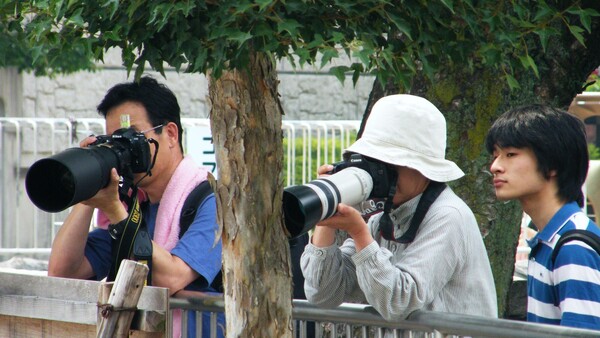
Before they spent more than seven decades trying to bury each other, Canon and Nikon were partners. The very first Canon cameras of the 1930s shipped with lenses ground by the company that would become Nikon, because Canon could not yet make its own glass. Everything that came after, the autofocus wars, the full frame race, the mirrorless scramble, grew out of that uncomfortable early closeness.
They Started as Partners, Not Rivals
Nikon is the older company by a wide margin. It began on July 25, 1917, as Nippon Kogaku K.K., a merger of Japanese optical firms built to make rangefinders, microscopes, and military instruments for a country that no longer wanted to import its periscopes and gunsights during the First World War. To learn the trade, the young company brought in a small group of German optical engineers in the early 1920s. For its first three decades it made lenses and instruments, not cameras, and much of that work was for the Imperial Japanese Navy: binoculars, gunsights, and the enormous "big eye" naval telescopes.
The war years swelled Nippon Kogaku to somewhere around 23,000 employees across roughly two dozen factories. Defeat gutted it. By the end of 1945, the company had collapsed to a fraction of that, its civilian work refocused on a single main plant, with no navy left to supply. That collapse is exactly what pushed it into consumer cameras. The mass-production know-how and the optical talent had to point somewhere, and civilian photography was where they landed. The first camera to wear the Nikon name, the Nikon I rangefinder, shipped in 1948, and the company would not officially rename itself Nikon Corporation until 1988.
Canon started later and scrappier. In 1933, Goro Yoshida, his brother-in-law Saburo Uchida, and Takeo Maeda set up a small lab in Tokyo to reverse-engineer the expensive German cameras of the day. Yoshida was a devout Buddhist, and he named his 1934 prototype the Kwanon, after Kannon, the Buddhist goddess of mercy. The prototype's logo showed the thousand-armed deity, and its lens was named Kasyapa after a disciple of the Buddha. The name was softened to "Canon" for the export market in 1935, and the company was formally established as Precision Optical Industry Co., Ltd. in 1937, with Takeshi Mitarai among the founders.
Here is the part most photographers never hear. Canon in those years could design a camera body, but it could not make a good lens. So Nippon Kogaku supplied the optics. Nikkor lenses sat on the front of Canon's earliest cameras, including the 1936 Hansa Canon, and the arrangement ran until the late 1940s. The two future giants of Japanese photography spent their first years leaning on each other.
What broke the two apart, and what first made the name Nikon famous, was a war. In 1950, the American photojournalist David Douglas Duncan was in Japan when a young Japanese photographer named Jun Miki showed him a portrait shot on a Nikkor lens. Duncan was struck by how sharp it was and asked to meet the people who made it. When the Korean War broke out that June, Duncan carried Leica bodies fitted with Nikkor glass to the front. Back at the Time-Life labs in New York, editors kept asking why his negatives looked so much crisper than everyone else's. The answer, reported in the American photo press, was Japanese lenses. That single word of mouth put Nikon on the map of professional photography.
The Nikon F and Twenty Years of Dominance
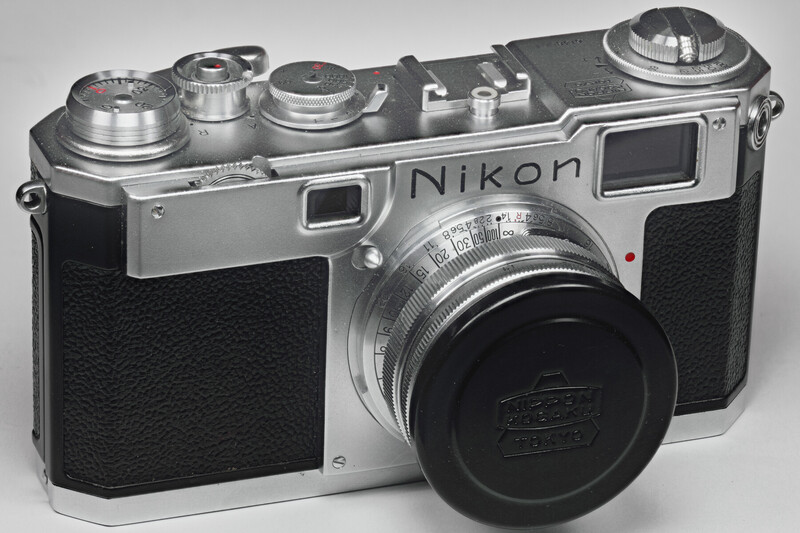
Nikon spent the 1950s building rangefinders that chased Leica, and the best of them, the Nikon SP of 1957, was good enough to worry the Germans. Then Nikon did something smarter than beating Leica at its own game. It took the SP, dropped a mirror box and a pentaprism onto the body, and turned it into a single-lens reflex.
The Nikon F arrived in 1959. Almost none of its individual features were brand new, but no one had ever put them all in one body: an instant-return mirror, an automatic diaphragm that stayed wide open until the shutter fired, interchangeable finders and focusing screens, a motor drive, and a deep catalog of Nikkor lenses on a new bayonet called the F-mount. It was a system, not just a camera, and it was built like a hammer. Professionals who had shot Leica rangefinders for a generation switched in droves, and Leica never fully recovered the working press.
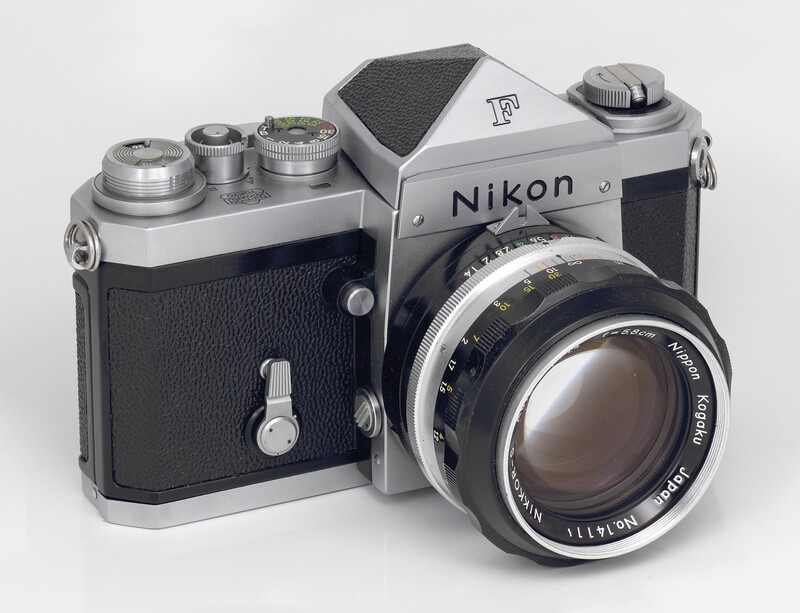
For the next two decades the Nikon F and its successors were simply what a serious camera looked like. They went to Vietnam on the shoulders of Larry Burrows and a generation of combat photographers. They went into orbit, too. NASA had the mechanically simple bodies stripped, relubricated, and finished in matte black, and a modified Nikon Photomic FTN flew aboard Apollo 15 in 1971. Nikon kept supplying cameras for the Space Shuttle and later the International Space Station for decades. The F-mount that debuted in 1959 became one of the longest-lived lens mounts in the industry, and for a long time owning Nikon meant your lenses would never be orphaned.
The F did not stand still. Nikon followed it with the F2 in 1971 and the electronically timed F3 in 1980, whose body and its now-famous red accent stripe were styled by the Italian car designer Giorgetto Giugiaro. Each generation carried the F-mount forward, and each earned the same reputation as a tool you could drop, freeze, soak, and keep shooting. That reputation for indestructibility, more than any single specification, is what kept Nikon bodies in war zones and on assignment desks year after year, and it is the standard Canon had to figure out how to beat.
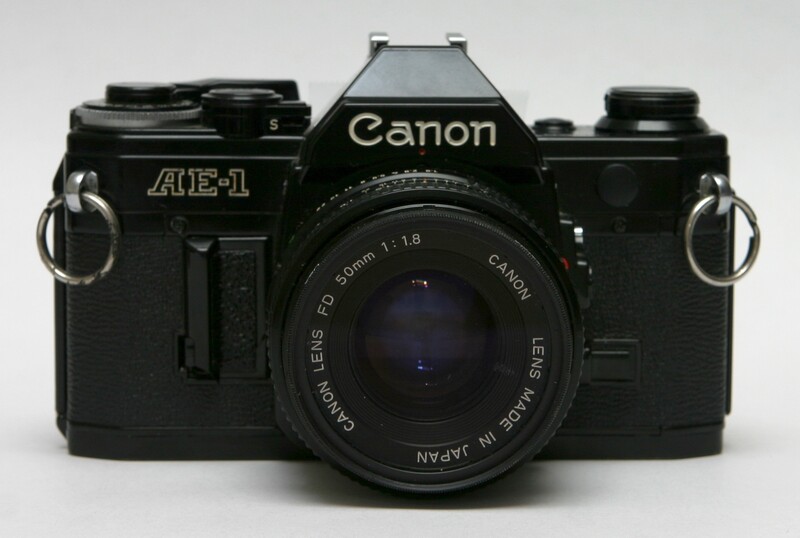
Canon spent those same years fighting a different battle, and eventually it found a smarter place to fight. Rather than beat Nikon head to head for the shrinking pool of press photographers, Canon went after everyone else. In 1976 it launched the Canon AE-1, the first 35mm SLR built around a microprocessor. That little chip let Canon strip roughly 300 parts out of the design, automate the factory, and sell a genuinely good automatic-exposure SLR at a price ordinary people could afford. Canon backed it with a television advertising campaign on a scale the camera business had never tried, treating an SLR like a consumer electronics product to be sold to everyone rather than a precision instrument sold to specialists. That philosophy, chase the many rather than the few, would shape Canon for the next fifty years. The AE-1 and its A-series siblings sold in the millions and became some of the best-selling SLRs ever made. Nikon owned the pros; Canon quietly took the far larger world of enthusiasts, and the far larger pile of revenue that came with it.
1987: Canon Burns the Boats
The fight that decided the next thirty years was about autofocus, and it started with a camera from neither company. In 1985, Minolta's Maxxum 7000 became the first SLR to put autofocus and motorized film advance together inside the body and sell in huge numbers. Nikon had actually shipped an autofocus professional body earlier, the F3AF of 1983, but it needed special bulky lenses and never caught on. Suddenly both giants were behind on the feature that would define the era.
They chose opposite paths. Nikon protected its customers. It kept the F-mount and made its new autofocus bodies drive the lens with a little screwdriver shaft turned by a motor in the camera, so most of a photographer's existing Nikkor glass still mounted and still made pictures. That compatibility was substantial rather than seamless. Depending on the body, older lenses gave up autofocus, metering, or automatic exposure, and pre-AI lenses from before 1977 could not safely mount on many later cameras without modification. Continuity was the promise, imperfectly kept, and Nikon would not abandon it.
Canon had already run the experiment. In 1985 it released the T80, its first autofocus SLR, which kept the FD mount and put the focusing motor inside each of its three dedicated AC lenses. The camera flopped, but the in-lens motor worked, and the lesson stuck. Two years later Canon did the ruthless thing. It threw the entire FD lens system in the trash. In 1987 it introduced a completely new, all-electronic EOS system and the EF mount, with no mechanical linkages at all and a focusing motor built into every lens. There was no adapter that kept old FD lenses working properly. Every loyal Canon shooter who had invested in FD glass was, in effect, told to start over. In the short term it was a betrayal, and plenty of photographers said so.
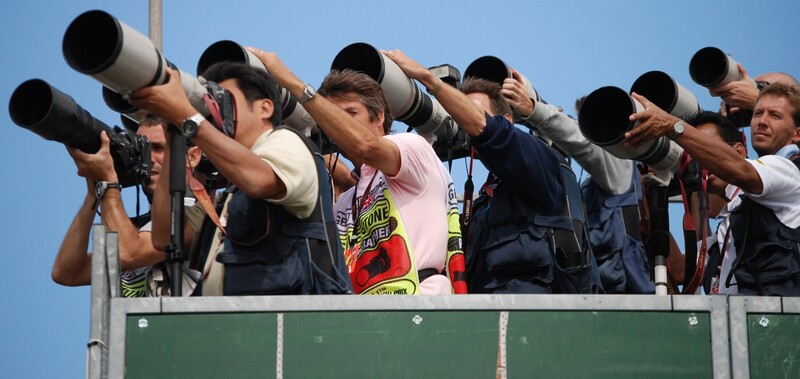
In the long term it was the most important decision either company ever made. Putting the motor in the lens meant Canon could tune each motor to its optics, build fast and near-silent ultrasonic focusing, and pour development into pro glass without dragging a 1959 mount along behind it. The EOS 650 opened the line in 1987; the flagship EOS-1 followed in 1989. Through the 1990s, Canon's autofocus and its white L-series telephotos steadily took over the sidelines of stadiums and the pits of racetracks. Walk past a press box by the late 1990s and the long white lenses pointed at the field were mostly Canon. The company that had been the enthusiast's brand had taken the professionals, too.
EOS handed Canon a second head start, and it used it. Optical stabilization was its own invention, requiring motion sensors, control electronics, and a shifting lens group that no autofocus motor supplied, but the EF mount's all-electronic interface and Canon's growing fluency with complex powered lenses made the lens the natural place to put it. In 1995 Canon shipped the EF 75-300mm f/4-5.6 IS USM, the first interchangeable stabilized lens for any SLR, letting handheld shooters claw back a couple of stops of shutter speed. Nikon did not answer with its own Vibration Reduction until a telephoto zoom in 2000. Five years is a long time to be the only company selling a feature that makes blurry shots sharp. That gap, more than any single camera, is what the 1987 gamble bought Canon.
The Digital Turn
Film had rewarded whoever built the better body and the better lens. Digital added a third contest, the sensor, and it reshuffled the deck again.
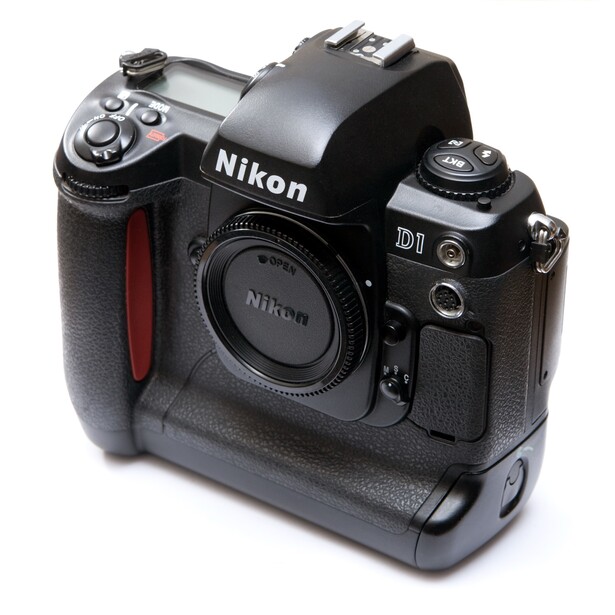
Nikon moved first with real conviction. In 1999 it released the Nikon D1, the first digital SLR designed as an integrated camera by one of the traditional camera makers rather than assembled from a Kodak partnership. It carried a 2.7-megapixel sensor, shot at 4.5 frames per second, cost around $5,500, and, crucially, it mounted the same F-mount Nikkor lenses working photographers already owned. For photojournalists on deadline, the D1 made digital feel like a tool instead of an experiment, and it pushed Kodak's far pricier digital bodies aside almost overnight.
Canon answered with a bet on physics. Instead of buying sensors, it committed to designing and fabricating its own CMOS chips at a time when most of the industry considered CMOS the cheap, noisy alternative to CCD. The EOS D30 of 2000 was a modest 3.1-megapixel consumer body, but it proved Canon's CMOS could work. That investment compounded fast. Canon reached full frame at the top of its range first, with the professional EOS-1Ds in 2002 and the 1Ds Mark II in 2004, but those bodies cost well over $7,000 and stayed in the hands of studio and commercial shooters. Then in 2005 the Canon EOS 5D put a full frame sensor into a compact body at $3,299, well under half the price of Canon's own full frame 1Ds bodies and far cheaper than any full frame camera before it. Wedding shooters, portrait photographers, and enthusiasts who had never dreamed of a 24x36mm sensor suddenly could have one, and the 5D became the camera that made full frame normal.
Nikon looked cornered, and then it did not. In 2007 it released the Nikon D3, its first full frame body, which it branded FX. The D3's twelve-megapixel sensor was a low-light machine that produced clean, usable files at ISO 3200 and beyond, at a moment when everyone else's images fell apart in the dark. Sports and news photographers who had drifted to Canon came back. Nikon soon paired it with the high-resolution D3X in 2008, and the two companies were once again trading the low-light and resolution crowns back and forth. The lesson of the digital decade was that neither company could rest, because a single sensor generation could hand the lead to the other side.
The Mirrorless Reckoning
For all their fighting, Canon and Nikon shared a blind spot, and a third company walked through it. While the two giants perfected the mirror-and-prism DSLR, Sony committed to full frame mirrorless with its a7 line starting in 2013 and spent years building a lead in the format while Canon and Nikon hesitated. Both had dipped a toe already, Nikon with the small-sensor Nikon 1 system in 2011 and Canon with the APS-C EOS M in 2012, but each kept those cameras carefully junior to its DSLRs. A mirrorless body could show you the exposure before you pressed the shutter, focus off the sensor across the whole frame, and shrink without the mirror box in the way. Both leaders knew the mirror was going away. Both were slow to kill the DSLR, because the DSLR was still paying the bills and their customers owned mountains of F-mount and EF-mount glass.
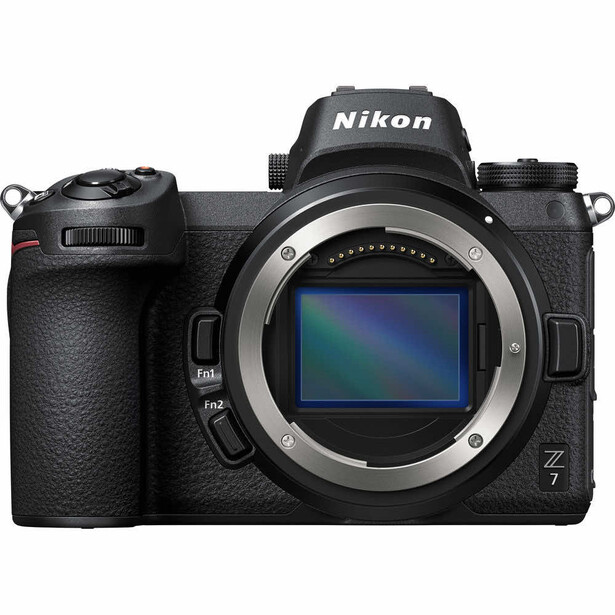
When they finally moved into full frame mirrorless, they moved within weeks of each other, in the late summer of 2018. Nikon announced the Z6 and Z7 and a brand-new Z-mount. Canon followed almost immediately with the EOS R and the RF mount. The symmetry with 1987 is tempting, but this time neither company burned the boats. Both arrived with first-party adapters, Canon's EF-EOS R for EF and EF-S glass and Nikon's FTZ for F-mount lenses, and both kept selling and supporting DSLRs and SLR lenses for years while the new systems matured. The real bet was on the glass to come: wide, short mirrorless mounts that let designers build lenses no SLR ever could. Nikon made its Z-mount 55mm across, which it promotes as the largest throat on any full frame camera, paired with a very short 16mm flange distance. The physics that Canon had chased in 1987, freeing the lens from the body, reached its logical end.
That is the throughline of the whole rivalry. Nikon's instinct is continuity, protect the customer's lenses and reputation for toughness, and it has cost the company dearly at exactly the moments when the market wanted a clean break. Canon's instinct is to burn the boats, abandon the old mount, bet on a new technology, and eat the short-term anger, and it has repeatedly bought the company the future. That same controlling instinct has a cost of its own. Canon spent the first years of the RF mount refusing to let Sigma, Tamron, and other outside makers build full frame autofocus lenses for it, keeping the new system walled off in a way Sony never did. Nikon guarded the Z-mount nearly as tightly at first, opening it to licensed third-party autofocus lenses only gradually, so the genuinely open ecosystem belonged to Sony, which had been welcoming outside lens makers to the E mount for years. Neither instinct is right on its own. The competition between them is what dragged both forward.
You can trace almost every feature in your bag back to a shot fired in this war. The motor inside your lens became the industry standard in large part because Canon bet the whole company on it in 1987. Affordable full frame exists because the 5D undercut everyone. Clean high-ISO files became the expectation after the D3 embarrassed the field. The huge mirrorless mount on a current Canon EOS R5 Mark II or Nikon Z8, and even the Sony a7 V, heir to the line that pushed both giants to hurry, is the endpoint of a fight that started when Canon could not make its own lens and had to ask Nikon for help. Seventy-odd years later they are still trading blows, and you are still the one who walks away with the better camera.
Lead image by Emran Kassim, CC BY 2.0. Source.




_with_5cm_f-1.4_lens_(5585559178).jpg)
.jpg)


Join the Fstoppers community for free
-
Post comments and join in the discussions
-
Browse the site ad-free
-
Share your work and get featured in the community
-
Compete in the photo contests for fun and prizes
5 Comments
Nikon vs Canon. Sort of like Beatles vs Stones. You can't like both. (I did). In my case the Nikon salesman who called on the camera store where I worked did a better job than the Canon guy. My opinion didn't change until I found an F1 system about 10 years ago. Loved it! Then I found a 20D at a flea market an it too impressed me. Now I can only quote CSNY, "time we have wasted on the way."
What an excellent story and write-up. Thank you, Alex! I learned a lot and it was fascinating reading.
Agreed!
A big factor in this rivalry story did not came out, though. Entry into the mirrorless competition with Sony was a success for Canon, and a bitter pill for Nikon. The difference was in the initial capability of the AF in the Canon-R versus Nikon-Z bodies, which became Achilles heel for Nikon and reduced significantly their market share. Today Canon has the lion share, Sony is "half Canon" and Nikon is "half Sony". So Nikon was severely marginalized, and that not only because of cameras. Their semiconductor stepper business was also in trouble. Nikon does not have the size and capital to really challenge Canon and Sony. And yet they spend a fortune on a new headquarter building... I am a Nikon user since I was 17 about, but today I mostly use a Canon. I owned both systems since 1996 I believe (the EOS-3 and the 28-135 IS was my entry, my 1st IS lens, a total revelation.) I also use Nikon Z and I truly like the system and great lenses. But I do not photograph action or wildlife, so that AF issue did not impacted me personally.
Fantastic article. Kind of like a time machine experience. I remember my father having the original Nikon F. Should have kept that camera. I have since always been a Nikon Fanboy and still have my old F3. I now use a Z8 and a ZR. Can't wait to see what Nikon and Canon come up with in th4 future.