
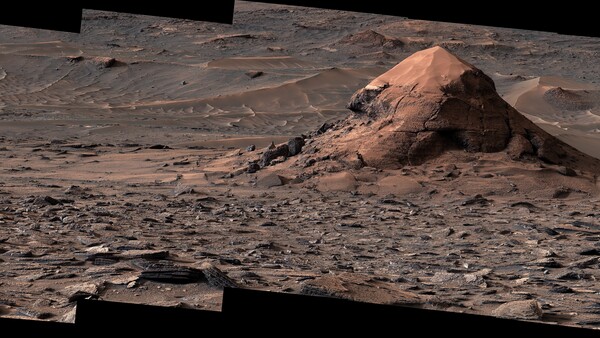
When Curiosity looked across Gale Crater and captured a portrait of "Miraflores," it wasn't simply documenting another rock on Mars. It was photographing a landscape shaped by erosion—a roughly 20-foot sand-capped butte that survived while the surrounding rock slowly disappeared.
From Earth, the image looks deceptively familiar. It could almost be mistaken for a desert landscape photographed from a distant ridge. But the camera that captured it was not mounted on a tripod, nor was it held by a photographer chasing golden-hour light. It was attached to a nuclear-powered rover operating on another planet, working with a fixed-focal-length lens, a two-megapixel sensor, and a carefully planned imaging sequence.
Miraflores isn't just visually striking. The roughly 20-foot butte is topped by a thick cap of sand and was left standing as the surrounding rock eroded away over time, deepening the broad valley Curiosity is climbing through. (NASA/JPL-Caltech/MSSS)
For photographers, that is where the real story begins. How do you build a sharp, detailed landscape photograph when your camera is sitting on another planet?
1. The Optical Rig: Anatomy of Curiosity's Mastcam
The eyes behind the portrait belong to Curiosity's Mast Camera (Mastcam) system, built and operated by Malin Space Science Systems in San Diego, California. Mounted on the rover's Remote Sensing Mast roughly 6.5 feet (2 meters) above the surface, the system views the landscape from a perspective that's surprisingly close to human eye level relative to the surrounding terrain, giving many of Curiosity's images an immediately familiar feel. Instead of a zoom lens, Mastcam uses two fixed-focal-length cameras mounted side by side. The final flight design used separate 34mm and 100mm lenses, preserving both wide and telephoto imaging capability.
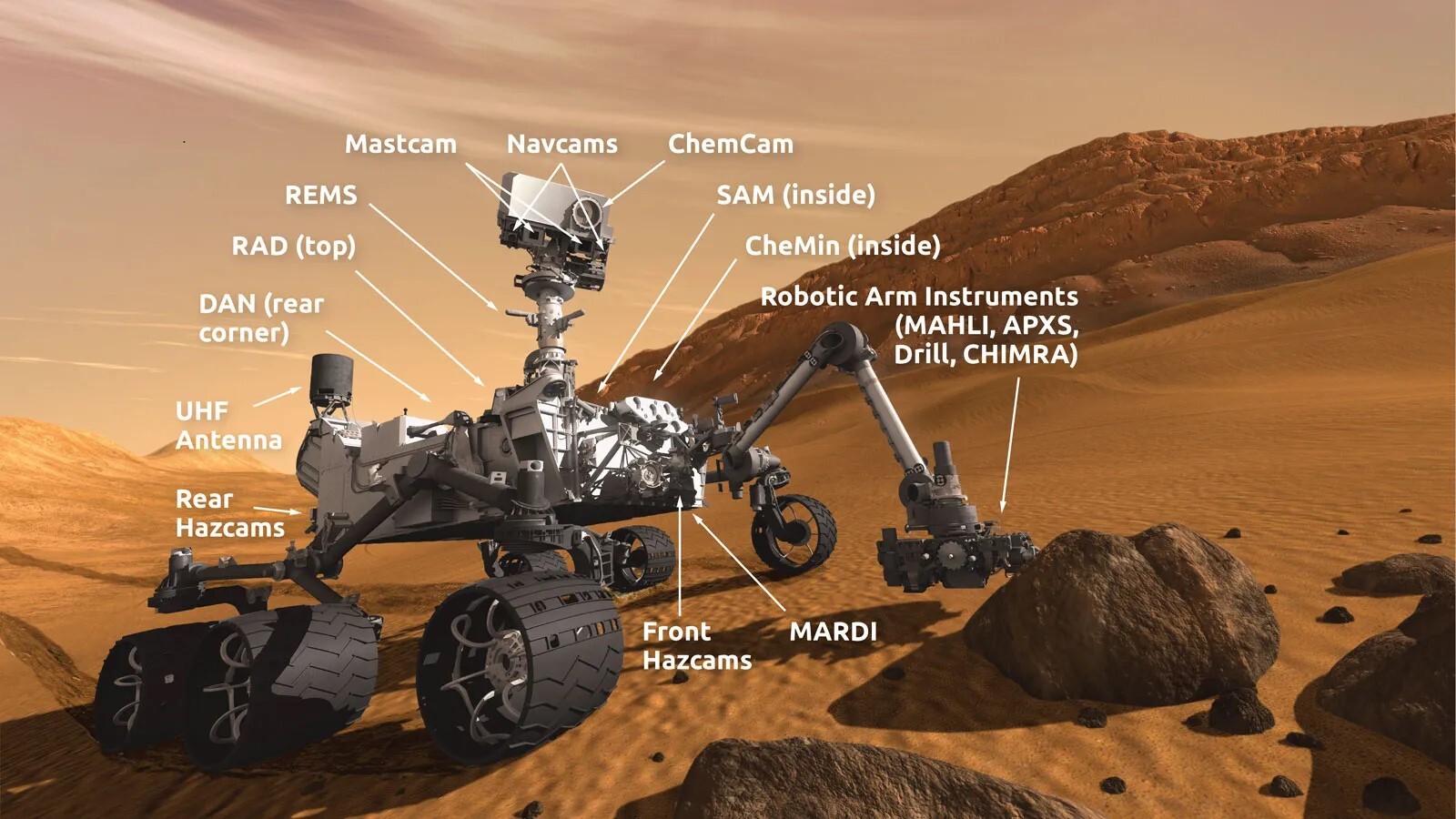
Curiosity’s scientific instruments are the tools that bring us stunning images of Mars and ground-breaking discoveries. Photo from: NASA/JPL-Caltech (Public Domain)
- Mastcam-34 (M-34): Features a 34mm focal length at f/8 with a field of view of approximately 18° × 15°. It serves as the wider-angle camera, providing broad landscape and geological context.
- Mastcam-100 (M-100): Features a 100mm telephoto focal length at f/10 with a field of view approximately one-third as wide as the M-34. It provides about three times finer image scale than the M-34 at the same distance, making it useful for detailed observations of distant targets.
Technical Breakdown: Mastcam Instrument Suite
- Mastcam-34 (Wide Angle): 34mm fixed focal length | f/8 aperture | Approximately 18° × 15° full-frame field of view | Broad landscape and geological context
- Mastcam-100 (Telephoto): 100mm fixed focal length | f/10 aperture | Approximately 6° × 5° full-frame field of view | High-resolution detail and distant targets
- Sensor Package: Kodak CCD | 1,600 × 1,200 active pixels
- Spectral Filtering: Bayer-pattern color CCD plus filter wheels for visible and near-infrared multispectral imaging
Both camera heads use Kodak CCD sensors with 1,600 × 1,200 active pixels, giving each camera a resolution of roughly 2 megapixels. By modern consumer standards, that sounds tiny. But resolution is only one part of a spacecraft imaging system, which must balance scientific requirements with power, storage, telemetry, reliability, and the hardware available when the mission is designed.
Although each individual image is only 1,600 × 1,200 pixels, finished landscape portraits can be dramatically larger. The Miraflores panorama, for example, was assembled from 11 individual Mastcam images that were sent to Earth and stitched together. Larger Mastcam mosaics can combine many more frames to record broad landscapes at substantially greater total resolution than a single exposure.
To expand beyond standard RGB imaging, each Mastcam uses a Bayer-pattern color filter array on the CCD and also carries a filter wheel. The filter wheels provide narrowband visible and near-infrared observations at several wavelengths, along with filters designed for solar observations. Those additional spectral measurements allow researchers to compare how surface materials reflect different wavelengths of light, providing information useful for studying Martian rocks, soils, and atmospheric dust.
2. Building the Frame: Telephoto Mosaics and Distance Constraints
A narrow telephoto field of view cannot always capture both a target and enough of its surroundings in a single frame. To solve this, Curiosity can build high-resolution panoramas much the same way a terrestrial panorama photographer does: frame by frame. The Miraflores portrait is an 11-image panorama.
- 1. Planning: Mission planners define the desired target and sequence of camera pointings before the rover executes the observation.
- 2. Overlap: Adjacent frames in a panorama overlap so that the images can be aligned and stitched together after they are returned to Earth.
- 3. Focus Sequences: Both Mastcam camera heads have mechanical focus and autofocus capability, allowing them to focus from roughly 2.1 meters to infinity.
- 4. Data Transmission: Images are stored onboard and returned according to mission priorities and available communications capacity. Curiosity commonly sends data by UHF radio to Mars orbiters, which relay it to Earth through NASA's Deep Space Network.
Pipeline Summary: Mosaic Acquisition to Downlink
- Phase 1 — Planning: Target and camera pointings selected
- Phase 2 — Capture: Overlapping individual frames acquired by Mastcam
- Phase 3 — Storage and Compression: Images stored onboard and prepared for transmission according to mission priorities
- Phase 4 — Downlink: Data typically relayed through a Mars orbiter and NASA's Deep Space Network
- Phase 5 — Assembly: Returned frames processed and stitched into the finished panorama
3. The Color Problem: Martian Dust vs. Familiar Color
If you've ever noticed that Mars imagery often carries a warm, dusty cast while some processed images show more neutral grays, tans, and other subtle colors, you've run headfirst into planetary color science.
Atmospheric Dust and Martian Light
On Earth, molecular Rayleigh scattering strongly favors shorter wavelengths, producing the familiar blue daytime sky. Mars presents a different environment. Its thin carbon dioxide atmosphere contains abundant suspended dust, and that dust significantly affects the color and scattering of sunlight. As a result, natural illumination on the Martian surface tends to be redder than typical daylight on Earth. That difference matters when scientists and image processors decide how to render the colors recorded by Mastcam.
The Onboard Calibration Target
To help calibrate its color measurements, Curiosity carries a Mastcam calibration target on the rover deck. It includes colored and grayscale reference materials with known properties, along with magnets designed to reduce the accumulation of magnetic Martian dust on portions of the target. Images of these known references help the team characterize the camera's color response under Martian illumination.
Color Rendering Comparison
- Natural or True Color: Retains the effect of the naturally reddish Martian illumination and aims to approximate how the scene would appear to a person viewing it on Mars
- White-Balanced Color: Adjusts for the color cast of Martian illumination, much as human vision or a digital camera's white-balance system adjusts to differently colored light
These approaches answer slightly different visual questions. A natural-color rendering preserves more of the effect of the Martian lighting environment. A white-balanced rendering compensates for that illumination, making surface colors easier to compare under more familiar viewing conditions.
The published Miraflores panorama uses the latter type of treatment: JPL states that its color was adjusted to match lighting conditions as the human eye would see them on Earth. That processing helps explain why the finished image can appear more familiar than many unadjusted views from Mars.
4. Why This Story Works for Photographers
Planetary photography occupies an unusual niche in photography publishing. The news itself is often straightforward—a rover reaches a new outcrop or captures another panorama—but the photographic process behind those images is anything but ordinary. Looking at Curiosity through the lens of photographic craft rather than space exploration transforms a routine NASA image release into a fascinating study of optics, composition, panorama construction, and color science operating under some of the most extreme conditions imaginable. NASA raw images are not copyrighted, and imagery published on JPL's public website can generally be used without obtaining prior permission, subject to NASA and JPL's usage requirements and restrictions. The image does the heavy lifting, and the technical story behind it gives photographers a reason to look twice.
NASA and JPL make enormous quantities of mission imagery available to the public, allowing photographers, educators, journalists, and creators to explore and share these views. Users still need to follow the applicable credit, third-party copyright, endorsement, trademark, and other usage restrictions associated with particular material.
For a deeper look at landscape technique and post-processing, see Photographing the World: Landscape Photography and Post-Processing.
Curiosity's portrait of "Miraflores" is a reminder that great landscape photography has never been defined by the planet beneath the camera. Whether you're standing behind a medium format camera on a windswept mountainside or commanding a robotic camera mast from millions of miles away, the fundamentals remain remarkably familiar: understand the light, choose the perspective with intention, maximize image quality, and tell the story of the landscape. Mars may be another world, but the language of photography is universal.
Lead image from NASA/JPL-Caltech/MSSS


Join the Fstoppers community for free
-
Post comments and join in the discussions
-
Browse the site ad-free
-
Share your work and get featured in the community
-
Compete in the photo contests for fun and prizes
1 Comment
No they didn't, shot on earth as always.