
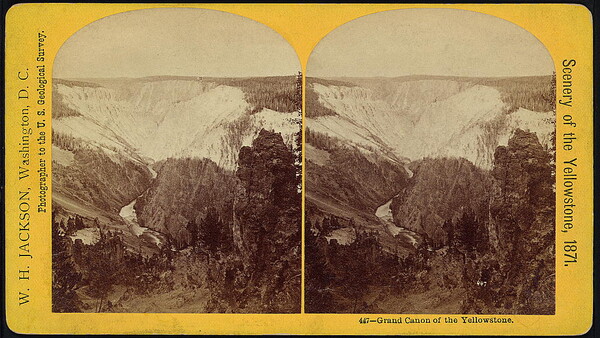
The 1872 law that created Yellowstone runs only a few hundred words and never mentions a photograph. By the time President Ulysses S. Grant signed it on March 1, prints of the region and a painter's field watercolors had reached Washington and were being used to sell the idea. The pictures entered the campaign before the vote, then left almost no trace in the formal legislative record.
A Government Survey With a Photographer Attached
In the summer of 1871, the geologist Ferdinand V. Hayden led a federally funded expedition, the United States Geological and Geographical Survey of the Territories, into the high country of what is now northwestern Wyoming. The party left Ogden, Utah, on June 8 and did not wrap up until October 2, spending late July and August inside the future park. Hayden assembled a team of roughly 32 men, and several were carried along for reasons that had nothing to do with rocks or elevation readings. William Henry Jackson came as photographer, and Henry Wood Elliott held the survey's official artist post.
Jackson was 28, had already worked the 1870 Hayden survey, and would go on to a career long enough that he lived until 1942. Thomas Moran arrived through a side door, which is the only door left when the artist's job is filled. Moran had never been west and had no government appointment. Jay Cooke, the financier bankrolling the Northern Pacific Railroad, pulled strings and helped fund his place on the trip, because the railroad wanted dramatic Western scenery it could turn into advertising. Moran and Jackson had not met before Yellowstone. They ended up working side by side, scouting the same viewpoints, one exposing glass plates while the other filled sketchbooks with color notes.
Photography by Mule and Darkroom Tent
This was the wet plate collodion era, decades before roll film. Every negative was a sheet of glass that had to be coated with collodion, sensitized in a silver bath, loaded into the camera, exposed, and developed on the spot, all before the emulsion dried. Miss that window and the plate was ruined. The whole cycle, from coating to a finished, washed negative, could eat the better part of an hour for a single frame.
Jackson did this at 8,000 feet, on foot and by mule. His photographic division ran to five or seven men, hauling around 400 pounds of cameras, glass, and chemistry on pack animals over rough country without roads or developed routes. On this expedition, he worked with an 8x10 inch camera and a stereographic camera for the parlor stereoscope market. The enormous mammoth plates he is also known for, as large as roughly 18 by 22 inches, belong to his later commercial and railroad work rather than to Yellowstone in 1871. The darkroom was a portable tent, sometimes so cramped he crawled in on his knees to pour a plate. In one of the few genuinely lucky breaks the landscape offered him, he used hot spring water straight from the geyser basins, around 160 degrees Fahrenheit, to speed up drying. His published list from the 1871 survey ran to more than 150 photographs in the 8x10 format alone, plus the stereographs. The Yellowstone views among them were the first photographs of the terraces, canyons, and geysers to reach a wide national audience.
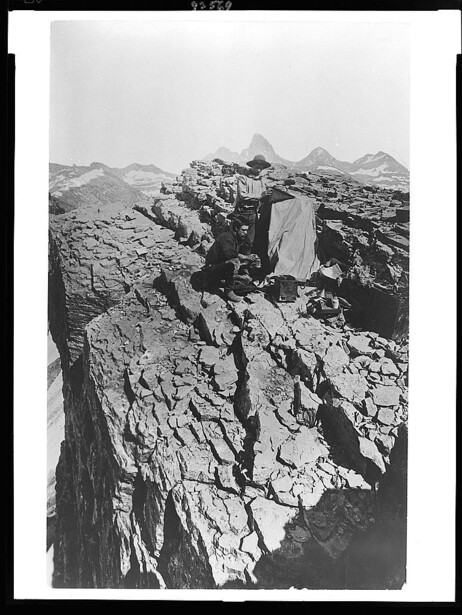
Written reports had come out of Yellowstone before, and readers had waved them off as tall tales. Boiling rivers, ground that hissed steam, water that shot a hundred feet into the air on a schedule; it read like the frontier fiction of the day. A drawing could be dismissed as an artist's imagination. A photograph was harder to argue with. That was the whole point of dragging the equipment up there.
Getting the Pictures to Washington
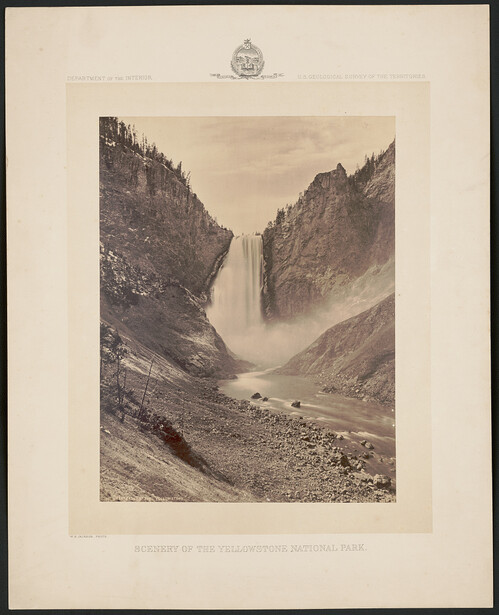
After the survey, prints were made from Jackson's 8x10 negatives and carried to Washington. Hayden, who understood exactly what he had, used them as lobbying tools. That fall he presented Congress with an extensive report on Yellowstone, and by the House historian's account, paintings by Moran and photographs from Jackson gave lawmakers vivid accounts of the region. The survey's formal illustrated report, carrying Jackson's photographs alongside illustrations by Moran and Elliott, was published afterward. Later accounts go further, saying Hayden put prints in front of individual members while the bill was in play, and describing congressmen crowding around to look at them. Those accounts are repeated far more often than they are sourced. The congressional record does not document who saw which picture, or what any of it changed. Jackson's images kept circulating after the park was law, too: a bound volume of 76 Albertype prints of his 1871 Yellowstone photographs, produced by Edward Bierstadt in New York in 1874, survives today at the Buffalo Bill Center of the West.
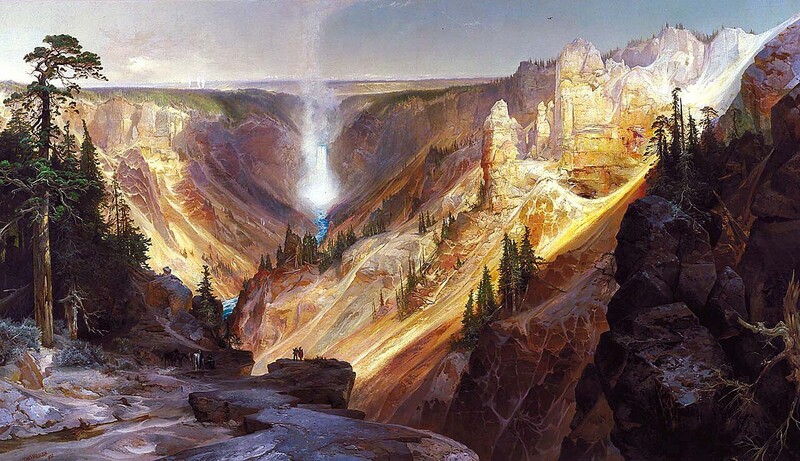
Moran's contribution to the campaign was mostly his watercolor sketches, done on site and worked up afterward. His giant oil, "The Grand Canyon of the Yellowstone," is the painting most people picture when they think of Yellowstone art, and Congress bought it for $10,000 to hang in the Capitol. That purchase, though, came in the months after the park was already law. What was available in Washington during the debate was the photographs, the field watercolors, and Hayden's written report. The huge canvas is a monument to the campaign more than a weapon in it.
What the Pictures Actually Did
The bill moved fast. A version passed the Senate on January 30, 1872, the House approved it 115 to 65 on February 27, and Grant signed it on March 1, setting aside the land as a "public park or pleasuring-ground for the benefit and enjoyment of the people." It is tempting to draw a straight line: Jackson pressed a shutter, Congress saw the truth, a park was born. The record is more tangled than that.
Start with the text of the act itself, which you can read in the National Archives. It makes no mention of the photographs, and no committee report hinged its argument on them. Behind the scenes, the Northern Pacific Railroad had a direct financial stake in a protected scenic attraction it could route tourists toward, and that lobbying muscle mattered. Hayden's detailed scientific report gave the proposal official weight. There had also been earlier expeditions, notably the 1870 Washburn party, whose members lectured and published about the region and helped seed the idea in the East.
The beloved tale that the national park idea was born around a campfire at Madison Junction in 1870, when a member of the Washburn party supposedly proposed setting the land aside for the public good, has been picked apart by park historians. Lee Whittlesey and Paul Schullery pointed out that none of the roughly 20 firsthand accounts from that trip mention the conversation, and that the story surfaced decades later. It makes a lovely founding myth. The documents do not back it.
The images were one force among several, not a magic bullet. But they were a real force, and a specific one. Railroad money and a scientist's report can win a committee. What the photographs did was different and harder to replace. They removed the excuse of disbelief. A representative from Ohio or Massachusetts who would never in his life see a geyser could no longer treat Yellowstone as a frontier exaggeration once Jackson's photographs of it existed. Jackson and Moran did not vote, but they made it much harder to vote no on the grounds that the place was made up.
One thing the pictures did not show, and the debate barely mentioned, is that the land was not empty. The National Park Service now recognizes 27 tribes with ties to the area and its resources, and people had used the Yellowstone region for more than 11,000 years. Setting the boundary drew a federal claim across ancestral hunting grounds, travel routes, and gathering places, and the decades of park administration that followed worked to keep Native people out of them. The photographs helped win an argument that was framed entirely as preservation against private development, and that framing left out the people already there.
The Case for Photographs as Evidence
The persuasive power was not in artistry alone, though Jackson had plenty. It was in the medium's claim to have been there. A photograph carried the implicit argument that a person stood on that spot, aimed a lens at that canyon, and recorded what the glass recorded. In 1871, that argument was close to unassailable. Hayden wanted photographic proof for a government survey, and railroad money wanted scenery it could sell to travelers, which is how one expedition ended up carrying both a camera and two artists.
Jackson's willingness to crawl into a hot, chemical-soaked tent to pour one more plate, to gamble 400 pounds of fragile gear on a mule trail, is the reason the evidence existed at all. You can still do this work, incidentally. Wet plate collodion never fully died, and photographers still carry large format gear into the backcountry, where a modern 8x10 field camera and a box of film holders remain a serious commitment of weight and patience. Anyone who has done it understands what Jackson accepted every single morning of that survey.
The negatives outlasted almost everyone involved. Jackson's 1871 plates are held in public collections, and you can pull the Grand Canyon of the Yellowstone up on the Library of Congress site in a browser, more than 150 years after a mule carried the glass down off the plateau. The park is still there because a lot of forces briefly pointed the same direction in the winter of 1872. Some of those forces have faded from memory. The pictures are still doing their job.
Lead image: William Henry Jackson, public domain. Source.
Join the Fstoppers community for free
-
Post comments and join in the discussions
-
Browse the site ad-free
-
Share your work and get featured in the community
-
Compete in the photo contests for fun and prizes
1 Comment
I'd encourage readers to look into the parallel story, from another region in another age, of the contributions George Masa and Jim Thompson made to the creation of Great Smoky Mountains National Park with their own photography.
Masa's story is particularly compelling - more to learn in the written and video work of biographer-sleuths Paul Bonesteel and Janet McCue. https://smokieslife.org/product/george-masa/