
Since the earliest days of film photography, we’ve been locked into aspect ratios defined by the film itself, whether that’s 3:2 from the standard 35mm film, 4:5 from the 4x5 large format film, or even 1:1 from the 6x6 medium format film that carved out its own niche result. The strange thing is, even after transitioning into digital, the aspect ratio has remained one of the least challenged conventions in photography. Digital cameras became faster, more powerful, and more efficient. But the frame is still the same old 4:3 or 3:2 rectangle that we have been stuck with for over a century.
If you think about it, most of the improvements in digital cameras since the 2010s have revolved around speed. Faster autofocus. Faster burst rates. Faster processing. And don’t get me wrong, these are huge leaps in performance that utilize the better part of technological improvements to produce a much more efficient camera. But here is the honest truth: personally, I think any camera from ten years ago is already fast enough to get the shot. You can shoot portraits, landscapes, even sports, and still get incredible results. After a while, this “faster, better, stronger” narrative in every new camera iteration starts to feel repetitive—a race to achieve more with diminishing returns.
The question is how much faster the camera needs to be practically if it's not going to change the inherent way that we produce images. That got me thinking. Where is the next big shift going to come from? What could genuinely change the way we approach photography? Then it hit me—square sensors!
We are already starting to see glimpses of it in imaging devices. DJI’s Osmo Action 360 brought it into the conversation, and most recently, Apple slipped it into the iPhone 17’s front-facing camera. At first glance, it might seem like a gimmick. But if you really think about what a square sensor in larger-format digital cameras could unlock, it starts to feel like the next logical evolution.
A Lesson From the Past: APS Film
Back in the 1990s, the APS film system shook things up, though it didn’t live long enough before the transition into the digital era quickly overshadowed it. The APS film allowed photographers to select different aspect ratios—Classic (C, 3:2), High-Definition (H, 16:9), and Panorama (P, 3:1)—on the same roll of film. Back then, it was a game-changer since, for the first time, aspect ratio was not dictated by the format of your negative—it was a creative option on location itself. That was revolutionary for its time, and it opened up new ways of framing without forcing photographers into a single aspect ratio.
In many ways, a square sensor feels like a logical digital descendant of that same disruptive spirit. Just as APS gave us some aspect ratio freedom in the film era, a square sensor could give us fluidity in the digital era, where images live across multiple platforms and aspect ratios matter more than ever.
Why a Square Sensor Might Be a Genius Move
Love it or not, we now live in a multi-platform digital world where we need to adapt to showcase our work. Shoot something for Instagram? It needs 1:1 or 4:5. For YouTube? 16:9. For traditional prints? 3:2 or 4:3. Instead of throwing away part of your frame by cropping into a rectangular image, a square sensor producing a larger square image makes it possible to pull any aspect ratio you want directly from the native capture.
We have already seen this exact idea disrupt the world of consumer video. “Open Gate” recording was first popularized on the Panasonic GH7 and now appears in newer mirrorless cameras like Canon C50 and Panasonic S1R II, which capture the entire sensor readout, not just a cropped slice of it. Videographers love it because it gives them more flexibility in post: they can punch out a 16:9 frame for YouTube or a vertical crop for TikTok and Instagram Reels in the same video that is not so tight in one recording format. It’s one of the biggest shifts in how modern cameras are designed for multi-platform content. Imagine bringing that same freedom into still photography through a square sensor.
Like me, there will always be purists who are firmly against cropping in post, as it often throws the original composition off. This is because you are essentially reframing an image you didn’t plan for at the moment. But this is different. With square sensors, it is not about figuring it out in post—it is about expanding the envelope of what a traditional camera can do. You are still composing intentionally on location, with the advantage of an EVF that previews the crop in real time and not salvaging an image in post. That means you’re not second-guessing yourself later on a computer screen—you’re making the creative decision right in the field, with the help of more sensor real estate. To me, that feels like a natural evolution of composition, not a compromise.
And here’s why the timing makes sense: we have now hit a sweet spot where high-megapixel sensors and power efficiency live in balance. If you recall, almost a decade ago, a 42 MP sensor would chew through batteries—think Sony a7R II. Now, we have 60 and even 100 MP sensors that can run for at least half a day of shooting when paired with processors that are efficient enough not to drain the camera’s battery.
Also, with today’s insane megapixel counts packed into a sensor, why are we still wasting them by cropping in further? A square sensor ensures every pixel is working for you, whether vertically or horizontally. Pair that with efficient modern processors and improved battery technology, and suddenly, what once seemed impractical is actually a sustainable solution that makes a square sensor practical today. Also, think about the possibility of getting better digital IS in video format since we will now have more headroom in the square sensor for stabilization without heavily cropping the image.
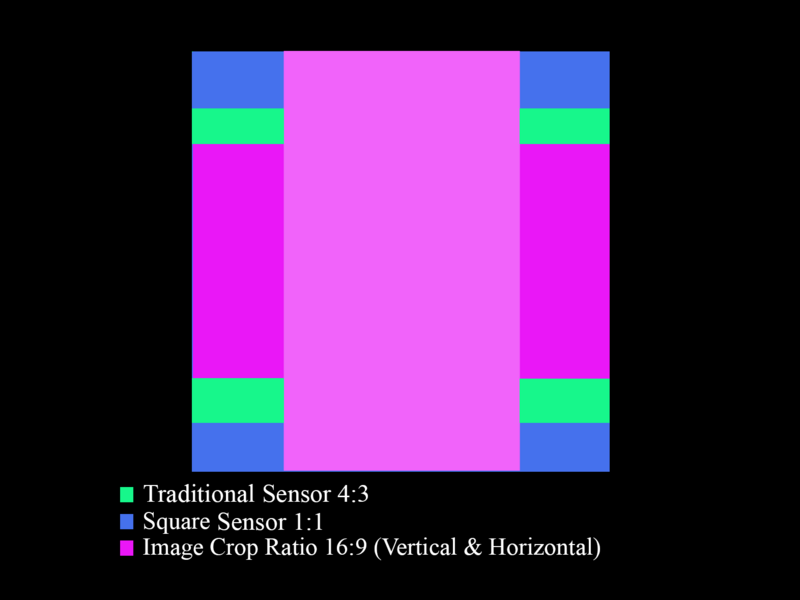
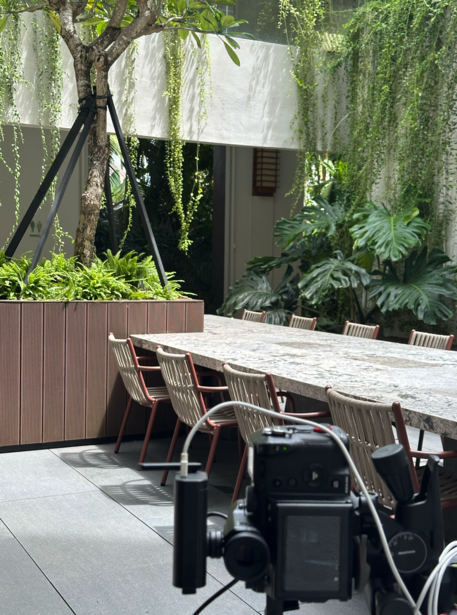
Here’s where it really excites me even more. If you have ever tried holding a camera vertically without a grip, you know how awkward it feels. Twisted wrists, raised elbows that potentially knock someone in the face, and bulky accessories. With a square sensor, suddenly you do not need to rotate the camera anymore. You can compose a vertical crop right there in the EVF without moving an inch. That means less fatigue, less gear, and more freedom to focus on composition.
On top of that, I think implementation of a square sensor will reintroduce something digital has long lost. Film photographers who have shot 6x6 film might agree with me on this, as it produces a refreshing perspective compared to a traditional format. By reintroducing square into the digital mainstream, larger-format cameras could inspire a whole new wave of creative approaches.
Final Thoughts
So here’s my bet: the square sensor is going to be the next big frontier for digital cameras. It practically solves modern needs for flexibility, makes better use of today’s megapixel monsters, and challenges photographers to rethink composition itself. It’s not just about speed anymore—it’s about unlocking better creative freedom with the same camera. I do think that the technology is mature enough to start experimenting with. And honestly, the narrative around faster cameras is getting boring. Maybe it’s finally time for the frame itself to evolve.



Join the Fstoppers community for free
-
Post comments and join in the discussions
-
Browse the site ad-free
-
Share your work and get featured in the community
-
Compete in the photo contests for fun and prizes
55 Comments
well it could be a 200mp square sensor. which will give you approx 100+ mp on average crop. Square sensors will mostly be practical to take advantage of the vertical height and other benefits that comes with it. But if we are not using those, then there are still conventional rectangle sensors for our benefits. Its not suppose to replace what we have now but something to build as an additional option or rather a specialised tool for a specific usage.
100% agree. Decades ago, I thought it would make sense for our devices with screens to adopt either 1:1 or 2:1 aspect ratios, depending on the use case. (2:1 could be rotated for 1:2 of course, for reading documents etc.) our eyes capture an elliptical area of visionspace, even when viewing through binoculars, despite what movies would have you believe! Therefore, cropping to 2:1 for landscape and other wide angle photography makes sense, whilst 1:1 is ideal for portraits and day to day captures. One thing Instagram got right unlike the awful TikTok that has lead to masses of horizontally cropped videos where you cannot even see what is doing on on the left or right! Lazy videoing, just rotate your phone!
Anyway, years ago, my company designed a bunch of devices with 1:1 or 2:1 displays, and will bring them to market over the coming years. During my time in Silicon Valley in the 1990s, I wrote to a contact at LG and suggested they adopt 2:1, and decades later, a famous movie director suggested the same, and LG quoted him in an article!
A 1:1 sensor also makes sense because it makes the most efficient use of light from the lens, that is of course circular. (I won't suggest a circular sensor, although circular displays are useful in some use cases like watches or funky car dashboard, but cannot be tiled to make larger or wider displays, so not suitable for general consumer and professional display purposes.
We are to be producing a camera ourselves, so will adopt a 1:1 sensor.
Yes, you covered some of my thoughts that I could hardly word. I honestly still struggle to understand vertical videos. They are at best good for vertical subjects only. Worse, there are current trends at put "anamorphic" 5:1 ratio videos onto a vertical video. Seriously, what am I even seeing at this point.
I think that the idea of a square sensor camera is great. Anyone who has ever printed from a square negative can tell you how flexible the format is. It allows for a more thoughtful approach to achieving the "perfect" image. You got to choose the best orientation and most appropriate aspect ratio from within the square negative in the darkroom at your leisure or, for the less chemically inclined among us, place them on a cropping card and send them to a lab. For landscapes, the horizon can be shifted up or down and for portraits the subject can be moved side to side to achieve the mose pleasing composition. Of course, some images are best suited using the entire 1:1 square. Many weddings were shot on 2 1/4" square negatives but nearly all photos were cropped to be printed in standard asymmetrical print sizes, ie. 5x7, 8x10, 11x14 etc. The framing and composition of the final image was fine tuned after it's capture, not in the camera. This entire process in the digital age can now be done with the click and drag of a mouse.
All that said, I wish you better luck with convincing camera manufacturers to change their sensor format to square than I had convincing photo frame manufacturers to change theirs. I thought it would be a no-brainer since photo display is their only purpose. I thought, who wouldn't want to see both photo orientations displayed in the same size on a photo specific device? Back in the days of slide film photography, when the size and format of the film was fixed, we adapted the shape of the screen to fit the image. We made sure that the screen was extended as high as it was wide to accommodate the images in either orientation. Asymmetrically shaped displays, while perfect for horizontal only video and text are far from ideal for photographs. They do not take into account the second orientation that photography presents. A new square format for digital photos made so much sense to me that I invested countless hours over four years and a significant amount of cash to obtain a patent, only to find afterwards that nobody except me seems to care.
Yes, and it makes a lot of sense now that we have all the technology ready. EVF that can overlay and change the aspect ratio in real time, fast sensors with a ton of megapixels packed for cropping and fast processors to make all these happen and take advantage of the benefits. I really hope it's coming in to the product pipeline in the near future. Can't wait for it to happen