
Since the earliest days of film photography, we’ve been locked into aspect ratios defined by the film itself, whether that’s 3:2 from the standard 35mm film, 4:5 from the 4x5 large format film, or even 1:1 from the 6x6 medium format film that carved out its own niche result. The strange thing is, even after transitioning into digital, the aspect ratio has remained one of the least challenged conventions in photography. Digital cameras became faster, more powerful, and more efficient. But the frame is still the same old 4:3 or 3:2 rectangle that we have been stuck with for over a century.
If you think about it, most of the improvements in digital cameras since the 2010s have revolved around speed. Faster autofocus. Faster burst rates. Faster processing. And don’t get me wrong, these are huge leaps in performance that utilize the better part of technological improvements to produce a much more efficient camera. But here is the honest truth: personally, I think any camera from ten years ago is already fast enough to get the shot. You can shoot portraits, landscapes, even sports, and still get incredible results. After a while, this “faster, better, stronger” narrative in every new camera iteration starts to feel repetitive—a race to achieve more with diminishing returns.
The question is how much faster the camera needs to be practically if it's not going to change the inherent way that we produce images. That got me thinking. Where is the next big shift going to come from? What could genuinely change the way we approach photography? Then it hit me—square sensors!
We are already starting to see glimpses of it in imaging devices. DJI’s Osmo Action 360 brought it into the conversation, and most recently, Apple slipped it into the iPhone 17’s front-facing camera. At first glance, it might seem like a gimmick. But if you really think about what a square sensor in larger-format digital cameras could unlock, it starts to feel like the next logical evolution.
A Lesson From the Past: APS Film
Back in the 1990s, the APS film system shook things up, though it didn’t live long enough before the transition into the digital era quickly overshadowed it. The APS film allowed photographers to select different aspect ratios—Classic (C, 3:2), High-Definition (H, 16:9), and Panorama (P, 3:1)—on the same roll of film. Back then, it was a game-changer since, for the first time, aspect ratio was not dictated by the format of your negative—it was a creative option on location itself. That was revolutionary for its time, and it opened up new ways of framing without forcing photographers into a single aspect ratio.
In many ways, a square sensor feels like a logical digital descendant of that same disruptive spirit. Just as APS gave us some aspect ratio freedom in the film era, a square sensor could give us fluidity in the digital era, where images live across multiple platforms and aspect ratios matter more than ever.
Why a Square Sensor Might Be a Genius Move
Love it or not, we now live in a multi-platform digital world where we need to adapt to showcase our work. Shoot something for Instagram? It needs 1:1 or 4:5. For YouTube? 16:9. For traditional prints? 3:2 or 4:3. Instead of throwing away part of your frame by cropping into a rectangular image, a square sensor producing a larger square image makes it possible to pull any aspect ratio you want directly from the native capture.
We have already seen this exact idea disrupt the world of consumer video. “Open Gate” recording was first popularized on the Panasonic GH7 and now appears in newer mirrorless cameras like Canon C50 and Panasonic S1R II, which capture the entire sensor readout, not just a cropped slice of it. Videographers love it because it gives them more flexibility in post: they can punch out a 16:9 frame for YouTube or a vertical crop for TikTok and Instagram Reels in the same video that is not so tight in one recording format. It’s one of the biggest shifts in how modern cameras are designed for multi-platform content. Imagine bringing that same freedom into still photography through a square sensor.
Like me, there will always be purists who are firmly against cropping in post, as it often throws the original composition off. This is because you are essentially reframing an image you didn’t plan for at the moment. But this is different. With square sensors, it is not about figuring it out in post—it is about expanding the envelope of what a traditional camera can do. You are still composing intentionally on location, with the advantage of an EVF that previews the crop in real time and not salvaging an image in post. That means you’re not second-guessing yourself later on a computer screen—you’re making the creative decision right in the field, with the help of more sensor real estate. To me, that feels like a natural evolution of composition, not a compromise.
And here’s why the timing makes sense: we have now hit a sweet spot where high-megapixel sensors and power efficiency live in balance. If you recall, almost a decade ago, a 42 MP sensor would chew through batteries—think Sony a7R II. Now, we have 60 and even 100 MP sensors that can run for at least half a day of shooting when paired with processors that are efficient enough not to drain the camera’s battery.
Also, with today’s insane megapixel counts packed into a sensor, why are we still wasting them by cropping in further? A square sensor ensures every pixel is working for you, whether vertically or horizontally. Pair that with efficient modern processors and improved battery technology, and suddenly, what once seemed impractical is actually a sustainable solution that makes a square sensor practical today. Also, think about the possibility of getting better digital IS in video format since we will now have more headroom in the square sensor for stabilization without heavily cropping the image.
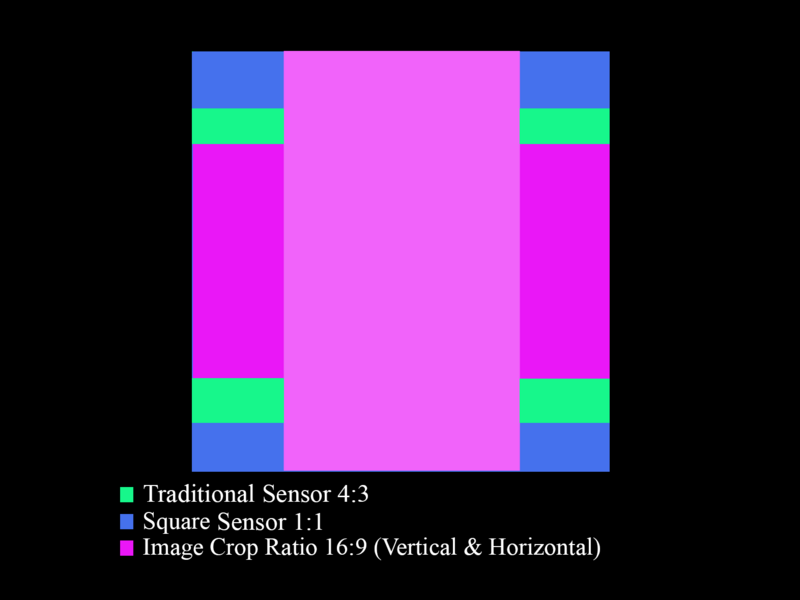
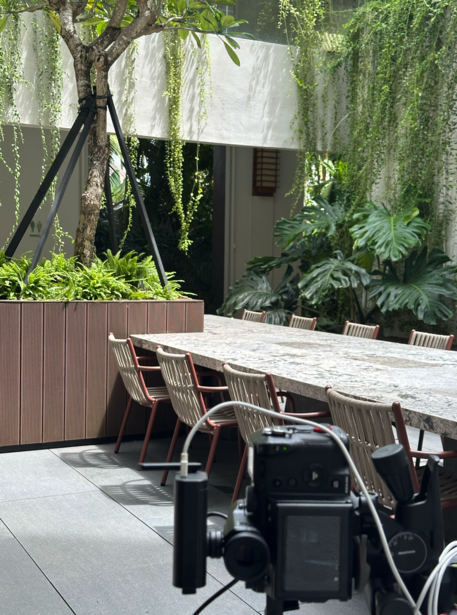
Here’s where it really excites me even more. If you have ever tried holding a camera vertically without a grip, you know how awkward it feels. Twisted wrists, raised elbows that potentially knock someone in the face, and bulky accessories. With a square sensor, suddenly you do not need to rotate the camera anymore. You can compose a vertical crop right there in the EVF without moving an inch. That means less fatigue, less gear, and more freedom to focus on composition.
On top of that, I think implementation of a square sensor will reintroduce something digital has long lost. Film photographers who have shot 6x6 film might agree with me on this, as it produces a refreshing perspective compared to a traditional format. By reintroducing square into the digital mainstream, larger-format cameras could inspire a whole new wave of creative approaches.
Final Thoughts
So here’s my bet: the square sensor is going to be the next big frontier for digital cameras. It practically solves modern needs for flexibility, makes better use of today’s megapixel monsters, and challenges photographers to rethink composition itself. It’s not just about speed anymore—it’s about unlocking better creative freedom with the same camera. I do think that the technology is mature enough to start experimenting with. And honestly, the narrative around faster cameras is getting boring. Maybe it’s finally time for the frame itself to evolve.





Join the Fstoppers community for free
-
Post comments and join in the discussions
-
Browse the site ad-free
-
Share your work and get featured in the community
-
Compete in the photo contests for fun and prizes
55 Comments
During the early days of digital, I remember a commenter on Photonews.net saying something about how they should make the sensors square. I never forgot that, and I still totally think they should!
They really should! It would have been such a game changer
Wrong. The aspect ratio is NOT the next big thing.
I am tired of my DLSR's being the least connected and most difficult to connect (looking at you Nikon's Snapbridge, really switch off Home WiFi, turn on camera Bluetooth then Wi-Fi)...... My toaster is better connected in the Internet or Things (IOT) era.
We can afford bodies that cost thousands of dollars, another monthly data plan is no big deal.
Cellphone connectivity built into ILC bodies or into battery grips for existing models IS THE BEST BIG THING. It is the only thing that will get me to upgrade from pairs of Nikon DLSR's, D850, D750, D7500, and D700 bodies with lenses including the Holy Trinity of F2.8 zooms, macro, both Nikon DC lenses, and many non-AF F-mount lenses dating back to the 1960s which meter fine (auto or manual depending on configuration with most of my bodies automatically if natively AI/AI-S, or those I had converted.
My point? Id spend $15,000 instantly to buy a system with full cellular connectivity as easy to use as a smartphone.
We need Android and Apple options in ILC bodies, perhaps FX only (square sensor allowed). We need access to App Stores to get editing apps and social media for sharing on the camera. We already have touch screens.
We need FX ILC bodies with the same type of AI Processing on the sensor used by smartphones is essential and the user should be able to select AI enhanced (think of the great way cell phones capture sunsets with well exposed foregrounds, or in mixed lighting like museums without thought, effort, filters, or editing, or traditional RAW/JPG mode via a selector.
This cannot be that difficult. The Japanese camera manufacturers need to adapt to the future lest they go the way of Kodak failing to move away from film and some Chinese company relating them to the dust heap. Moving away from having to manually download or automatically download images to our computer after considerable configuration, is like unloading film and sending it in for processing, very antiquated.
I use an Android phone with Dropbox and Drop-Sync. When I hit Wi-Fi, my smartphone photos are automatically sent to Drop Box,then synced to my home server computer and appear on gPhotoShow screensavers on laptops (placed below TV monitors in my living room, den, bedrooms, and various monitors throughout my house), often before I get home. I set the screensaver to a weighted mode where photos taken in the last 90 days (a time period of my choosing) appear 70% more than older photos. The new photos show up instantly upon my arrival at home with no work on my part.
I still have to manually download photos from my "real camera's" to get them shared.
Oh, despite using fill flash, polarizing and ND filters with my ILC cameras, I still have to edit the ILC photos. Smartphone photos rarely need editing due to AI compensating for low light, mixed light, or color balance.
I do get where you come from. Solving the "last mile problem" in getting the images out. Zeiss did came out with their own take on integrating Adobe Lightroom into their ZX1 camera but demand has been horrible. Not too sure why.
And yes, I am curious too on why with all the dynamic range we have now, the JPEG engine tonal range is still pretty crappy out of the camera. Lacking of customisation, bla bla bla.. In the end, we will have to edit it somehow to get the best out of it. And I am not even talking about blending. Most of my street images are single raw tweaked in Lightroom with no selective masking edits. If I can do it in a single raw, some form of curves and tonal range tweaking in camera would be great.
My Canon camera links to my iPhone very easily and I very rarely use it. I don’t want my camera to edit my raw images. When I do a landscape shoot and come home I load the images in my computer and then the choosing and editing start, I also love that part of photography. The edited images go to my archive on the computer and to SmugMug. Via SmugMug I can acces those images anywhere on any device.
I would rather have a square sensor , love that format and as mentioned in the article no more need to turn the camera sideways.
But different people , different needs and wishes.
I have always used a tethering device (camranger 2) for my canon cameras for the longest time until recently when i was forced to travel light. I tested the canon connect app with canon r5. I was surprised by how good it is. it can even do video tethering wirelessly and the images shot shows up almost in real time. The last time i used any in camera wifi, i recalled it suck badly and this has changed my perception. Apart from the battery being drained faster than it should, I really couldn't think of any negatives. maybe a little hard to get it started? Pretty sure it will improve as time goes by.
What you are saying is " I wan't a camera with smartphone features", but what you really want, is a smartphone with interchangable lens options.
Go nag the smartphone companies for such a montrosity and see if you have any luck.
Most modern cameras can take HDR image of a sunset if you set the camera in such a mode. They can also handle mix, low lighting situation and colour balance with ease. All you have to do, is learn how to set the camera settings to the shooting situation.
Even though more and more computational features are being build into modern cameras, they are not set to on as default. The reason being, that people that use a camera wants to be in control of their pictures. The want to be able to take several pictures in a row or over a timeframe, and know each picture looks the same.
You can't really do that if you let software decide the outcome.
I do admit though, that the lag of an option to just connect my camera to my home wifi network and have it work as any other drive, boggles my mind too.
How about a proper app that allows seamless transferring of images from camera to phone? No we don't need ilc's with smartphone features and yet more monthly data plans (and bloody OS boot up times) or smartphones trying to be ilc's. Each device does what it is designed to do very well, just make it much easier to communicate between the two and let each device handle what it does well without ruining the experience of either, attempting a poor integration of both. I have zero interest in connecting my camera to the internet and really don't want a compromised experience and poor battery trying to power any OS/internet bloat just because social media obsessives want it. Your phone already has it and no internet enabled ilc will better that experience.
I think there are already such connectivity. I recall olympus has the feature that allows you to transfer images via bluetooth through their app without messing with a ton of "connecting" here and there. Its pretty seamless
Agreed re connectivity. I just bought an otherwise excellent cute Canon R50 APSC mirrorless DSLR. Love it to bits, but 1. My Mac mini M4 Pro cannot see the camera when I connect it using the camera USB-C port. (I have tried everything!). 2. Connecting camera to my iPhone 16 Pro Max is hit and miss, the app, like most apps from Japanese companies, is like something from 1803. Compare to apps from DJI for their drones! Or Bambu Lab 3D printer apps.
I have to pop out the SD card and insert it into a reader connected to my Mac. This risks me forgetting it and rushing out with camera, minus SD card!
I love the square sensor idea.
But I think they should go one step further and make a sensor that covers the ENTIRE circular image that the lens projects. Yes, this means that the square sensor will be bigger than the image circle, so that the corners of the sensor will record .... nothing. Yeah those blank corners will technically be wasted sensor real estate, but so what? Who cares? (interpret that as "no one should care and if they do then they are wrong to care")
If we have sensors that are any smaller than the circular image projected by the lens, then we are wasting image area, and that is a gazillion times worse than wasting sensor area. Any sensor less than the image circle is forcibly cropping the image for us and I am against any such cropping. Record everything that the lens sees, and then let me rotate and crop it later, to taste.
It would work too, either way with a standardized large square sensor size, user can then decide whether to use any lens with larger or smaller image circle to utilize the whole sensor and also crop factor. I am waiting for that to come!
Perhaps we need circular sensors to maximise the use of the image circle.
Well that would be great but sensor technology does not allow any of the rows of senses to be any longer, or shorter, than any of the other rows, so square or rectangular is all that is possible with current technology. At least that is what people who are in the know have told me.
This is interesting to know. I didnt know it was impossible
I sometimes think there must be a competition to see who can get the dumbest article published on Fstoppers.
You are absolutely right!
Likewise in the comment section
Sensors are a large proportion of the cost of a camera. Sensor cost is proportional to sensor area.
A square sensor is only optimum for capturing square images. A rectangular sensor is more optimum (that is uses a larger proportion of that expensive sensor area) for all other aspect ratios.
Taking the current Shallow Depth of Field / Bokeh contest as an example I had go through 50 images before finding a second square one. Square sensors optimized for 1 in 25 images is a dumb idea.
Suggesting square sensors could be the next big shift pushing digital cameras into their next evolution is an extraordinarily dumb idea.
Seems like you have a very close-minded and limited way of thinking.
There is not and has never been anything preventing the manufacture of cameras with square sensors yet there are essentially none and only a few obsolete MF film cameras.
My way of thinking matches that of every camera manufacturer on the planet and their business depends on making cameras people want to buy.
We have the technology now to make it very usable. I am actually seeing more benefits with the implementation. But only time will tell if manufacturers wants to take that risk again
That is because camera manufacturers are primarily interested in doing things that result in the best profits, the greatest number of sales, etc. The vast majority of camera buyers are not perfectionists who want the ultimate. And those who are are not able to pay for the ultimate. And that is why we get shafted with the rectangular sensors that chop off some of the circular image that is projected by the lens.
They make design decisions on the profitability basis, not on the ultimate capture basis. But here on Fstoppers we like to talk about and fantasize about what would be the most ultimate thing ever, regardless of whether or not it is practical or affordable. Life would be so freaking boring if we just thought about practical things.
Who made you the arbiter of what Fstopper readers like to do?
At least you agree with me that this article is fantasy.
The least we could all do is dream, without dream, the next big thing would not happen. At least if its out there, someone crazy enough would probably pick it up and manufacture it then we as a consumer could enjoy it.
Robert Barclay wrote:
"Who made you the arbiter of what Fstopper readers like to do?"
Huh? Weird question that you asked me.
I am not the arbiter of what Fstoppers readers like to do. I simply observe the comments and message with other users and see what they like to do.
If you see a couple hundred happy people at Red Robin eating hamburgers and say, "Red Robin customers like hamburgers", that does not make you the "arbiter" of what Red Robin customers like to eat. You are simply observing what they like to eat.
What a strange and weird and whacko thing for you to say something about me being an "arbiter". What an odd word for you to completely misuse in this context.
Without new lenses a square sensor would waste the sides more than the current sensors of the image circle. If one wants square then crop in camera.
I agree connectivity is a bigger issue. Canon Camera Connect is amazing, works extremely easily and perfectly. But I still have to connect to my cellphone, relatively quick and easy but still have to do it then quickly download the desired photos.
Yes, a cellphone type internal connection with user defined phone numbers or whatever. Take the photo then share to anyone anywhere Without having to take the short download step.
Of course this is all amazing sci fi to what was available 20 years ago.
Technically, we can mount a medium format lens onto the square full frame sensor. Unless we are talking about medium format square sensor. then we may need to have a new set of lens developed for it. But what I had in mind was never to use the corners. the idea was to allow flexibility to let users work within the image circle in any orientation they need.
No it wouldn't waste the sides, because a properly sized square sensor would cover the entire image circle that is projected by the lens.
The possibilities of in camera solutions trumps any mechanical advantages in today's world! The ability to have frame averaging, recording a three dimensional light-field instead of two, post capture re focusing, quantum photography seeing through fog or rain, the ability to capture very low light images without noise or grain.
Hardware technology advancing curved sensors with the addition of ultra thin meta surfaces making lenses 20x thinner and using stacked global sensors to capture the entire frame instantly.
These are the ideas of the near future that will transform photography and video recording in our life-time.
Reducing the weight of a system, making the system faster, being able to shoot in any light, having intelligent capture learning your style and framing the image and capturing it with out you pressing the shutter button is the next great thing. Imagine a 2000mm F2.0 lens as big as a pancake lens that combined with the camera body only weights 500 grams.
Im all for the larger square sensor I own the H6D-100c and always wanted a Square sensor but without the issues of huge heavy glass and without the extreme limitations of burst speed. It's about time companies like Hasselblad took the path and realized that making a new camera system with 10 year old technology is not going to cut it two-three years from now. I digress lenses covering most photographers needs are light weight zooms. 16-24, 24-105, 50,-150 and so on. Long glass is way to heavy as it is made today and having two bodies with two zoom lenses mounted is the ultimate KIT!
Barry wrote:
"Imagine a 2000mm F2.0 lens as big as a pancake lens that combined with the camera body only weights 500 grams."
That sounds great, but would it actually be a true 2000mm focal length, or would it just give is the field of view that corresponds to 2000mm, without actually being 2000mm by definition?
focal length: the distance between the optical center of a lens and the focal point where parallel light rays converge after passing through the lens
Memories are short around here... Phase One's P20 was a square sensor for Hasselblad V series cameras. I shot on 120 Film (square) for the beginning of my professional career. Moved to a 4:3 sensor in Phase One on H2 bodies and then Hasselblad systems (4:3) and now Mirrorless MF (4:3) I think 4:3 is the happy medium. I hate the 3:2 on canons etc whenI have to.
Yes there are square sensors. but it would make much sense now just because we have all the tech ready now. a 100mp square sensor would be sufficient to cover any aspects that you need. I too find it hard to work with the 3:2 ratio for vertical shots. Its not too bad on horizontal images
I had to double check it wasn’t April fools. Then I stopped and had a think, if the 24x36 sensor were replaced with a square sensor the largest practical size that would still allow all our lenses to be used would be around 30x30 which would in effect offer slightly more sensor real estate than the current 24x 36.
From the manufactures point of view it does offer some real advantages and is not such a crazy idea as I initially thought. I see no reason why it would not work and can imagine some manufacturer launching one in the not so distant future. It’s a solid idea that I think many photographers would jump at especially those shooting; macro, studio and wildlife. I must crop at least half of my own images into a square format for printing. Bring it on.
Exactly my point! Its not too hard to make it with whatever technology we have now. The amount of pixels and speeds that we have in the camera nowadays will make it even more flexible for shooting
Not for me, thanks
100mp sensor which easily switches to a square crop when I want it
I don’t want to be forced into a square format in stills, and particularly not in video
Well its really just the other way round but the idea is there.
In terms of composition it is much harder to compose for a square format (or at least it is for me), and I think this relates to human vision, 2 eyes naturally lead to an elongated format. Then the square introduces a symmetry, and often you need an inbalance to lead the eye into the picture, thats not to say this cannot be done with a square format, but I think its more challenging, Sure you can crop a square format sensor to get an elongated format, but then again you can crop a 35mm sensor to get a square, so swings and roundabouts.
I agree with other posters, that its getting the image out of the camera, where the next steps can be really improved. I would love to be able to just upload my RAW images 100% reliably to a cloud based repository, today that is a distant dream. Using Nikons snapbridge, its kinda doing this, but its not reliable. I suspect we need the phone communication components more on board the camera.
Well perhaps I was not clear enough in my sharing. Having a square sensor will benefit mostly in the reframing into vertical formats as you will be using more of the sensor height. Also the more sensors, we can look into digital stabilisation in video and even open gate video recordings that allow even more flexibility.
Also yes, connectivity is also important. I have been wanting to have my raw files in my computer at my office right after my on location shoot, but as of current imaging architecture I dont see it happening without tapping into a much more complex setup like ftp, etc etc
Excellent idea! I have been wishing for square sensors for years.
4:3 sensors already come closer than 3:2 sensors, thus make better use of the image circle.
Cameras could overlay crop frames to help visualise the desired result.
Yes, which is why I love shooting medium format more these days. and with the powerful evf technology, overlays or blackout is not an issue at all. The technology is ready. we just have to wait for manufacturer to implement it
There's an old joke: I pay taxes on all the road, so I'll drive on all of it. Forget any kind iof rectangle, wouldn't it be great if a raw image was the full circular image cast by the lens?
You have the same thought as another commenter above, well apparently Tom had an answer for it
How about a multi-aspect sensor like the one in the Panny GH2? But if there was one for a FF cam, could today's lenses give full coverage for multiple aspect ratios?
GFX100rf is allowing multi aspect ratio. the issue with current sensor technology is the limitation on vertical heights, which a lot of the content demands are. Square sensor would have solve that easily
N/A
What a well-done article. When you get as many comments as you did, it has been worth the effort.
I have lately (in the last year) found myself using my camera's ability to let me choose what aspect ratio I want to use. My camera (a Z50 II) gives me three options: 3:2, 1:1 (square) and 16:9
I have even set function button 2 to easily being able to switch between them.
I too have a tough time cropping in posts. A picture is made at the moment of capture, så cropping in post hurts me, but by using the different aspect options doing capture, I can, in most situations, get a much better composition right in camera.
I would really like more aspects ratios to choose from, like 4:3 or panorama, but I make do with what I got.
What I have found though, is that I use the 16:9 much more than the square 1:1 option. So much so, that I use the 16:9 more than I use the native DX 3:2 mode. It is so easy to get rid of unwanted skies or distraction foreground.
16:9 is such a nice aspect ratio to work with.
Some might say that by cropping like that, I lose a lot of resolution, but that is not true. I still get the same pixel density in the area I capture, as I would if I used the whole sensor.
It is a case of daring to try new stuff. Yeah! let's get square sensors but give us a lot of aspect ratios to choose from. That, I think, will set a lot of photographers free.
N/A
In my case, I always struggle for post-cropping. I could not remember which crop on what image, etc etc. I made a lot of decision with composition during the process of capturing and not having the crop embedded in is frankly quite annoying. So far all my work has been at least 90% as it is in terms of framing, post cropping is just for a little alignment and trimming on human error
Sorry but other than the argument for using the maximum megapixels in square format, there are no other advantages to a sensor in this aspect ratio. Don't forget, plenty of people like higher megapixels for the ability to crop. I'd rather go for a 100mp camera with various aspect ratios that gives me choices rather than say a single square format 100mp sensor. I can't see how it would be an advantage over what we already have if we are talking about flexibility. Besides, for most occasions a very high mp count really is overkill.