

The children chose the spot. Nyancho NwaNri was photographing a ballet class at a free school in Lagos, Nigeria, when she asked the young dancers where else they wanted to be photographed, and they led her outside to a worn concrete platform. The frame she made there, "Of Grace and Concrete," won the 2026 Flickr x Black Women Photographers grant, the biggest award in the program's four cycles.
I spoke with NwaNri about the photo, how she works, and what she plans to do with the $10,000. Earlier this year, I also spoke with Polly Irungu, who founded Black Women Photographers (BWP) in 2020, about the grant and how her community of more than 2,100 photographers in over 60 countries turns visibility into paid work.
The Photo the Children Chose
NwaNri knew of the school before she went. In June 2020, a video of 11-year-old Anthony Mmesoma Madu dancing barefoot in the rain outside the Leap of Dance Academy drew millions of views and made the free ballet school in the Ajangbadi area of Lagos international news. "I don't know if you ever saw this story about this boy dancing ballet in Lagos," she said. "It went viral. So I went there to photograph the school."
She started indoors, in the room where the students normally take class, and photographed a real lesson as it happened. "None of that was staged," she said. Then she wanted the setting to carry more of the story. The school sits in what she called "an underprivileged neighborhood or an underserved neighborhood," and in Nigeria, she said, ballet usually reads as something foreign, "reserved for people that have the money to be able to afford it."
"It was actually the children that chose that place to be photographed," NwaNri said. She asked them, "Where else would you like to be photographed? I want to see you do your thing, express yourself more, not just within the confines of the space where you're being told." They took her to the platform, which, as she remembers it, is a place they like to go on their own.
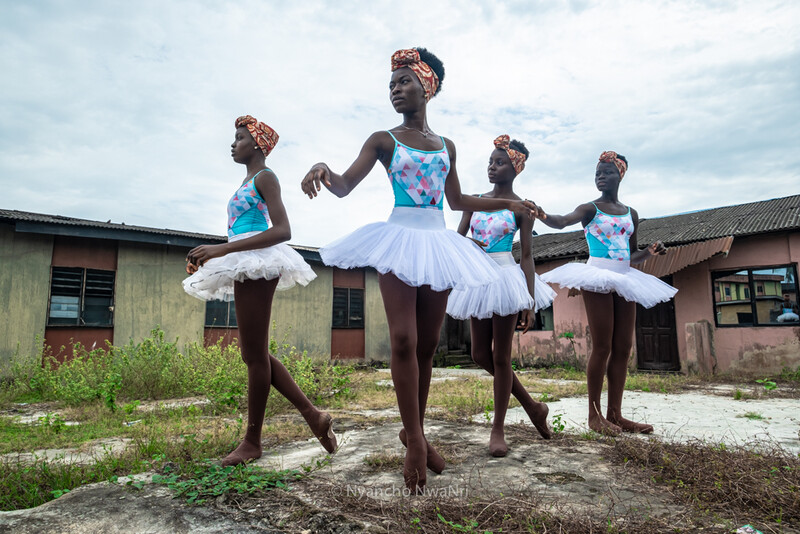
Her grant statement describes the frame: "Five young ballerinas stand on a weathered concrete platform, drawn toward the same unseen point. One rises onto pointe, another's hand is already there to hold her…gently. They wear white tutus and Ankara headwraps, two worlds carried as one. Behind them, a building holds its silence. Broken glass, faded walls, the quiet residue of years. Grass pushes through the concrete anyway."
A Grant That Keeps Doubling
Flickr and BWP started the grant in 2022 with $1,200 for Naomi St Juste, a self-taught photographer in Birmingham, England. It rose to $2,500 for Chicago portrait photographer Genesis Falls in 2023, then to $5,000 in 2025 for Éléonore Menga, a portrait and documentary photographer in Montreal. This year's recipient gets $10,000, a two-year Flickr Pro membership, and a one-year SmugMug Pro membership, and ten runners-up each receive one-year Flickr Pro and SmugMug Pro memberships. Applicants submitted one photograph and a short statement on the theme "Traces of Connection," which Menga chose.
"When we launched Black Women Photographers in 2020, my mission was simple," Irungu said. "It was literally just create more pathways for Black women photographers to be seen, supported, and hired. And grants became one of the most direct ways to invest in our community's creative futures. And Flickr immediately understood that vision."
"Yes, people have walked back on their DEI commitments, but at the end of the day, creatives, especially creative careers, as you know, require real resources," she said. "And financial support can be that difference between simply sustaining a practice and truly investing in it." Raising the award to $10,000, in her words, shows "what it looks like to actually put your money where your mouth is."
The grant carries no restrictions on how it's spent, and Irungu said she loves that. "At the end of the day, creatives know what they need best," she said. Menga told Irungu that the industry "can already be really isolating" for photographers outside "the quote-unquote hot markets like New York or Los Angeles." Menga is also a mother, and Irungu said last year's grant gave her "the freedom to do the work that she needed to do and create more time and also upgrade some of the things that she's been using."
When I asked what separates a winning application, Irungu put storytelling ahead of technique. "We really look for compelling storytelling first and foremost," she said. "Strong technical execution matters, but really what stands out is the work that leaves a lasting impression." She said the judges would be looking for "originality, authenticity, emotional resonance and a clear point of view," and that the strongest entries show "not just beautiful images, but a thoughtful body of work, purpose and vision."
For the first time, Flickr named the winner in person, onstage at the inaugural MODE by Flickr festival, held September 18 to 20 in Minneapolis. "Yes, we could post it on social media and call it a day, but it doesn't really make it a moment," Irungu said. Past winners also stay involved. Menga served as this year's guest judge, and Falls has returned as a judge as well. "We always find a way to bring previous grant recipients back into the fold," Irungu said.
Part of the Moment
NwaNri's statement ends: "Connection, it turns out, doesn't end where the picture does. It reaches beyond the frame to whoever pauses long enough to see it." When I asked what reaches beyond this frame for her, she started with the photographer. "If you're not connected, you're not seeing what's happening," she said. "If you're not connected, you don't understand the moment."
The scene, she said, was "such a contrast": tenderness and youth against a building left to age, with "actual living memories being made in this moment." At one point, one of two sisters in the group reached over to fix the other's headwrap. "It wasn't just about capturing that moment," NwaNri said. At times, she put "the camera down and away" to "just look at them and be part of that scene, part of that memory."

"There should always be that moment where you're not just a photographer," she said. "You're part of the moment itself."
Showing Up Without the Camera
Much of NwaNri's work deals with Indigenous African spiritual traditions, culture, and memory. Her usual method is to visit a community first without a camera, get to know people, explain what she wants to do, and hear their stories. "Once you bring up the camera, everybody's like, is my tie straight?" she said. "They're not even wearing a tie." In documentary work, she said, the depth of a story comes out "when you're not photographing. When you're just randomly talking to someone over a cup of tea."
"With time and with being present, not as a photographer, but someone that's genuinely interested in them and their story, that's usually where the trust is built," she said.

The ballet shoot was an exception. She visited the school only once beforehand, mostly to make sure she could find it, then talked with the students on the day before she began shooting. Her most recent long-term project, which she just finished, ran three and a half years, and during its final year of production she was there constantly, eating lunch with people and going to community events. People started asking where she was when something happened, even when it had nothing to do with her project. "We wish she was here to photograph," she remembered them saying.
The habit carried over from her years in broadcast, which included production design for TV series. Even then, she went to the source. "I don't want to just design off of my head or off of the pictures I see online," she said. She would drive out, "even if it's a faraway place in the country," to talk to people one-on-one before doing the work.
What the $10,000 Is For
NwaNri opened her answer with a joke about going shopping, then named professional development courses, including in creative direction, updates to her gear, a redesign of her online presence, and funding for the projects she's researching now. "I usually self-fund my projects unless I get a grant to do otherwise," she said, so some of the money may also recoup what she has already spent.
She spoke to me from Brazil, where she's preparing a project that links Brazil and Nigeria. The two countries "are almost like sister countries, very distant sisters," she said. They share the history of the transatlantic slave trade, which carried enslaved Africans from what is now Nigeria to Brazil, and with them their spiritual traditions, language, music, and food. They also share, she said, some of the highest deforestation on their continents. Her project looks at Indigenous cultures in Brazil, Afro-descendant cultures with roots in Nigeria, and Indigenous Nigerian cultures, and asks how their relationship with nature could help both countries face their environmental problems.
She also wants to rebalance her practice. After finishing her last project, she promised herself time for her art, which for her means installation video art, where her interest in African spiritual traditions shows up most. "Not in any way abandoning documentary. I love documentary photography," she said. "But the scales have sort of been tipped towards the documentary side a lot." She's now researching display technologies to make her video installations more interactive and immersive.
NwaNri was born and raised in Nigeria to a Gambian mother and a Nigerian father, and she makes a point of naming both. "In the art world, there's not a lot of Gambian names coming up," she said. "I want my work to be able to fly the flag for both countries, not just one."
Persistence and Your Own Way of Seeing
NwaNri's work has appeared in The New York Times, The Guardian, Al Jazeera, and Reuters, and she won the Reuters Yannis Behrakis Photojournalism Grant in 2021. When I asked what it takes to land those assignments as an independent photographer, her answer was "a lot of persistence," along with dedication "to your own work, to your way of seeing, to your way of telling stories."

She warned against chasing clients at the expense of that. "If you're focused on I need to get clients, I need to get clients, you're taking away from focusing on who am I, how do I see the world, how do I see things, how do I tell these stories," she said. Putting the focus on those questions, she said, is what builds "the experience, the expertise, the voice" that makes an editor call.
NwaNri has also worked with Canon as a film and photography trainer, and she noticed young photographers drifting toward the same kind of work and trying to shoot like someone who took years to develop a style. "You don't need to be like anybody. Be your own person," she said. "I'm not saying don't look at references or don't connect with someone else's work. Definitely do if it inspires you. But don't hold that as the template to which you should build your own."
She gives viewers the same freedom with her own pictures. "It's not really about what I meant. It's about what it means to you who is engaging with the work," she said. "There's no wrong interpretation of the work. There's just your own connection with it."
You can see more of NwaNri's documentary and video work on her website and Flickr and follow her on Instagram.
How BWP Turns Visibility Into Paid Work
BWP began as a directory that photo editors, art buyers, and curators could use to find and hire Black women photographers. It has since added grants, free educational programming, and portfolio reviews. When I asked whether editors have changed how they hire in the six years since it launched, Irungu said, "I feel like yes and no." Editors she has long relationships with understand the value of diverse photographers on assignments, but others keep returning to the core group they already trust.
"I love to remind people that there was a time that it was the first time you worked with that person, right?" she said. "And you took a chance on them." BWP's job, as she describes it, is creating "those yeses."
BWP has run free portfolio reviews with the New York Times photo desk for several years, Irungu said. One member who took part, Lagos documentary photographer Taiwo Aina, had never been on assignment for a major publication. About a year after her review, she got an assignment from the Times that ran as a front-page story, and she has been a regular contributor since. "It's not that she wasn't capable of landing that assignment," Irungu said. "We helped that editor work with this photographer for the first time."
Other members have become Getty Images contributors after reviews with Getty editors. A major airline found one photographer through the BWP directory and featured her work on the walls passengers pass while boarding. "It never even dawned on me, oh yeah, of course they hired somebody to take those photos," Irungu said.
Through a partnership with TrackTown USA, now in its fifth season, BWP hires Black women creatives to cover track and field at Hayward Field in Eugene, Oregon, including the Prefontaine Classic and, this past August, the World Athletics U20 Championships. One photographer from an early cohort was shooting track for the first time when she was selected. A Nike producer later found her TrackTown work on BWP's Instagram and flew her to Paris to photograph Breaking4, Kenyan miler Faith Kipyegon's 2025 attempt to become the first woman to run a mile in under four minutes.
Members tell Irungu they never thought they would work with Nike, The New York Times, Getty Images, or Adobe, and BWP's partnership with Live Nation Urban has turned into first paid concert assignments for some of them. "I know for me in my career, all it took was one person saying yes, and it changed the trajectory of my career," Irungu said. "And so that is just what we're doing here."
The group also puts tools and training in members' hands, including free software from Capture One and Adobe and programming on the business side of the work. "You don't know what you don't know," Irungu said. "If you don't know anything about contracts, it's maybe because you never had to actually receive a contract and read through a contract."
Irungu's Own First Yes
Irungu, who was born in Nairobi and raised in Kansas and Oregon, studied journalism at the University of Oregon and, as she tells it, did her photography outside the program. She applied to every photo internship and fellowship she could find. "It was just rejection after rejection after rejection," she said. Her resume listed social media and journalism jobs, never a photo title.
Her break was a three-month photo editor fellowship at The Intercept, and she left a full-time job in New York to take it. The editors who interviewed her asked if she was sure, since there was no job waiting afterward. She told them she was "willing to take that risk and bet on myself." She's also candid that she had a fallback: if it didn't work out, she could move back home, and between jobs she worked at Sonic for a few months. "Not a lot of people have that, so I just like to be transparent in that way," she said.
She took the fellowship partly to learn how photo editors think, why they hire who they hire, and why they pick one photo for a headline over another, so she could pass that on to BWP members. It led to contract photo editing roles and then to the White House, where she became the first photo editor in the office of Vice President Kamala Harris. "It was a domino effect," she said. The job didn't change how she runs BWP. "It just really has reinforced my commitment to this work."
To date, Irungu said, BWP has given more than $230,000 in grants and more than $80,000 in new camera equipment. "As somebody who grew up with nothing and my first job was McDonald's, I had to buy my own camera through my high school job at McDonald's, and now I'm able to give cameras out each year," she said. Within five years, she would like to say BWP has given more than $1 million in grants and $300,000 in equipment, and she plans to add support for the many members who now work as directors and cinematographers.
"My goal and just my hope is just to leave the industry better than I found it," Irungu said. She ended our call with a suggestion for editors: "Maybe an editor will read this interview and be like, you know what? Yeah, let me give somebody a yes today. Let me reach out to them and set up some free portfolio reviews."
Lead image by Nyancho NwaNri, used with permission.


Join the Fstoppers community for free
-
Post comments and join in the discussions
-
Browse the site ad-free
-
Share your work and get featured in the community
-
Compete in the photo contests for fun and prizes
No comments yet