
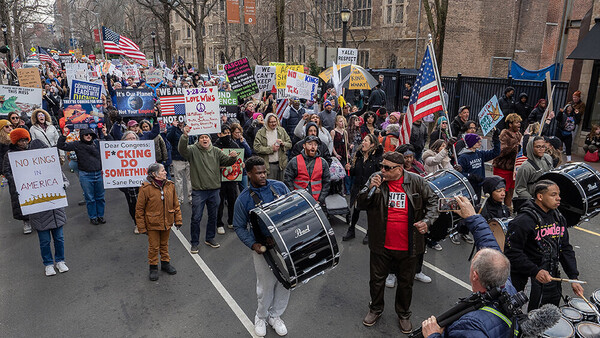
I've been covering protests for a long time, as a journalist and journalism professor, and one of the things I've noticed is that, at least in the Trump era of the last decade, more people are showing up with cameras to photograph these happenings than before. I've been trying to parse out why that is.
At a recent "No Kings" protest held in New Haven, Connecticut, last month (pictured above), and at many of the recent "No Kings," "Hands Off Democracy," and other similar protests, there's been an abundance of photographers with professional equipment — more than I saw in the past covering things like Occupy Wall Street or even Black Lives Matter.
It would be easy to say that it's 2026 and more people have digital cameras than ever before, but that doesn't account for the fact that the majority of digital cameras people would ostensibly use at these events are the kind that also make phone calls. It certainly can't be a proliferation of photojournalists; that group is the first to get the axe at almost any news outlet. And you can't chalk it up entirely to curious people with cameras.
Instead, I'll offer this: the act of photographing a protest can be an act of protest in and of itself.
I've often made the high-minded argument that by pointing my camera at protestors, I'm committing the journalistic act of creating the first draft of history. But one could argue that, in some way, showing up with a camera aligns me with the ideals of whatever I'm photographing.
The two concepts are not mutually exclusive.
For all that journalists attempt to feign objectivity, the truth is that we're also living in a politically charged moment, which makes photographing acts of resistance feel both cathartic and important to many of the people doing it. It was easier to make the argument for pure objectivity when objectivity didn't feel, to some, like tacit endorsement of policies they find hard to stand behind. To quote a letter from the journalists of The Philadelphia Inquirer, who staged a mass sick-out in 2020 over the newspaper's "Buildings Matter, Too" op-ed headline that ran after the murder of George Floyd: "We're tired of being told to show both sides of issues there are no two sides of."
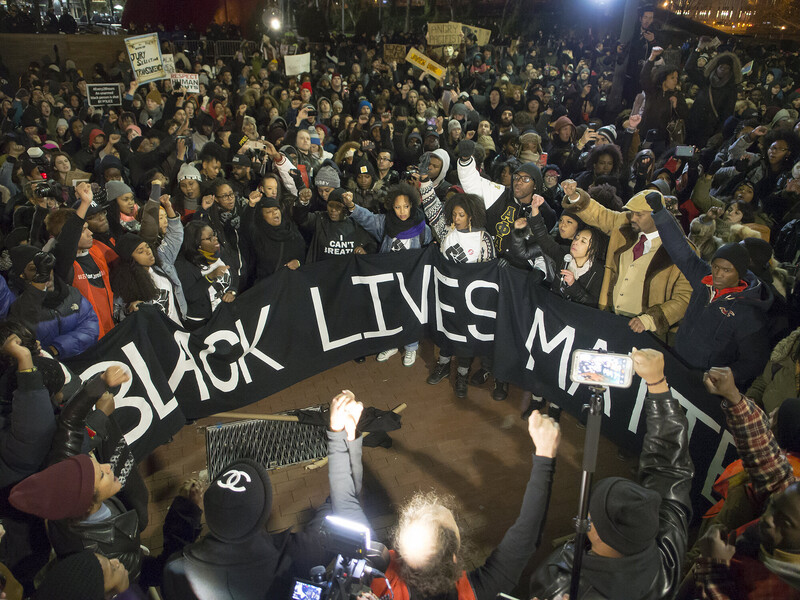
Maybe it's a lot to pick up a sign and carry it in the streets. Maybe it's not enough. Maybe it's safer to wield a camera than cardboard. Maybe the camera is a form of armor or anonymity. Maybe it's the tool that opens the doors for greater access. Maybe it's all of these things.
For me, it's about bearing witness to history and making sure that the first draft of it is photographed by people who are just trying to tell the truth in a moment overrun by AI slop and genuine disinformation.
Whatever the case, in the absence of photojournalists, movements need chroniclers of the visual kind. The person holding the sign would not get their message to the world if not for the person photographing it.
6 Comments
Why are more people showing up to "protests"with cameras? That's easy. Everybody has one in their phones and they require no technical skills. Second, social media has exploded and everybody thinks they'll be famous. There are other reasons too, of course. But we have a perfect storm of the ever present camera, the easy proximity to social media so they can get the images published, and a lot of aggrieved people that think they are owed something that someone else has. It wouldn't matter who the president is, or isn't.
A lot of aggrieved people think they are owed something because, yes, we are owed honesty, integrity, stability, respect for institutions, and if not asking too much, a reasonable degree of intelligence and good judgment from our government. And, yes, it does matter who the president is, or isn't, because the one we have now has failed miserably at almost every facet of human character, made incredibly poor decisions, and placed himself above the law and best interests of the country. As the country crumbles and Congress dithers, we'd better protest.
Please keep your political commentary to yourself. This is not a political commentary site or page.
You wrote: "... a lot of aggrieved people that think they are owed something that someone else has. It wouldn't matter who the president is, or isn't."
That's not exactly photography. If you're going to make that sort of comment, you should expect a political response. There is so much innuendo in what you said that I could have written a book in response. Really, Nathan, who are the people you're talking about, and what is it they think they are owed? Oh, and please tell me how your answer relates to photography.
Photography is politics and politics is photography. Photography has changed the course of history, turned the tide of wars and, in the current climate, shone a light on a population that isn't being heard.
"Photography has changed the course of history,..." What a fascinating idea. You should write an article about that. A book would be better.