Switching camera systems is one of the most nerve-wracking decisions you can make as a serious photographer. After 15 months of real-world testing, one photographer's bold move from medium format to full frame reveals surprising insights about what actually matters in the field.
Coming to you from Mark Denney, this honest video breaks down his complete experience switching from medium format to the Nikon Z8. Denney doesn't hold back about his initial concerns and whether the switch proved worthwhile after shooting in extreme conditions across multiple continents. His main motivation wasn't image quality; it was the limited telephoto options and constant focus stacking required with the medium format system. The GFX100S forced him into focus stacking scenarios he never expected, even with subjects just eight feet away. What started as frustration with lens limitations turned into a complete system overhaul.
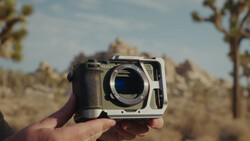
The Z8's sensor shield immediately caught Denney's attention. Unlike traditional mechanical shutters that close when powered down, the Z8's electronic shutter system uses a dedicated sensor shield for protection. This seemingly small feature completely changed how he approaches lens changes in dusty, sandy, or wet conditions. Denney also discovers unexpected advantages in highlight recovery and high ISO performance that he wasn't anticipating. The camera's ability to shoot at ISO 32 opens up creative possibilities for longer exposures without neutral density filters.
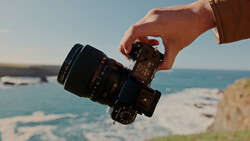
His three-lens setup covers an impressive range from 14mm to 400mm, with the 24-120mm f/4 S becoming his unexpected favorite.
Key Specs
- 45.7-megapixel effective resolution from a full frame CMOS sensor
- 5-axis sensor-shift stabilization
- Native ISO range from 64 to 25,600 (extendable to 32-102,400)
- Electronic shutter enabling up to 30 fps continuous shooting
- Internal recording supporting formats up to 8K at various frame rates
- CFexpress Type B/XQD and SD card slots
- Weather-sealed magnesium alloy construction
Denney found the faster shooting speeds particularly valuable for wildlife photography, something he rarely attempted with the slower medium format system. The reduced need for focus stacking with the full frame sensor proved to be as significant as he hoped.
Weather-sealing performance exceeded expectations across harsh conditions in Norway, Patagonia, and the Smoky Mountains. Denney's only real miss from the GFX system is the extreme cropping capability that comes with 102 megapixels, though he admits this hasn't been as limiting as expected. His experience suggests that practical shooting considerations often outweigh pure image quality specifications when choosing between systems. Check out the video above for the full rundown from Denney.


Join the Fstoppers community for free
-
Post comments and join in the discussions
-
Browse the site ad-free
-
Share your work and get featured in the community
-
Compete in the photo contests for fun and prizes
8 Comments
Nerve racking???? Really??? I use both a Nikon Z8 and the Fuji GFX 100s, and while they work differently, it's not a big deal going back and forth. FWIW, I'm not interested in anything that "self-proclaimed" expert says.
Don't fall for it, the Industry will always have new products because they "sell" products. They love to get "influencers" to try and move product when consumers likely already have what they need, so they "create" a demand/desire for what's new. Said the guy that's freelanced for over thirty years and still shooting with older Canon DSLR's, Profoto Pro and Acute gear.
I think you need both formats unfortunaetly they are used for many of the same but some different solutions. Fact is most photographers try to make a selection of one camera system based on unique features that will never be comparable.
A large square sensor if ever produced in the future would be my preference of choice.
One could invest in a complete system by selecting system requirements based on the job and what is
the expected delivered media to the client or for what end use.
Some will still choose an APC format to shoot a video and be happy with the results
Thomas Heaton went from full frame to medium format and back again because of the limited telephoto options for medium format. He then got gifted a Hasselblad x2D and now shoots both depending on his requirements.
They only thing is, how to get a free Hasselblad
There is a photographer who once said he doesn't like EVF's and prefers an optical viewfinder. Some time ago he became a Fujifilm ambassador and now just talks positively about every camera he gets given to try out and seems to like EVF's now too. Not a complaint as he can do what he likes but sometimes successful Youtubers do get advantages others don't and I guess they need to show this appreciation in their videos.
Thomas Heaton had a trial version of a X1D he liked but had to give back and the cvf 100 he didn’t like.
He also shoots 501 and XPan Hasselblad he bought himself before he got gifted the x2D . So I guess he really likes Hasselblad and is not just saying it because of the free earth explorer kit.
Brand ambassadors who test cameras, I take their reviews with a heap of salt.
Agree with you and Peter Mckinnon is the classic example of this.
The thing that always frustrated me when I first took up photography in high school 40 years ago was resolution, or lack thereof. I dealt with it by keeping things very simple with prime lenses and slow slide film. K64 and Velvia or Provia 100 with a Minolta X300 and the 28 and 135 f3.5 lenses along with the 50/1.7. Fast forward and I am now set up around the Nikon Z8, and it is effectively, at least to me, like merging 35mm and medium format, around a camera that deals with the other thing I didn't like about SLRs, the shutter noise. I love it. I've been on Nikon sine the early 1990s; the immediate reason was getting more control over exposure with shutter speeds with the faster flash sync and 1/8000th top speed, but being able to shoot silently and on lenses that max out a 45mp sensor is quite something.
Never did get a true medium format camera in the end!
If there's one thing I'd like in the current system it would be enabling the 1.2x crop that the DSLRs in Nikon have. Not sure why they have so far skipped that in mirrorless; it would be helpful for workflow and it's nothing more than a firmware switch, I would have thought. You don't often need 45mp, not even for a recovering Kodachrome addict like me, and it would be nice just to be able to switch that on, it's 31 megapixels and change, when a smaller file and a modestly narrower angle of view are both called for.