The Canon EOS R6 Mark III mirrorless camera has been pushed through real-world testing, from heavy rain to fast-moving wildlife, to see if it can handle serious field work. It’s built for speed and precision, and that’s exactly what matters when you’re tracking unpredictable action and can’t afford to miss a shot.
Coming to you from Jan Wegener, this field-tested video puts the Canon EOS R6 Mark III mirrorless camera through heavy rain, backyard takeoff tests, and beach hunts to see where it excels and where it flinches. The headline change is speed you can actually use, not just on a spec sheet. Pre-capture in raw saves the moment before you fully press the shutter, which matters when a subject launches from nowhere. The buffer is deep thanks to CFexpress Type B, so you can rip 40 fps sequences without the camera sulking mid-action.
Wegener also digs into ergonomics that help and a few that don’t. The photo/video switch sits out of reach when cradling long glass, which slows you down when a scene flips from stills to clips. The EVF resolution is fine, but you don’t get blackout-free bursts, so tracking very fast motion feels different, especially when pre-capture shows image loops rather than live view. None of that killed the shots in the video, but it changes how you time your pans and half-press holds.
The camera’s 32.5 MP sensor provides clean detail and allows for more cropping flexibility compared to lower-resolution models. In challenging light, autofocus still performs consistently, locking onto small, fast subjects even at high ISO levels. Noise handling remains strong up to ISO 12,800, and Wegener’s tests with dark-feathered birds show impressive shadow detail and texture retention. Even when paired with long telephotos and extenders, autofocus speed stays snappy, with good sharpness across frames.
Key Specs
-
32.5 MP effective full frame CMOS sensor
-
Sensor-shift, 5-axis stabilization
-
Up to 40 fps electronic, 12 fps mechanical/electronic first curtain
-
Photo ISO: 100–51,200 native (50–102,400 extended)
-
Video ISO: 100–25,600 native (100–102,400 extended)
-
Internal recording options up to 6960 × 4640 12-bit raw and H.265/XF-HEVC 10-bit, plus 4K up to 120 fps
-
4:2:2/ProRes RAW 10-bit via full-size HDMI output
-
Dual card slots: CFexpress Type B and SD UHS-II
-
Articulating 3" touchscreen LCD and 0.5" OLED EVF (3.69M dots, 0.76x)
-
Wi-Fi 5 and Bluetooth 5.0, USB-C (USB 3.2 Gen 2) data and power
-
LP-E6P battery rated around 620 shots, BG-R20 grip support
-
5.4 × 3.9 × 3.5 in, 1.3 lbs body only
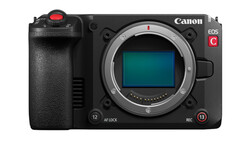
Video features look strong if you shoot clips between bursts. You get 4K 120 without crop and 7K open gate with raw options that pair well with Canon Log 2 and 3. The body can overheat if you roll many 4K 60p oversampled takes back to back on a warm day. Opening the rear screen helps a bit, but if continuous high-rate video is your main thing, a cooled body like the EOS C50 makes more sense for long sessions.
The action sequences tell the story better than bullet points. With 40 fps and raw pre-capture enabled, Wegener nails claw-spread dives and splash moments that often fall between frames at 20–30 fps. Rolling shutter shows up with certain angles and very fast motion, as expected for a non-stacked sensor, yet larger subjects at distance looked clean enough that the electronic shutter remained usable for the speed.
If you run long glass, the pairing choices in the video are familiar. A sharp tele zoom like the Canon RF 100-500mm f/4.5-7.1L IS USM keeps weight manageable on hikes, while a big prime such as the Canon RF 600mm f/4L IS USM with the Extender RF 2x lets you stack reach when behavior kicks off far out. Plan on LP-E6P spares, and if you like vertical controls, the BG-R20 grip keeps balance tidy with heavier lenses.
You’ll see where the buffer actually taps out, how pre-capture behaves when the cache locks until cleared, and why assigning that feature to the multi-function button speeds things up in the field. Check out the video above for the full rundown from Wegener.



Join the Fstoppers community for free
-
Post comments and join in the discussions
-
Browse the site ad-free
-
Share your work and get featured in the community
-
Compete in the photo contests for fun and prizes
No comments yet