
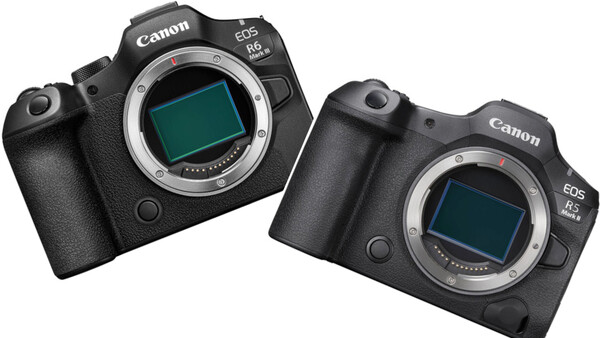
Canon has given us two mirrorless cameras that, on paper, seem to occupy different tiers. The EOS R5 Mark II is the technical marvel, the headline grabber, the 8K cinema monster built for those who need the absolute maximum in resolution and cutting-edge technology. But here's what the spec sheets won't tell you: for the vast majority of working professionals and serious hybrid creators, the EOS R6 Mark III isn't just the budget option. It's actually the smarter, more practical, and more efficient choice.
At $2,799 versus the R5 Mark II's $3,899 sale price (down from $4,399), the R6 Mark III saves you $1,100 (or $1,600) at full price. That's enough for a professional lens. But the real story isn't about saving money; it's about getting a camera that's actually smarter in key areas and delivers a more manageable workflow for real-world shooting.
The Technical Foundation: Understanding the Sensor Differences
Before diving into real-world implications, let's understand what we're actually comparing. The R5 Mark II features a 45 MP sensor that delivers images through a stacked, back-side illuminated (BSI) CMOS design. The R6 Mark III uses a 32.5 MP sensor through a standard CMOS architecture.
That stacked BSI design in the R5 Mark II is exotic technology. It places the circuitry behind the photodiodes rather than beside them, allowing more light gathering area per pixel. The "stacked" element adds a high-speed processing layer that dramatically accelerates data readout. This isn't just marketing; it's a fundamental architectural difference that costs Canon significantly more to manufacture.
Resolution: The Sweet Spot Versus the Storage Nightmare
Let's address the elephant in the room with actual numbers. The R5 Mark II's 45 effective megapixels create raw files averaging 50 MB each. The R6 Mark III's 32.5 MP sensor produces files around 35 MB. That might not sound dramatic until you do the math on a typical wedding with 3,000 images. We're talking 150 GB versus 100 GB just for single card backup. Add a second shooter, and you're looking at managing over 300 GB of data from one event with the R5 Mark II.
- Import and Backup: Transferring files takes longer, meaning more time before you can begin editing your images.
- Processing Power: AI-powered tools like DxO DeepPRIME or Lightroom's AI masking analyze every pixel. Masking operations on 45 MP files take roughly 40% longer than 32MP equivalents. Multiply that across hundreds of images, and you've added hours to your workflow.
- Storage Economics: The R5 Mark II will fill your storage faster than the R6 Mark III. Over a camera's typical 3-year upgrade cycle, that difference compounds significantly.
The 32.5 MP sweet spot isn't arbitrary. It exceeds the resolution requirements for double-page magazine spreads (300 DPI at 16x20 inches needs just 28 MP), provides ample cropping headroom, and delivers files that modern hardware handles efficiently.
The Speed Paradox: More Frames Versus Better Frames
This is where things get interesting and where Canon's marketing doesn't tell the whole story. The R6 Mark III shoots at 40 frames per second. The R5 Mark II tops out at 30 fps. Case closed, right? Not quite.
- First, rolling shutter becomes nearly invisible. If you've ever photographed a golf swing or helicopter blades with a conventional sensor, you know the weird distortion that can occur. The R5 Mark II's stacked sensor essentially eliminates this problem with much faster readout speeds.
- Second, the faster readout enables a maximum electronic shutter speed of 1/32,000 second on the R5 Mark II versus 1/16,000 on the R6 Mark III. This isn't just a spec sheet victory. It means shooting wide open with f/1.2 glass at ISO 100 in broad daylight without ND filters. For portrait photographers who live at f/1.2, this is genuinely useful. The R6 Mark III would require either stopping down or adding an ND filter in the same conditions.
- Third, the stacked sensor design allows for cleaner, more consistent data readout at high frame rates. While both cameras offer impressive burst speeds, the R5 Mark II's stacked sensor architecture provides inherently better data integrity during rapid capture sequences. That means 14-bit files at 30 fps on the EOS R5 Mark II versus 12-bit files at 40 fps on the EOS R6 Mark III.
Autofocus: Nearly Identical, With One Key Difference
Both cameras feature Canon's Dual Pixel CMOS AF II system with 1053 AF points in photo mode. Both offer the same subject detection capabilities including people, animals, vehicles, and both feature Register People Priority for remembering specific faces.
The R5 Mark II includes Eye Control AF, allowing you to move the focus point just by looking at it through the viewfinder. This feature is notably absent from the R6 Mark III's specifications. For photographers who've mastered this feature, it can speed up focus point selection significantly, particularly in portrait work.
The R5 Mark II also has a slight edge in low-light AF sensitivity at -7.5 EV versus the R6 Mark III's -6.5 EV. This one-stop difference means the R5 Mark II can autofocus in slightly darker conditions, though both cameras will handle even the dimmest wedding receptions without issue.
What's more interesting is what's the same: both cameras now feature the same advanced subject tracking algorithms, the same AI-powered subject recognition, and the same customizable AF area modes. Canon hasn't hobbled the R6 Mark III's AF system to protect the R5 Mark II, which is refreshing.
Video: The Practical Creator Versus the Cinema Specialist
The video specifications reveal two fundamentally different philosophies. The R5 Mark II is built for productions where post-production flexibility trumps everything else. The R6 Mark III is designed for creators who need to deliver quickly without sacrificing quality.
The R5 Mark II's Cinema Credentials
- 8K 60p raw internal recording
- 4K 120p with full sensor readout (no crop)
- DCI formats throughout (true cinema aspect ratios)
- Raw video file sizes approaching 5.5 GB per minute at 8K 60p
The R6 Mark III's Hybrid Approach
- 7K 60p 12-bit RAW Light internal
- Open Gate 7K 30p
- 4K 120p DCI and UHD formats
- 180 fps at 1080p for extreme slow motion
- Raw recording at 970 to 2600 Mb/s bitrates
Let's talk about that Open Gate recording on the R6 Mark III. This uses the entire sensor area, capturing more vertical resolution than standard video formats. In post, you can extract both a 16:9 horizontal video for YouTube and a 9:16 vertical for Instagram Reels or TikTok, all from the same take with no quality loss. For content creators juggling multiple platforms, this feature alone might justify choosing the R6 Mark III.
The R5 Mark II's 8K sounds impressive until you consider the complete workflow. A 128 GB CFexpress card holds roughly 23 minutes of 8K 60p RAW footage. A single hour-long interview would require three cards costing $400 each. Editing that footage requires a workstation with minimum 64 GB RAM, a high-end GPU, and fast NVMe drives in RAID. We're talking about a $5,000+ computer just to scrub through footage smoothly.
The R6 Mark III's 7K RAW Light is the sweet spot Canon discovered. It provides nearly all the post-production flexibility of raw (white balance, exposure adjustment, color grading) with file sizes that standard hardware can manage. That same 128 GB card holds about an hour of 7K footage, and you can edit it on a decent laptop with 32 GB RAM.
Both cameras offer Canon Log 2, Canon Log 3, and HDR-PQ (Perceptual Quantizer) support according to their specifications. The R5 Mark II additionally lists HDR-HLG and Rec2020 gamma curves. In practice, CLog3 provides extensive dynamic range for professional color grading on both cameras.
The Professional Body Experience
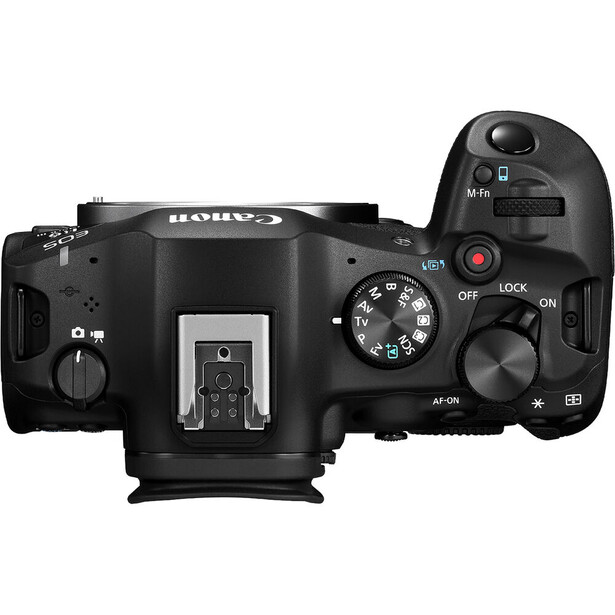
- Viewfinder Technology: The R5 Mark II's 5.76 million dot OLED viewfinder beats the R6 Mark III's 3.69 million dots. The higher resolution EVF provides better detail and more accurate manual focus confirmation. When you're focusing a fast prime wide open, those extra pixels help you nail critical focus on eyelashes rather than eyebrows.
- Top LCD Panel: The R5 Mark II includes a top status display, that monochrome LCD that shows exposure settings, battery life, and shots remaining. Old school? Maybe. But it's invaluable when the camera is on a tripod above your head, mounted on a gimbal, or simply when you want to check settings without powering up the main display and destroying your night vision. The R6 Mark III omits this, requiring you to wake the rear LCD or look through the viewfinder for the same information.
- Connectivity and Studio Features:
- R5 Mark II: PC flash sync port, Canon N3 remote port, HDMI output
- R6 Mark III: 2.5mm remote port, HDMI output
- The PC sync port matters for studio photographers using older strobe systems or those who need redundant triggering methods. The N3 port accepts Canon's professional cable releases and intervalometers. These aren't deal-breakers for most shooters, but they matter in commercial environments where compatibility with existing equipment is crucial.
What $1,100 ($1,600) Actually Buys
Consider what that $1,100 price difference could add to your kit, each option potentially having more impact on your work than the spec differences between these bodies. That's the price of a professional lens, a nice flash setup, or even a decent backup camera should you need one.
Real-World Shooting Scenarios
Let's examine how these cameras perform in actual professional situations:
- Wedding Photography: The R6 Mark III wins for most. Its superior battery life means fewer battery changes during critical moments. The 40 fps burst ensures you never miss the ring exchange or first kiss. The smaller files mean faster backup to dual cards and quicker turnaround for client previews. You might miss the top LCD or better burst bit depth, though.
- Sports and Wildlife: Split decision. The R6 Mark III's 40 fps gives more chances to capture peak action, crucial for unpredictable subjects. However, the R5 Mark II's higher resolution provides more cropping flexibility when you can't get close enough, and the minimal rolling shutter is vital for fast-moving subjects. Golf, motorsports, and bird-in-flight photographers should lean toward the R5 Mark II. You might miss the better burst bit depth, though.
- Studio and Commercial: The R5 Mark II edges ahead. The resolution advantage matters when clients need maximum detail for product shots or fashion campaigns. The PC sync port and top LCD are genuinely useful in studio environments. The superior viewfinder helps with critical manual focus when shooting with studio strobes.
- Documentary and Journalism: The R6 Mark III takes it. Smaller files mean more shots per card, crucial in situations where you can't stop to swap media. Better battery life extends shooting in remote locations. The practical video specs allow quick turnaround for web delivery without overwhelming post-production.
- Content Creation and YouTube: The R6 Mark III by a mile. Open Gate recording for multi-platform delivery, manageable file sizes for quick editing, and that $1,100 saved can go toward lighting, audio, or a second camera for multicam setups. The 7K provides plenty of resolution for reframing in post while keeping render times reasonable.
- Landscape and Architecture: The R5 Mark II but barely. The resolution advantage helps with large prints and provides more flexibility for perspective corrections. However, the R6 Mark III's 32.5MP is more than adequate for most landscape work, and the saved money could buy quality filters or a tilt-shift lens that would have more impact on architectural photography.
The Bottom Line
The Canon EOS R6 Mark III is not a compromise; it's an optimization. It takes everything most professionals actually need, packages it in a body that runs cooler, shoots faster (in fps terms), delivers longer battery life, and produces files that won't destroy your workflow. At $2,799, it's positioned perfectly for the working pro who values efficiency over specifications supremacy.
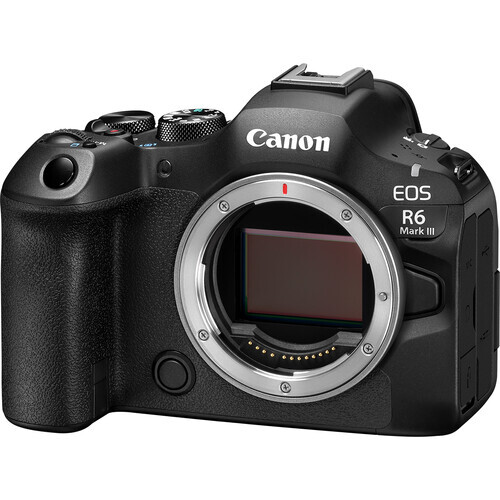
For wedding photographers battling changing light and unpredictable moments, the R6 Mark III's speed and efficiency win. For event shooters who need all-day endurance, the R6 Mark III's battery life and thermal management are decisive. For photojournalists on deadline, the R6 Mark III's smaller files and faster workflow are crucial. For content creators juggling multiple platforms, the R6 Mark III's Open Gate recording and manageable data rates are fantastic.
- You need maximum resolution for specific client requirements
- You're delivering cinema-quality productions
- You can afford not just the camera but the entire ecosystem upgrade it demands
- Rolling shutter elimination is critical for your subjects
- You're already equipped to handle 45MP+ raw workflows efficiently
- You value operational speed and efficiency
- You shoot high volumes of images regularly
- You need all-day shooting endurance
- You want professional capability without workflow penalties
- That $1,100 could improve other aspects of your kit
- You're building a sustainable, profitable photography business
Canon has given us two excellent cameras that serve different purposes. The R5 Mark II serves the god of specifications, pushing boundaries and enabling edge cases. The R6 Mark III serves the god of efficiency, delivering professional results without professional headaches.
For most of us making a living with our cameras, efficiency beats specifications. The Canon EOS R6 Mark III understands this truth. It's not just the smart choice for your wallet; it's the smart choice for your workflow, your clients, and your sanity. In a world obsessed with bigger numbers, sometimes the winning move is knowing when enough is exactly right.



Join the Fstoppers community for free
-
Post comments and join in the discussions
-
Browse the site ad-free
-
Share your work and get featured in the community
-
Compete in the photo contests for fun and prizes
16 Comments
The fact that peoples requirements are so wide and varied, claiming this camera 'is the best choice for most photographers' is a huge sweeping statement.
The problem with the R6 is the number 6 in its name. That ain't good. 666, the number of the beast, the ruler of the earth, also known as satan, the devil, the deceiver, etc. Or, maybe that's just what they want us to think!!!
US Highway 666 (changed in 2003 to Hwy 491) was known for a disproportional number of fatalities. Of course, alcohol and speeding may have had something to do with that, but nevertheless the highway number was thought to be a curse. Renaming and road improvements led to a reduction in accidents.
Maybe it is a beast of camera…..
Third-party lenses.
Yes, maybe its time to let some lens on Canon from the 3rd party. Well, they are already for RF-S... so... but I guess FF too then. If people want Canon anyway, they usually buy it anyway.
I moved from Canon 12 years ago to Micro Four Thirds, then 5 years ago to Sony FE. My lens arsenal now comprises 1 Sony zoom, 1 Samyang zoom, 1 Viltrox prime, 2 Tamron zooms, and 8 Samyang primes, and I use all of these regularly for event work.
It's unclear whether there are any third-party lenses available for Canon full-frame mirrorless cameras. Don't speculate.
I usually don’t like tech talk. Nevertheless, this was excellent….,
I finally did it. After two decades of photography thinking Canon camera names were stupid, I asked Google: 'What does EOS mean?"
Here was its reply:
"EOS stands for Electro Optical System. It is probably no coincidence that Eos is the name of the Greek goddess of the dawn. The name has continued through several evolutions of camera design. The first EOS cameras were film, with the advent of the first digital model in 1995."
I'll bet hardly anyone knew that. Now I need to go find the reason for Mark and III. Why they could not just stick to one word or letter and a number is a mystery. I suppose it all sounds royally impressive. Something with the name Mark III surely must take better pictures than Nikon or Sony. Sounds kind of pretentious to me but what do I care... I've never owned a Canon camera.
I do own a Canon inkjet printer though and it is the best. Of course it can't just be a Canon 4100 printer; it has to be a Canon imagePROGRAF Pro-4100 printer. I felt like I was paying for the length of the name instead of the size of the printer.
I'm surprised at the the glowing discussion of a 32.5 megapixel mid-level camera, when 24 megapixels is way more than you need anyway (as said by many). Also, the trend of judging the quality and value of cameras based on it's hybrid video capabilities is becoming disturbing. Is photography no longer important? When will Fstoppers publish videos of the day?
Also people judge cameras based on the specs, not real world needs. If one camera only does 4K crop, does it matter if all you are doing is simple YouTube videos? If I was serious about video and planned on making money from it, I'd invest in a dedicated video camera alongside a decent stills camera.
I own an A7C II that is perfect for my photography but the way lots of reviews and opinions are, they berate this camera for it's somewhat lacking hybrid capabilities. I only own a hybrid because there are so few affordable stills only options, other than looking at older secondhand cameras.
A colleague, a very capable wedding shooter for whom I've been second shooter several times, uses Canon and Profoto and has asked me more than once how I like my Sony and Godox/Flashpoint gear. Guess it's not all roses on his side of the fence. Or maybe he just doesn't like the thorns.
Leopold Bloom - What's your beef? All I did was tell a true story.
For all those who argued that 24 MP was enough, the Canon R6 MKIII isn't ideal because it already has 32 MP. So, that's too much. Nobody needs that much. Hehehe
Get A Canon 90D & R62 and then go to sleep.