
Every lens catalog has a flagship tier. These are the lenses that dominate reviews, anchor marketing campaigns, and justify the system's reputation: the Canon RF 24-70mm f/2.8 L, the Sony FE 70-200mm f/2.8 GM II, the Nikon Z 50mm f/1.2 S. They deserve the attention. They are genuinely excellent. And they are not the lenses that most photographers would benefit from buying next.
Below the flagship tier, in the corners of the catalog where the marketing budget does not reach and the review cycles rarely visit, there are lenses that are small, inexpensive, optically interesting, and disproportionately useful relative to what they cost. They do not generate headlines. They do not win awards. But they produce photographs, quietly and constantly, in the hands of photographers who discovered them by accident or recommendation and never took them off the camera.
Here is one per system.
Canon RF: The RF 16mm f/2.8 STM
The Canon RF 16mm f/2.8 STM gives Canon RF shooters access to an entire focal length category for roughly $260. Before this lens, native ultra-wide options on Canon RF were expensive: the RF 14-35mm f/4 L IS USM at $1,700, the RF 15-35mm f/2.8 L IS USM at $2,400, a Samyang AF 14mm f/2.8 RF at roughly $700, or a Laowa 14mm f/4 FF RL at roughly $550. The 16mm f/2.8 STM undercuts all of them substantially at roughly $260.
At 165 grams and approximately 40 mm in length, it is essentially a pancake. It uses a 43 mm filter thread, the smallest in the RF system. The STM autofocus motor is quiet and adequate for both stills and casual video. The build is plastic with a metal lens mount, and there is no weather-sealing. None of these specs would survive a comparison with the L-series ultra-wides on any axis except two: size and price. On those two axes, the 16mm f/2.8 is so far ahead that the comparison is not worth making.

The optical quality is honest rather than exceptional. Corner sharpness wide open is soft, improving significantly by f/5.6 to f/8. The lens relies heavily on in-camera digital corrections for distortion and vignetting, which means the corrected JPEG and Raw files look much better than the uncorrected optical output. For landscape photographers who shoot at f/8 to f/11 anyway, for vloggers who need a wide field of view in a tiny package, for architecture and interior photographers who want an ultra-wide option they can throw in a jacket pocket, and for astrophotographers who need f/2.8 at 16mm without spending $2,000, the RF 16mm f/2.8 does the job at a price that makes the decision trivial.
Nikon Z: The Z 40mm f/2
The Nikon Z 40mm f/2 is perpetually overshadowed by its more expensive siblings: the Nikon Z 50mm f/1.8 S and the Nikon Z 50mm f/1.4. Both of those lenses are optically superior. Neither of them transforms the shooting experience the way the Z 40mm f/2 does.
At 170 grams and 45.5 mm in length, the Z 40mm f/2 turns any Nikon Z body into a compact camera. Mounted on a Zf, the combination weighs under a kilogram and fits in a messenger bag or a large coat pocket. On a Z50 II or Zfc, it creates a package small enough to carry everywhere and unobtrusive enough to use in situations where a larger camera draws unwanted attention. The 40mm focal length on full frame (60mm equivalent on DX) is slightly wider than a traditional 50mm normal, which gives just enough environmental context for street photography and everyday documentation without the distortion of a true wide angle.
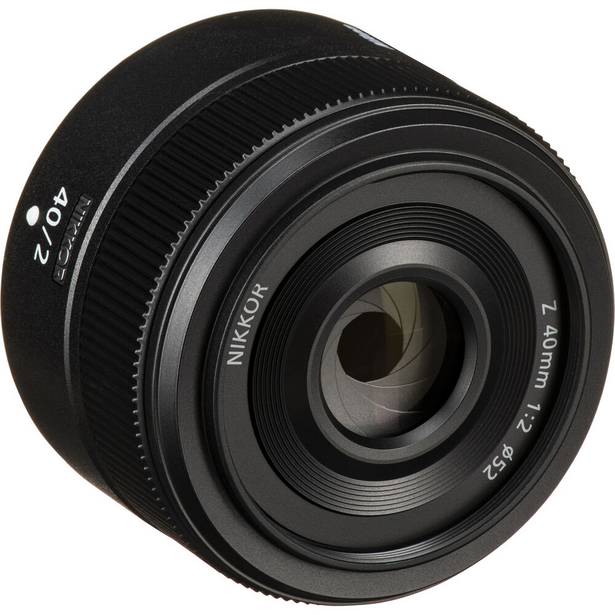
The lens costs roughly $300. It uses a 52 mm filter thread and a stepping motor for quiet autofocus. The minimum focus distance of 0.29 meters allows for casual close-ups of food, products, and tabletop subjects. The nine-blade rounded diaphragm produces pleasant background blur at f/2. It is not an S-line lens, and pixel-level sharpness does not match the Z 50mm f/1.8 S, particularly in the corners wide open. For the vast majority of output (social media, web, moderate prints), the difference is invisible. The weight and price difference is not.
Sony E: The FE 20mm f/1.8 G
The Sony FE 20mm f/1.8 G is the odd entry on this list because it is not cheap. At roughly $900, it is one of the most expensive lenses here. It earns its place because it is overlooked, and it is overlooked because 20mm is a focal length most photographers do not think to buy as a prime.
That is their loss. The FE 20mm f/1.8 G is one of the most versatile wide primes ever made for any system. At 373 grams and 85 mm in length, it is smaller than most 24mm or 28mm primes. The f/1.8 aperture at 20mm produces the seemingly contradictory combination of an extremely wide field of view with genuine background separation, which is unusual and visually distinctive. The close-focusing ability (0.18 meters in manual focus, producing 0.22x magnification) means the lens can shoot environmental portraits, broad landscapes, tight interiors, and near-macro close-ups of small subjects with exaggerated wide angle perspective, all without a lens change.
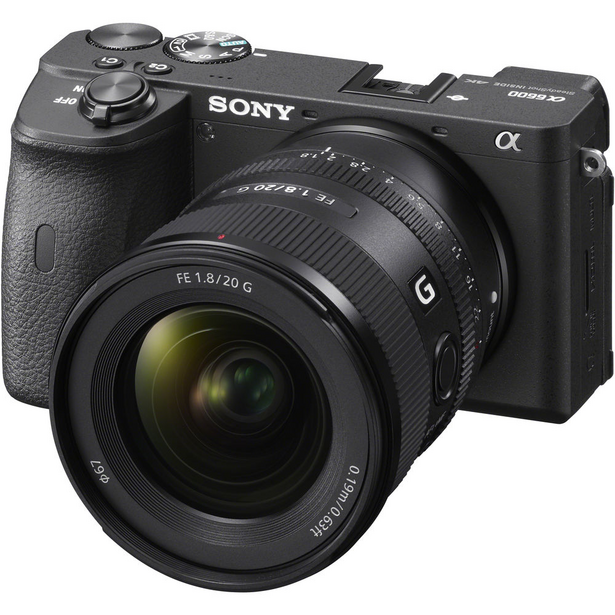
For astrophotography, the combination of 20mm, f/1.8, and minimal coma and astigmatism at the edges makes it one of the strongest Milky Way lenses on any mount. The dual XD linear motors focus fast enough for tracking, the de-clickable aperture ring serves videographers, and the focus hold button can be remapped to any function the photographer needs. The FE 20mm f/1.8 G is not a secret to the photographers who own it. It is a secret to everyone who has not tried one yet.
Fujifilm X: The XF 27mm f/2.8 R WR
The Fujifilm XF 27mm f/2.8 R WR is so thin that the camera looks like it has no lens attached. At 84 grams and 23 mm in length (less than one inch), it is the most compact lens in the Fujifilm X-mount system by a wide margin and one of the thinnest interchangeable lenses on any current mirrorless mount. Mounted on an X-E5, the combination is a genuine pocket camera. Mounted on an X-T5, it disappears into the body's profile.
The 27mm focal length on Fujifilm's APS-C sensor produces a 41mm equivalent field of view, which sits in the gap between the classic 35mm (the XF 23mm f/2 R WR) and the classic 50mm (the XF 35mm f/2 R WR). That in-between perspective is closer to what the human eye sees than either the 35mm or the 50mm, and for everyday documentation, street photography, and casual portraiture, it covers an enormous range of situations without feeling too wide or too tight. Fujifilm describes the 27mm as covering "the field of view of the human eye," which is a slight marketing simplification but directionally correct.
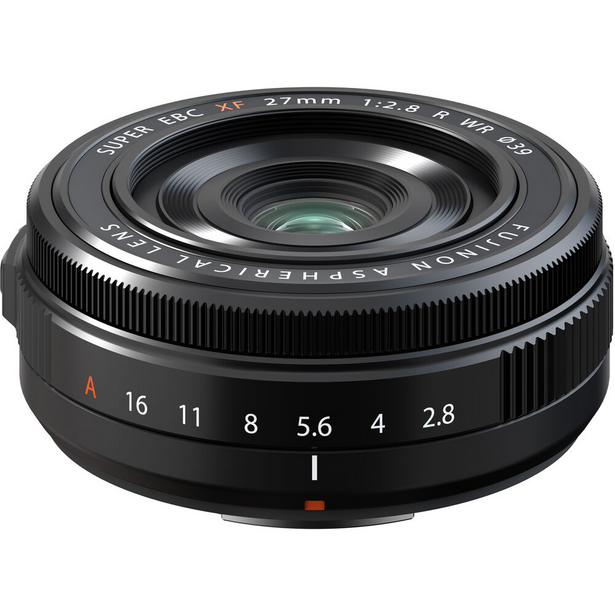
The Mark II version (R WR) adds weather-sealing at seven locations and a physical aperture ring with an A-position lock, matching the control philosophy of Fujifilm's X-series bodies. The optics are unchanged from the original 2013 design: 7 elements in 5 groups with one aspherical element. At roughly $400 to $450, it costs more than the Canon and Nikon entries on this list but delivers a shooting experience that no other Fujifilm lens replicates. The XF 23mm f/1.4 R LM WR is faster and sharper. The XF 35mm f/2 R WR is more traditional. Neither of them disappears into the camera the way the 27mm does, and for many Fujifilm shooters, that disappearance is the point.
Micro Four Thirds: The M.Zuiko Digital 45mm f/1.8
The M.Zuiko Digital 45mm f/1.8 has been in production since 2011, which in the camera industry might as well be the Paleozoic era. It has no weather-sealing. It has a plastic build. It has been available for so long and at such a low price (roughly $250 to $300) that most photographers who are not already in the Micro Four Thirds system have never given it a serious thought.
They should. On the Micro Four Thirds 2x crop sensor, the 45mm focal length produces a 90mm equivalent, which is one of the most flattering portrait perspectives available. The f/1.8 aperture, combined with the short subject distance of a 90mm-equivalent portrait lens, produces smooth background separation. The depth-of-field equivalent on full frame would be roughly f/3.6 due to the 2x crop factor, so it will not match the extreme blur of a full frame 85mm f/1.8, but at typical portrait distances the separation is more than sufficient to isolate a subject cleanly from a busy background. The MSC (Movie and Still Compatible) autofocus motor is fast, precise, and quiet. The optics are sharp wide open, with the kind of clean, neutral rendering that gets out of the way and lets the subject carry the image.
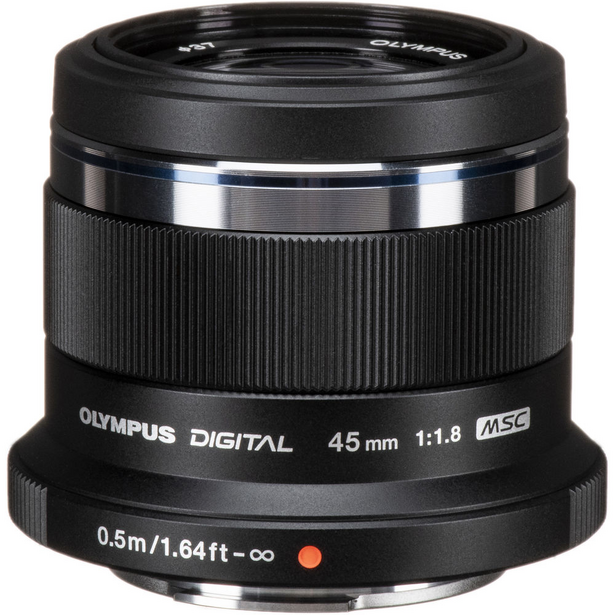
At 116 grams and with a 37 mm filter thread, the lens is so small that it adds almost nothing to the camera's size or weight. On an OM System OM-5 Mark II with IBIS, the combination produces stabilized 90mm-equivalent portraits handheld in dim conditions that would require a tripod on a larger system. For the price of a single dinner for two, you get a portrait lens that has been making beautiful images for over a decade and shows no sign of being replaced, because there is nothing wrong with it.
L-Mount: The Panasonic Lumix S 26mm f/8
The Panasonic Lumix S 26mm f/8 is the wildcard. It has a fixed aperture that cannot be changed. It has no autofocus. It cannot accept front filters or a front lens cap (it has a protective front element designed to stay exposed, with a rear cap included for storage). It is made almost entirely of plastic. It costs $200. And it is the most fun lens on this list.
At 58 grams and 18.1 mm in length, it is not so much a lens as a body cap that happens to contain optics. Panasonic designed it to match the Lumix S9, their compact full frame body, and the combination produces a pocketable full frame camera that weighs almost nothing and shoots 26mm at f/8 with an 80-degree field of view. The optical formula (5 elements in 5 groups, including one UED element) is simple and optimized for the one thing a fixed-f/8 lens can be optimized for: sharpness across the frame. The small fixed aperture eliminates most aberrations by brute force, because the light only passes through the center of each element where the glass is most uniform. Panasonic claims "high resolution from corner to corner," and the results bear that out at the sizes most photographers share.

The manual focus ring has a short throw. The minimum focus distance is roughly 0.25 meters. There is no autofocus to miss and no aperture to adjust beyond the fixed f/8. You point the camera, you focus, you press the shutter. The constraint is the entire point: when the lens cannot do everything, you stop worrying about optimization and start paying attention to the scene.
The Lumix S 26mm f/8 will not replace any lens in your bag. It will replace the body cap, which is the point. And the photographs it produces, when you stop thinking about what it cannot do and start thinking about what is in front of it, are the most honest images you will make all week.
Pentax K: The HD Pentax-DA 40mm f/2.8 Limited
The HD Pentax-DA 40mm f/2.8 Limited is 15 mm long. Fifteen millimeters. That is thinner than most camera body caps. Mounted on a Pentax K-1 Mark II or a KF, the lens barely protrudes from the body flange, producing a profile that looks less like a camera with a lens and more like a camera that someone forgot to put a lens on.
At 89 grams, the DA 40mm f/2.8 Limited is a machined aluminum pancake with the build quality that Pentax reserves for its Limited line: metal construction, HD multi-layer coating for flare resistance, SP (Super Protect) coating on the front element for fingerprint and dirt resistance, and a nine-blade rounded diaphragm. The 40mm focal length on Pentax's 1.5x APS-C crop produces a 60mm equivalent, which is a slightly tighter perspective than a traditional 50mm normal and naturally flattering for casual portraits and everyday shooting. The Quick-Shift Focus System allows instant manual focus override during autofocus without flipping a switch.
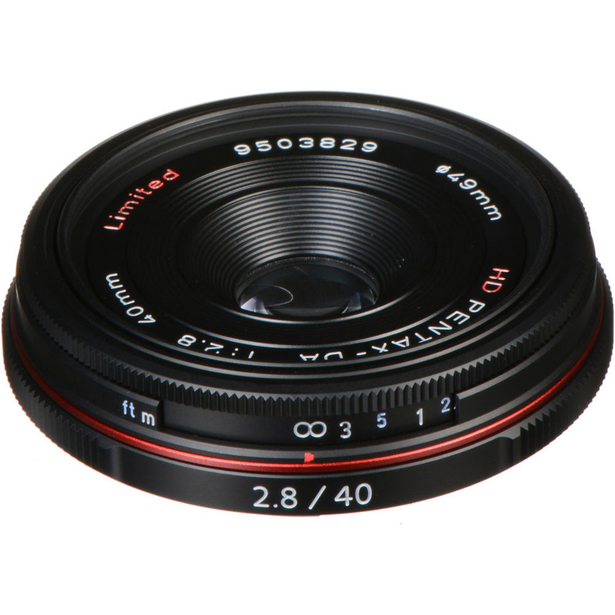
The DA 40mm f/2.8 Limited exists in a system that the broader photography press has largely stopped covering, which makes it doubly invisible: overlooked within Pentax's own catalog (where the DA 21mm, DA 35mm, DA 70mm, and FA 77mm Limited primes attract more attention) and overlooked by the industry at large (because Pentax K-mount is not where the review traffic goes). For photographers who shoot Pentax, the 40mm Limited is the lens that lives on the camera when no specific assignment demands something else. It costs roughly $400 to $450, produces sharp and characterful images from a body that adds almost nothing to the camera's dimensions, and embodies the philosophy that made the Pentax Limited line special in the first place: small, beautiful objects that prioritize the shooting experience over the spec sheet.
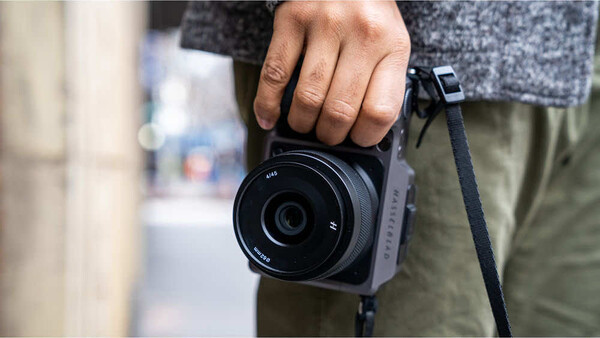
Hasselblad X: The XCD 4/45P
The Hasselblad XCD 4/45P is the least Hasselblad-feeling Hasselblad lens, and that is exactly why it belongs on this list. At 320 grams and 47 mm in length, it is one of the lightest and most compact autofocus lenses in any digital medium format system (the newer XCD 4/28P is lighter still at 245 grams). Hasselblad describes it as weighing "about the same as a professional hot-shoe flash," which is accurate and tells you everything about how it changes the handling of a system that is normally defined by its heft.
The 45mm focal length on Hasselblad's 44 x 33 mm sensor produces a 35mm equivalent field of view, which is one of the most versatile perspectives in photography: wide enough for environmental portraits and street work, tight enough for detail shots and intimate compositions. The f/4 maximum aperture is modest by full frame standards but produces an equivalent depth of field around f/3.2 on the larger sensor, which is sufficient for meaningful subject separation. The integral leaf shutter offers flash sync up to 1/2,000 s at any aperture, a capability that no full frame focal-plane-shutter system can match. The optical design (9 elements in 7 groups, 2 aspherical) focuses down to 35 cm with a maximum magnification of 1:5.2, which makes it usable for food, still life, and tabletop subjects in addition to general photography.

At roughly $1,100, the XCD 45P is the most affordable lens in the Hasselblad X system by a significant margin. Most XCD lenses cost $2,000 to $4,000. The 45P costs less than many full frame primes and delivers Hasselblad's medium format image quality, color depth, and tonal gradation in a package that makes the X2D or X1D II a viable street and travel camera rather than a studio-only tool. It is overlooked because Hasselblad shooters tend to buy the faster, more expensive lenses in the system, and because the broader photography community does not think of Hasselblad as a brand that makes compact, affordable glass. The XCD 45P is both, and it is the lens that makes the Hasselblad X system accessible to photographers who thought medium format meant heavy, slow, and expensive.
The Common Thread
What the lenses share is invisibility. Not one of them appears on a "best lenses" listicle. Not one of them generates forum arguments. Not one of them is the lens a salesperson recommends when you walk into a camera store. They exist in the quiet corners of each system's catalog, overshadowed by flagships that are bigger, faster, sharper, and more expensive.
And yet the photographers who own them reach for them more often than they expected, keep them longer than they planned, and recommend them with the specific enthusiasm of someone who found something good that nobody told them about. That is what a best-kept secret looks like: not hidden, just unnoticed. The lens was there all along. You just have to look past the flagships to find it.
If you are building your lens collection and want to understand how focal length, aperture, and lens selection shape the images you make, the Fstoppers Photography 101 tutorial covers those fundamentals in depth.


Join the Fstoppers community for free
-
Post comments and join in the discussions
-
Browse the site ad-free
-
Share your work and get featured in the community
-
Compete in the photo contests for fun and prizes
6 Comments
An informative and entertaining article. I have the Olympus 45mm but haven’t given it any attention for some time, I shall soon give it a try. Thanks.
I have an Olympus 45/1.8. It's about 10 years old now with some fungus. Left it out in the rain. Water droplets were visible behind the front element. Shook it out and let it dry in the sun. It left water marks inside but otherwise it works perfectly with no obvious image degradation. Nevertheless, as soon as (if) they bring out a weather resistant one, I'll snap it up. The lens is so small and light, perfect for portraits of kids. I don't use it that much but it always pleases.
Fujifilm also has a 23mm 2.8 pancake...
In place of the Olympus 45mm f1.8, I'd substitute Panasonic's 42.5mm f1.7. It's much less well known because it arrived years later. I had the Olympus, but if I were building an MFT kit today, I'd get the Panasonic just for the additional versatility of its unusually short MFD.
Fujifilm GFX - the kit lens...35-70 4.5 it's an absolutely phenomenal lens. I've actually shot a wedding with it as well no problems fast focusing sharp as a tac and very light!
Nikon’s wider counterpart to the 40mm f/2, the 28mm f/2.8, is also underrated. Similar optical qualities, a bit punchier on the colours.
Sony has a ton of underrated lenses. I think the 28mm f/2 is the most underrated lens on that system. No other manufacturer has a native mirrorless 28mm FF lens faster than that. And it’s very compact. The older 55mm f/1.8 is also relatively unique, and is lightweight & awesome. The older ZA primes like the 35mm 1.4 and 50mm 1.4 are also decent, with more character compared to the optically perfect GM primes.