
Film is having another moment. Thrift stores are lighter on old SLRs than they used to be; teenagers are loading rolls their grandparents forgot about; family closets keep surrendering shoeboxes that smell like basements, cedar, and Kodachrome. If you want those images to live again—on phones, on walls, in books—you don’t need a museum-grade scanner or a lab behind a glass wall. You need a steady hand, a repeatable rhythm, and a machine that shows up every time. For me, that’s the Epson Perfection V600 Photo Scanner.
The V600 isn’t a miracle worker; it’s an honest coworker. Treat it the way you’d treat a good enlarger in a darkroom—clean negatives, flat film, sensible exposure—and it will give you what’s there without drama. It won’t turn a thin frame into a billboard, and it won’t rescue blown highlights on a slide, but if you respect its limits, it will carry you through a family archive or an editorial deadline with files you can stand behind. Most scanners live in the land of spec sheets. The V600 lives in the land of habits. What you bring to it—the way you clean, the way you seat a slide, the way you set a white point—is the difference between a digital shrug and a photograph that holds a room for a second.
Before I scan, I slow the room down. Gloves go on. The rocket blower does its thing. An anti-static brush lifts what the air left behind. I don’t polish emulsions; I don’t chase perfection with a tissue. The goal is simple: keep grit off the glass, keep scratches out of the conversation, keep the film as flat as a sheet of paper. Mounted slides hate bowing. I reseat them, check the corners, and set aside the troublemakers for a fresh pair of eyes later. Flat film is sharp film on a flatbed—there’s no Lightroom preset for that. When I hear people complain that their scans are soft, nine times out of ten it isn’t resolution they’re missing; it’s flatness. You can’t sharpen out geometry.
When the scanner wakes, I keep everything as neutral as possible. Professional Mode is home base. Slides get scanned as positive film, in 48-bit color, at 3200 ppi. Every automatic helper takes a nap: no unsharp mask, no grain reduction, no color restoration, no backlight correction. I want a faithful capture first, judgment later. Digital ICE is the one exception, and even then, I treat it like a tool, not a religion. E-6 stocks—Ektachrome, Provia, Velvia—play nicely with ICE because the infrared channel reads dust properly on those emulsions. Kodachrome does not. Its chemistry fools the IR pass and “fixes” what isn’t broken, so Kodachrome runs clean with ICE off, and I prepare to spot by hand afterward. Masters land as wide-gamut 16-bit TIFFs. When the pictures are ready for the world, I export sRGB JPEGs around 3600 pixels on the long edge so anyone can open them without thinking. There’s a certain peace in a file that just opens, looks right, and doesn’t ask a civilian to choose a color space.
Color work happens downstream, deliberately and lightly. Slides from the sixties and seventies carry their own weather systems. E-6 leans a little magenta on winter batches and a little green on summer evenings; Kodachrome often wears a warm-shadow bias that makes skin feel alive without trying. I set black and white points like I’m printing for a living room wall, lift the mids where projectors once struggled, and then I stop. Grain is a texture, not a crime. Capture sharpening is small-radius and low-amount, just enough to breathe life back into edges after they’ve been smoothed by glass and light. If a frame is unusually dense—a living room with heavy curtains and a single lamp—then I might rescan with a slightly longer exposure or, in third-party software, use a multi-exposure pass to help the shadows sit up straight. But I don’t chase miracles. Consistency beats heroics when an entire family history is on the table.
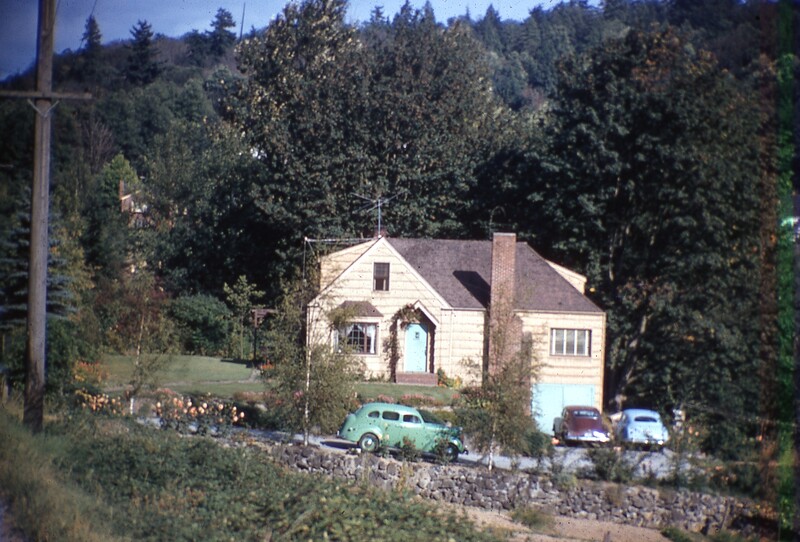
Every so often, a job walks in and reminds you why any of this matters. A few months ago, a family handed me a shoebox that held their timeline: three hundred mounted color slides from the 1960s, each one labeled in a careful ballpoint hand. New homes. Family trips. Candid moments. The box felt like it was humming. Before the scanner even warmed up, I made one quiet decision that would save hours and preserve the film’s voice: I split the stack in two. E-6 on one side, Kodachrome on the other. That small fork in the road determines the rest. E-6 gets Digital ICE on; Kodachrome runs ICE off, because nothing kills a frame faster than an algorithm that thinks emulsion is dust.
On the V600, I kept to the same steady baseline I’d use on my own archive: positive film, 48-bit color, 3200 ppi, all automations off. The holder takes four slides at a time, so three hundred frames became seventy-five batches. The first hour felt slow; after that, the work found its rhythm. While the scanner hummed behind me, the next four slides were cleaned and ready. E-6 marched along briskly with ICE doing most of the heavy lifting; Kodachrome became a series of short, focused sessions so my eyes stayed honest when I spotted dust by hand. The V600 isn’t fast, but it’s steady. Steady wins these races.
Two lessons kept repeating themselves like a drumbeat. First, protect the highlights. Slides blow fast, and once the whites are gone, they’re gone. That’s not drama; that’s physics on transparency film. I’d rather lift a quiet midtone later than pretend I can print detail back into a clipped window. Second, watch flatness like a hawk. A bowed winter mount that looked a touch soft came back to life when I reseated it; another needed to be remounted before it behaved. None of those fixes live in software. They live in care. If you’re tempted to crank sharpening to “rescue” a bowed slide, you’ll etch the grain and keep the softness. Put the energy where it pays: seat the slide, keep the film flat, and you’ll see micro-contrast you didn’t know the frame had.
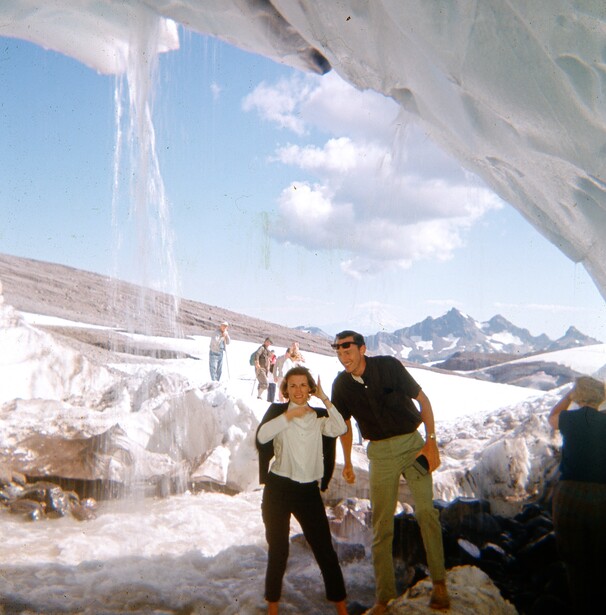
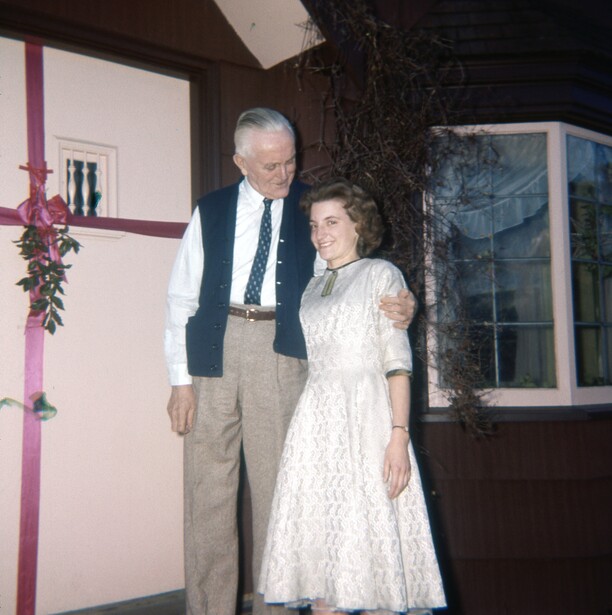
The color in that family box felt like opening a time capsule one breath at a time. On a summer road trip, E-6 leaned green in the shade of pines; a gentle curve and a nudge in white balance took it back to human. On Christmas morning, Kodachrome carried those warm shadows that made skin look like skin, even under the jaundiced glow of old bulbs. I let it live there. I cooled it a whisper when faces drifted too far into orange, but I didn’t scrub the stock’s voice out of the room. These are photographs, not auditions for a neutral chart. The point isn’t to erase time; it’s to bridge then and now truthfully.
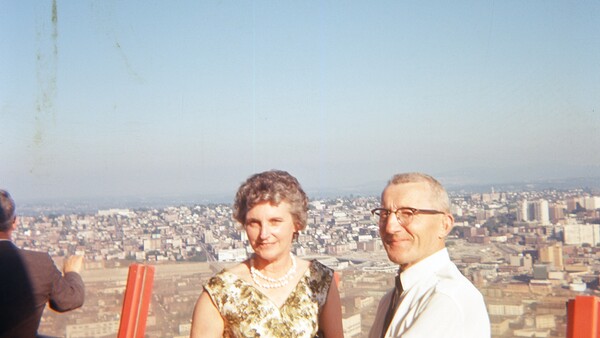
Organization stayed human on purpose. Primaries lived in TIFF under plain-English folders named like a memory: 1967_07_SpaceNeedle, 1965_12_NewHome, 1962_FamilyTrip. The access files mirrored the same tree as sRGB JPEGs that anyone could text, email, or drop into a slideshow. No metadata. No spreadsheets. Just a timeline in folders you can read at a glance. You open the year you remember, the month you remember, the place you remember—and there’s Grandpa in a gray suit, a dog asleep under the table, a cake with too many candles. I heard, more than once during delivery, the quiet pause that tells you a picture landed where it needed to land. That’s the work, right there. Not the curve. Not the ppi. The pause.
People love to ask where the V600 sits in the pecking order, so here’s the condensed version without turning this into a shootout. Dedicated 35 mm film scanners—think Plustek and its cousins—can squeeze more detail per frame and manage infrared cleaning on compatible films with confidence that’s hard to beat. They’re also single-format and, for big mixed archives, often slower to live with. On the other end, the Epson V850 class brings better holders, faster throughput, and more headroom in dynamic range, but with a price tag that assumes you’re running a lab or you just like pleasant things. A DSLR copy rig with a good macro lens will out-resolve any consumer flatbed on a good day and can be quicker once you dial in the alignment, but it demands a copy stand, a truly even light source, and a dust discipline that belongs in a lab coat. If you already own that gear and love tinkering, you’ll make magic. If you don’t, the V600 is the scanner that gets the job finished before enthusiasm fades. I think about tools the same way I think about lenses: the best one is the one that fits the assignment’s truth, not the spec I can brag about in a forum.
Let’s talk about the “what it is and isn’t” with the V600 in a way that’s useful. What it is: a repeatable, dependable flatbed that rewards careful input with honest output, especially for slides and 35 mm, and it will absolutely manage medium format when the subject is contrast-friendly and the expectations are sane. What it isn’t: a drum scanner, a miracle worker for underexposed frames, or a shortcut around the simple realities of film geometry. Effective resolution is lower than the billboard numbers on the box; that’s fine. Most family slides were never meant to be dissected at 400 percent. They were meant to be projected to a room full of people who knew the voices in the pictures. The V600 is a projector that lives in a file system.
My scanning process, at this point, is almost superstitiously simple. I keep the room quiet, and I try to scan like I’m printing for someone I love. The preview window isn’t a place to decorate. It’s a place to frame accurately, keep whites safe, and let the film walk to the finish line with its dignity intact. I don’t use driver-stage sharpening because it steals options later. I don’t use grain reduction because I’d rather see the texture of the stock and decide, in context, how much bite the final image needs. If the end use is a web album for a cousin who wants to share the trip to Yellowstone, I might give the JPEG a little extra crispness so it sings on a phone. If the end use is unknown, the primary stays gentle, because gentle masters grow up into all kinds of outputs without breaking.
There’s a tendency, especially online, to treat scanning like alchemy. The truth is friendlier. It’s darkroom work. You build a rhythm that respects the film. You make a few good choices early—clean, flat, neutral—and they save you from a thousand tiny compromises later. You learn the differences between stocks in the same way you learn the differences between voices at a dinner table. E-6 has a way of talking in daylight and a way of whispering in shade; Kodachrome has a tone in the shadows that shouldn’t be bleached to match a catalog. You accept that not every picture wants to be a hero, and that the true test of an archive isn’t whether you can print a 30×40—it’s whether a family can sit down, open a folder, and fall quiet for a second because the room in the photograph looks like the room they remember.
If you’re staring at your own box right now, here’s the rhythm that never fails me. Start with four slides tonight. Don’t announce a project to your calendar or tell social media what you’re about to do. Clean them like you’re about to print them. Seat them like you’re clicking a lens into a mount you trust. Scan them neutral—positive film, 48-bit color, 3,200 ppi, all the little helpers asleep. If they’re E-6, let ICE carry a bit of the dust load; if they’re Kodachrome, accept that the price of integrity is a little time with the spot-healing brush. Protect the whites. Let the mids breathe later. Name the folder like a sentence you’d say aloud. When you’re done, send the JPEGs to someone who was there or put them on a TV and watch a room go still for a beat. If they reply with, “I can hear that room,” you did it right.
There are small practicalities that make big differences over a long job. Work in sprints, especially on Kodachrome. Manual dusting is precise work; it asks for fresh eyes. Set a timer and step away when you stop seeing the little specks in your peripheral vision. Keep a microfiber cloth for the holder and a separate one for the glass, and don’t let them switch duties. Put a strip of gaffer tape on the table and use it to pin down the corner of a whisper-curling mount just long enough to seat it in the frame without bowing. If a particular slide refuses to sit flat, don’t argue when you’re tired. Put it in a small “later” tray and treat that tray like a final exam when you’ve got patience in the bank. Your success rate goes up when you separate stubbornness from care.
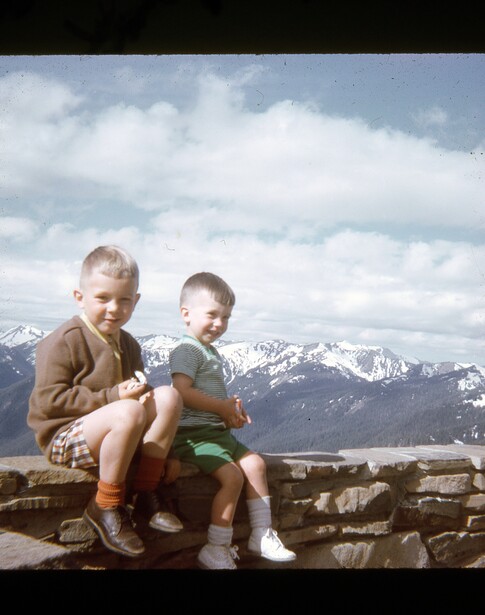
Somewhere around batch forty on that 1960s box, I hit a roll that looked like summer even before I could name the place. The greens wanted to run away; the shadows were patient, like the air under pines at noon. In the frame, a boy—I think eight—held a fishing pole like it was something holy. The slide had a hair across the emulsion. In another life I might have trusted a machine to guess, but here it was a gentle sweep of the spot-healing brush and a breath I didn’t know I was holding. His father’s hand, just on the edge of the frame, was a curve that needed nothing from me. You don’t always know which picture in a box will carry the weight. You just show up for each one like it might.
If you’re wondering whether all this care is “worth it” on a humble flatbed, the answer depends on your question. If the question is, “Can I make a gallery-size print that withstands a loupe,” then no, build a copy rig or hire a drum scan for the hero frames. If the question is, “Can I digitize a family’s history so that the color breathes, the grain feels like paper, and the sequence reads like a story,” then yes, one hundred times yes. The V600 is a little stubborn, a little slow, and perfectly content to be boring. That’s a compliment. Boring tools, used with love, build the kinds of archives that outlast us.
I’ve been asked what I deliver on a job like that. The answer is intentionally plain. A “Masters” folder with 16-bit TIFFs that will survive the next decade of software changes, and a mirror “Access” folder with sRGB JPEGs that anyone can open without learning a new trick. The names read like a timeline: 1967_07_Yellowstone, 1965_12_Christmas_Tulsa, 1962_Picnic_FortGibson. Inside, the files echo the folder, with batch and slide numbers that make sense if anyone ever wants to talk about a particular frame: B01_S0001, B01_S0002. There’s a small text note that says, essentially, “Open Access, open the year, open the event.” That’s it. I don’t need them to learn my system. I need them to find Grandma.
When I handed that family their files, the room didn’t erupt. It softened. Someone laughed at a haircut; someone else said a name I hadn’t heard yet; a kid pointed at a car and asked why it looked like a spaceship. That’s the part no spec sheet ever captures. The V600 didn’t turn those frames into billboards. It turned them back into photographs. That’s the bar that matters for a family archive: the feeling of recognition when someone says, “Oh—look at her hands,” and the room goes quiet for a second.
I’ll leave you with this. Scanning can feel like admin work until you remember what’s on the film. It’s not admin; it’s stewardship. The V600, used with care, is faithful. It’s the kind of tool you can put between a shoebox and a living room TV and feel good about what you’re giving back. The process doesn’t need to be fancy. It needs to be repeatable and kind to the picture. Start with four slides. Build your rhythm. Protect the whites. Respect the grain. Name the folder like a sentence. When you’ve finished the first box, you’ll know what the second one needs before you lift the lid.
All photos belong to the author, Steven Van Worth.

Join the Fstoppers community for free
-
Post comments and join in the discussions
-
Browse the site ad-free
-
Share your work and get featured in the community
-
Compete in the photo contests for fun and prizes
4 Comments
This was EASILY the best FStoppers article I have ever read (and I've been reading articles here for YEARS). It was well written, well explained, and described a respect for and care very well taken with a family's important heirlooms. If you even do half the stuff on a scan job that you're describing here, then the family has invested well.
It’s unfortunate the Epson has discontinued that scanner.
What would you recommend for a replacement for the now discontinued Epson V600?
CanoScan 9000F, it beats the V600 in true optical resolution: https://www.filmscanner.info/en/CanonCanoScan9000F.html. I just bought one used and witing for it to arrive. Also bought an IT8 target for color calibration.