Choosing a Fuji lens is not just a spec decision, it quietly shapes how close you stand to people, how much environment you show, and how fast you can react in the middle of a busy scene. This video walks through real-world use of several Fujifilm primes and a zoom so you can see how different focal lengths actually behave on the street instead of just reading spec sheets.
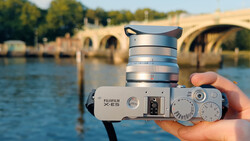
Coming to you from Shane Taylor and Josh Edgoose of Framelines, this thoughtful video starts with what they both see as a sleeper workhorse, the Fujifilm XF 35mm f/2 R WR. You see how its tiny size and 53mm equivalent view make it the lens that accidentally ends up on the camera most of the time, which is exactly how it quietly fills your archive with keepers. Taylor talks about using it wide open at f/2 on bodies like the X-T2 and X-T5 in dark buses and subway cars, leaning on modern noise reduction rather than chasing faster glass. The video makes a useful point about depth of field on APS-C, where f/2 gives enough blur for portraits without turning a face into a single sharp eyelash surrounded by mush. You come away seeing the 35mm f/2 less as a budget compromise and more as a practical “always-on” lens that encourages you to carry a camera constantly.
From there, the conversation shifts to the Fujifilm XF 23mm f/2 R WR and the X100 series as that classic 35mm equivalent option. Edgoose describes 23mm as the default when you do not know what the day will throw at you, since it works for family, events, and street without forcing you into one way of seeing. You get to see how a slightly wider field of view opens up environmental portraits, where the person and the location both matter, instead of just tight headshots. The hosts talk about how this focal length sits in a sweet spot where you can still work close to people while holding on to context like graffiti, storefronts, or full-body framing. If you are trying to pick a single lens for a Fuji kit that covers daily life as well as street, their examples make a strong case for starting at this focal length and learning it deeply.
The video does not stay locked at the “sensible” end of the lineup, though. Taylor brings out a fast short telephoto like the classic Fujifilm XF 56mm f/1.2 R and talks about using that look almost exclusively for a long-term London project, leaning into its slight softness and slower autofocus to create images that feel closer to an older film era. You also see a more modern take with the updated Fujifilm XF 56mm f/1.2 R WR, plus a brief look at a faster normal like the Fujifilm XF 50mm f/1.0 R WR and a workhorse zoom such as the Fujifilm XF 16-55mm f/2.8 R LM WR. Instead of just reading out specs, they show how these bigger lenses sit on bodies like the Fujifilm X-T3 and how that affects whether you actually want to carry them all day. There is also a recurring theme about “desert island” choices, where both Taylor and Edgoose look back through their Lightroom catalogs and realize which focal lengths actually produced their favorite work rather than just sounding good on paper. You get enough of that discussion to start questioning your own kit and how many lenses you really need. Check out the video above for the full rundown from Taylor and Edgoose.





Join the Fstoppers community for free
-
Post comments and join in the discussions
-
Browse the site ad-free
-
Share your work and get featured in the community
-
Compete in the photo contests for fun and prizes
No comments yet