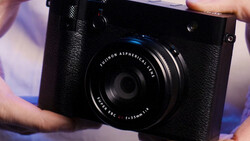
“Are you worth $5,000, little Fuji?” That’s the very first question asked in this video that reviews how the new Fujifilm GFX100RF medium format camera holds up in real-world use. The answer? Maybe for some people.
Fujifilm created quite a stir when they introduced their new “point and shoot” camera, the GFX100RF, with a fixed focal length lens, medium format sensor, and 100 megapixels of resolution. While this camera is certainly an intriguing and novel offering from a company that has never shied away from innovation, it often leaves photographers with a number of questions—first and foremost of which is, “Who is this camera intended for?”
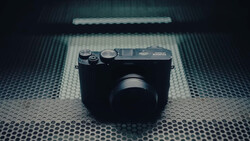
The GFX100RF is certainly an attention-grabbing camera, its aesthetic echoing that of Fujifilm’s incredibly popular X100 range of smaller APS-C point and shoots, but it seems to sit in a kind of no-man’s-land somewhere between these compact cameras and Fujifilm’s professional medium format cameras like the GFX100S II. That in itself is not necessarily a bad thing, but the fact that it costs as much as one of those professional camera bodies (albeit with the lens included) begs the question about who this camera is intended for.
Presumably in the interests of saving space to keep the GFX100RF body as small as possible, Fujifilm has sacrificed a lot of the features that you get on the professional body that costs about the same price. There’s no flippy screen, for example, and the biggest compromise, in my opinion, is the complete lack of stabilization, either in the body or the lens. For a camera with such a high-resolution sensor, whose primary advantage is image quality, this seems to me to be a poor sacrifice to make. You might be able to make the argument that these compromises would be worthwhile if Fujifilm had been able to engineer a medium format sensor into a compact, perhaps even close-to-pocketable, camera like the X100VI. But the GFX100RF is still a pretty large camera, and not one that anybody would ever describe as “pocketable.”
In the video presented here, Jared Polin from the popular FroKnowsPhoto website and YouTube channel presents an insightful review of what it’s like to use the GFX100RF in different shooting situations. Jared did not set out to make a technical review covering the specifications and features of the camera in detail, but rather to make a video that explores the uses of this camera in various real-world shooting situations, with the goal of answering the question about its intended audience—and also, of course, whether or not it’s worth the price.




Join the Fstoppers community for free
-
Post comments and join in the discussions
-
Browse the site ad-free
-
Share your work and get featured in the community
-
Compete in the photo contests for fun and prizes
11 Comments
‘it often leaves photographers with a number of questions—first and foremost of which is, “Who is this camera intended for?”’ Really? I don’t think k that occupies many people’s thoughts for very long. Surely those that want (and can afford!) to buy one, will do so and those to whom it’s no real use, won’t. I mean, there are probably dozens maybe hundreds of cameras launches and never once have I thought ‘I wonder who this is intended for.’
For a little less money(!), I'd much rather buy this than the new Sony RX1R. (And yet neither have image stabilization????) It would be great for street photography.
We survived 100 years without stabilisation while it's handy. It certainly not necessary to do most photography and given that this is a fairly wide angle lens. I actually tested my GFX 100 SII and turned off the stabilisation and then I put my 20 to 35 lens on there and set it to 28 mm and then I took a heap of images with no stabilisation. I got down to 1/20 of a second and that 20 to 35 lens is a lot bigger than this particular lens so you could easily get down to 1/15 of a second handheld no problems at all if you know what you're doing.
Yup. I rarely need stabilization but there's always that twilight/nighttime shot without the tripod handy....
So you're using a 100 year old 8x10 and developing glass plates in your bathtub, right?
I've travelled light for a while, but I regret I did. You never know what image you'll miss by not bringing your full camera bag.
No IS is a deal breaker will stick with 100V1
Stopped at a camera store this week and the Fuji rep was there. He was showing me this camera and I was impressed. First thought was great camera to take hiking. If you are a pro there are better tools for the kind of work you do. As for lack of stabilization I spent most of my career being the stabilizer. Funny how once we have a feature we think we can’t live without it. This would be a cool camera to have.
The main reason I use IBIS is for slower shutter speeds to create movement but do generally agree with what you are saying. It's a bit like people who insist they need high megapixels so they can crop their photos. Wildlife photogs I can understand but it does often feel like everyone is cropping instead of just getting the right shot in camera.
You never crop? You've never seen a better composition well within a photo that you've casually taken. It doesn't happen that often but it happens on a semi-regular basis with me. It's a great thing to have.
One of the reasons I love my GFX cameras is the ability to crop into insane levels. You can take one lens out which I often do which is my 35 to 70 and you can crop into 130 mm and still get a 50 megapixel fil and that's pretty cool. Megapixels actually equals less lenses and I do like that about the system and if I didn't own two GFX cameras already then I would probably look at this camera.