
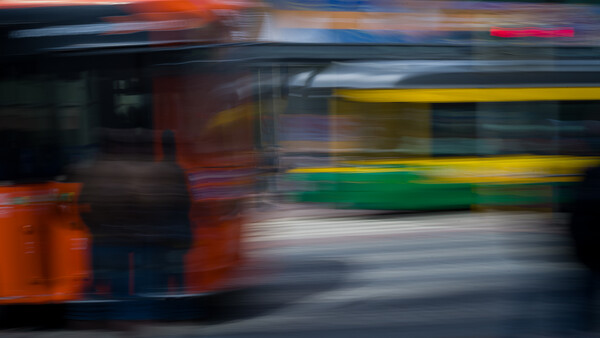
Street photography was built on proximity, on the unscripted moment when two strangers briefly shared the same space and the same gaze. In a world where every face is searchable, traceable, and legally accountable, that proximity no longer carries the same meaning.
The future of street photography doesn't look like a sudden collapse. It looks like a slow, managed retreat. On the surface, the genre seems healthy: cameras are easier to use, and cities are more crowded than ever. But the shift isn't about aesthetic trends. It's about a fundamental change in the status of the human face. Street photography was built on the "friction of the second" — the unscripted encounter between strangers. In this tradition, the face wasn't an accessory; it was the raw material of the craft. Now, that material has become toxic.
The idea of the "random passerby" is eroding as a category. In a data-driven environment, the person in the frame is no longer anonymous by default. They are a data subject. The language shifts quietly, but the implications are significant: what once appeared as incidental presence now carries traceability. The camera no longer captures a passerby. It captures a profile.
From Eye to Scanner
The street is no longer a neutral stage. Today, a camera in a public space functions less like an artist's eye and more like a biometric scanner. In many jurisdictions, the moment a face is captured, it ceases to be "character" and becomes "personal data." Once an image is uploaded, licensed, or even used to build a photographer's online brand, it enters a commercial context that strips away the old protections of "artistic freedom."
This isn't just a theoretical threat. Reverse-image search has turned every street portfolio into a searchable database. A stranger in your frame is now one click away from being de-anonymized, linking their private life to your "decisive moment." Legal risk no longer starts with a court order; it starts with a DM or a takedown notice. Even a baseless privacy complaint is expensive to fight. This financial pressure is pushing spontaneous work toward insurance policies and written consent. The ethical weight has shifted, too: you aren't just capturing a moment, you are fixing a person into an endlessly retrievable digital record for someone who never asked to be indexed. The photographer has evolved from a witness into an involuntary agent of surveillance.
We can already observe the direction of travel by looking at news photography. Photojournalism is gradually losing its faces — not because of a new love for minimalism, but as a defensive adaptation to tightening legal standards. This is not a completed transformation but an ongoing drift. As publication becomes instantaneous and global, every photographer with a social media account operates, in effect, as a micro-publisher. The boundary between street shooter and newsmaker is thinner than it once was. To avoid the legal minefield of publishing identifiable people without consent, photographers are adjusting in real time.
Across editorial environments, a quieter adjustment is visible. Faces appear less centrally framed. Crowds are described through scale rather than expression. The camera lingers on space, signage, architecture, density. Individuals remain present, but less individually legible. This is not stylistic fashion. It is a gradual narrowing of what can be published without risk. This pattern is not confined to newsrooms. It reflects a broader recalibration of what can be shown without consequence.
The Cost of Proximity
The canon of street photography — Winogrand, Meyerowitz, Gilden — is a history of faces and the tension of the "close-up." Distance was never just about focal length; it was a declaration of involvement. Even the most chaotic, layered frames relied on the legibility of the human figure.
Consider a midday intersection seen from above. Crosswalk lines, shadows from traffic lights, pedestrians reduced to shapes moving between blocks of concrete and glass. Shot from a distance, the composition becomes about rhythm and alignment rather than expression. The people remain present, but their faces are no longer the anchor of the image. It's atmospheric, legally neutral, and utterly anonymous.
But this isn't the encounter that defined the genre. It lacks the exchange of gazes, the flash of recognition, the social friction. Anyone who has worked the street knows the "tremor in the hands" — that spike of adrenaline and guilt when a stranger starts to turn toward your lens. That collapse of distance from observation into confrontation was the genre's heartbeat. When the face becomes a liability, that heartbeat stops. What once felt like courage now carries legal exposure.
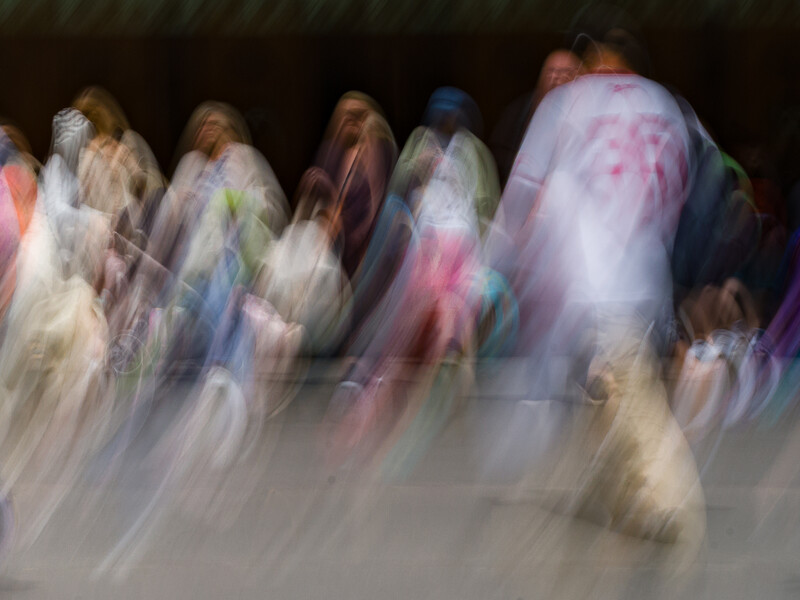
Some will argue that nothing fundamental has changed, that the street remains public and the law still permits capture. The right to capture may remain intact. The consequences now concentrate at publication. Those who claim that nothing has changed often focus on the right to capture. The pressure now sits elsewhere, at the point of publication, circulation, and liability.
Over time, these adjustments accumulate. Shooting from behind, relying on distance, dissolving faces into motion — what appears as stylistic refinement may also reflect constraint. When some approaches carry less risk than others, they spread. Over time, that changes the look of the genre.
Regulation and Simulation
AI intensifies this pressure by offering a risk-free alternative. Artificial generation has broken the link between the image and the location. A city scene no longer requires a city; a confrontation no longer requires a stranger's consent.
If a perfect, tense moment on a subway platform can be prompted into existence from a desk, the value of traditional street photography shifts toward "authenticity" — the raw proof that this actually happened. But here is the trap: the "proof" of the event — the identifiable face — is exactly what the law is making increasingly fragile to publish. The genre is being squeezed from both sides. Simulation removes the need for physical risk, while regulation makes that risk too expensive to bear.
There is another layer to this shift. Every publicly uploaded image now enters datasets beyond the photographer's control. Images of strangers do not only circulate socially; they are absorbed into training environments that refine the very systems competing with human photographers. Documenting the street now feeds the very systems that reduce the need to document it.
The practice does not need to be outlawed to be transformed. Instead, the practice is narrowing until it resembles something else. Spontaneity is being traded for "negotiated portraits." Instinct is being replaced by legal awareness. Street photography is not disappearing. It is moving away from proximity. In a world where every face is data, standing close to a stranger no longer carries the same meaning. When the face becomes a point of liability, proximity ceases to function as an encounter. The genre may continue, but it no longer belongs to the conditions that created it.


44 Comments
Does street photography have any monetary value these days? I mean, can you actually sell it? That's what drives legal matters. Newspapers place value on those types of images, and I'm sure they're well equipped to face any sort of legal challenges, but for everyone else the consequences for sharing a street picture on a social media site couldn't possibly be that significant. Theoretically there's a legal issue that surrounds virtually everything we do... jaywalking for example. Practically speaking, it's too common to prosecute. And with billions of photos posted to social media, where to start?
If someone decides to pursue this idea in court, all it will take is a couple high profile cases to put a stop to any sort of legal challenges. As said, there's no law which prevents shooting pictures of people on public streets, virtually all of which are not for profit. It certainly won't make any difference to me because I've been asked enough times already not to take someone's picture that I've long given up on taking a camera downtown. Too many crazy people walking around on the streets, which by itself should discourage anyone from shooting pictures on public streets. The threat of being whacked with a blunt object is far more risk from shooting street pictures than some future cease and desist order. I wouldn't even be the slightest bit interested in a modern street photo book. Take me back 50 years or more and that's different.
You’re right about enforcement, most images won’t lead to any legal action. But that’s not the level I’m addressing.
It’s not about how often cases reach court. It’s about how publication conditions change once a face is searchable and tied to a profile.
Street photography doesn’t shift because people suddenly get sued. It shifts because anonymity no longer holds the way it used to, and that changes what can be published long before any case appears, something we already see in practice: photographers stopped shooting other people’s children.
And I'm saying that nothing changes until the law says it should. Photographers will continue to stand where they want to stand, shoot pictures of what they want to shoot, and continue to use them in the manner of their own choosing... until a legal decision tells them otherwise. Street photography won't shift until people get sued... and lose. We've been down that road with copyright infringement. We've gone down that road establishing rights to privacy. The use of AI is just now being litigated to set limitations of proper use. The law defines boundaries… everything else is simply conjecture.
One other point: You're assuming that there's a societal backlash against face recognition, something which would trigger some sort of threatening DM or takedown notice you speak of. I suspect rights to privacy in that regard are slowly deteriorating and what you think might be an invasion of privacy is becoming normal. Who knows what the younger generations are adapting to. For instance, every major retail store uses spy cameras. I was at the self-checkout line in my grocery store the other day (I hate those things) and ran into an issue. I had placed my items on the wrong side of the scanner. The clerk came over and replayed the whole event on their monitor. Good grief... more reason to hate those things.
I'm sure that technology and its implications for security, privacy, fair use of the images, etc., have been thoroughly debated, probably in and out of court. The fact is that the technology remains and there's not much I can do about it. I suspect that would be the same case if I were to see my face in a social media post from one of my friends or neighbors. Unless they've slandered or used it in a way that I can claim actual damages, there's nothing I can do about it. My children probably wouldn't even think twice about it because they've grown up with Facebook and a gazillion pictures scattered all over the internet. The government is also pushing acceptance of facial recognition for security purposes. Safety may require some degree of loss of privacy. It's the world we live in today.
That’s where we disagree.
You treat legal judgment as the only thing that changes practice. I don’t.
Photographers adjust before courts do. They respond to platform rules, reputational risk, editorial caution, and changing norms around identifiable faces.
Law names the boundary later. It doesn’t produce every shift in advance.
And your second comment points in the same direction: if privacy is already being normalized away, then the conditions around publication have already changed.
I hadn't considered the point about anonymity. Very true. The last portion is truly identifiable, the attitude has most certainly shifted and as I mentioned earlier, I suppose there is legitimate reasons for the change.
This reminds me of a clip or two floating around the internet of street photogs having their cameras broken/being assaulted. I look at the Bruce Gilden styles of hand-held flash candids and see how that is perceived quite differently now, or least looked upon with an attitude of initial guardedness, which I feel is not entirely unfounded.
Street Photography remains a vital genre and few will be scared off by this absurd fear mongering. I’m out there every day shooting. Street photographers are not wimps.
They’re not wimps.
That’s just not the point.
The issue isn’t whether street photographers are brave enough to keep shooting. The issue is that more and more of the genre now depends on conditions where the subject doesn’t participate. Shooting backs instead of faces, or anyone unlikely to respond, doesn’t change that. It’s still a one-way gesture, often at odds with the very idea of street photography as an engagement with the world.
"Street Photography remains a vital genre"
Vital for what? What individual or societal value does street photography provide?
(edit) I saw your smugmug, so clearly you are selling photographs. Not that I would buy any of them. Many cities look pretty much the same, and taking inviting me to view a composition of a dirty, disgusting, ugly city is the opposite of what I want to see in a photograph, much less, in life. New York City is probably the prime example of what I hate about street trash photography: cliché, overdone, and hideous.
I would argue that street photographs are an important record of how we were, as a document of our times for historical record. Posed images reflect how we and photographers want to show us and often are highly stylized and not at all like we looked at that moment in our lives without the interaction with the photographer and their input and guidance, and selection. Street photos show how people really were, and how our world looked like at that time, usually without the bias caused by posing, pretending, acting, lighting, directing, props etc. Today social media is filled with images where individuals show themselves in weird poses, and often youtube channels need to make those in order for the algorithm to select them for viewing by others. This gives a really odd idea of how we really were in our time. You might think most street photos are just bad photos; with any art most of it is not very good, I would agree with that, but after a while people do select images of value and hopefully keep those and delete the bad ones, leaving a more interesting set of images for the historical record. Yes, any selection of images is bound to be biased, but street photos are selected based on different criteria than portraits, and I would argue both are valuable.
GDPR allows for national exemptions for journalistic, scientific, and artistic purposes (for storing and processing the data). Whether these are implemented in law depends on the national parliaments. Private individuals (as opposed to companies) are not governed by GDPR at all. Further, it seems likely the EU will make changes to GDPR to make it more practical for businesses, reducing the administrative burdens and to facilitate AI development. With regards to publication, in Finland, if the photo is likely to cause harm to the subject then publishing might well be illegal, and this is definitely something to keep in mind. Also the use of images to advertise something like a political party or a product without permission is not legal. But if the photo is obviously not harmful to the subject's good reputation and is not used to market or sell anything, I don't see how it would result in a lawsuit. This part of the legislation regarding the publication has been consistent for as long as I can remember. I don't think that people such as journalists or artists should need to be scared of publishing images of recognizable faces, as long as the context is such that there is nothing that would put the subject's good reputation at risk.
However, you may be correct that the photographers are avoiding making recognizable images of strangers in the public and publishing them online because they could be algorithmically identified and linked to other information on that person. The problem there is, in my opinion, allowing this kind of algorithms to crawl the net, and use them for (what is eventually) commercial or political purposes. Big tech billionaires and authoritarian governments are allowed to do whatever they want, legal or not, and this results in a huge array of social and other problems. A company like Google processing of personal data without the subject's explicit consent is probably not legal in the EU but it seems the authorities aren't really able to do anything about it right now, except issue fines which are too small to make these companies really change their behavior. If everyone adhered to GDPR then there would be no linking of personal data to street photos, published or not, unless the subject specifically allows it by giving specific informed consent.
In the U.S., newsworthy/public interest publication is strongly protected by the First Amendment. U.S. legal standards governing photography in public have not significantly tightened in recent decades. Photographs taken in public spaces are generally lawful to publish without consent for editorial use. Courts have consistently upheld broad protections for journalistic and documentary photography. Major outlets (e.g., AP, Getty, Reuters) still rely heavily on face-centered imagery as core storytelling. Faces remain essential for emotion, accountability, and humanization of news. If anything, the dominant trend is selective caution, not disappearance.
I agree the faces are key for conveying emotion and storytelling in photographs. I have noticed that in local newspapers in my country it is now more common that they show mostly portraits (either tight or environmental) rather than true documentary photos which show unposed people in the midst of events unfolding. Comparing NY Times to Helsingin Sanomat the difference is very obvious, the former still has classical documentary photos. However, US media are under pressure from the administration to not publish critical articles of the administration's actions and media ownership is concentrating which could lead to the vanishing of critical voices over time. Though it seems at present there is media chaos rather than concentration. ;-) Since journalism is one category where exceptions are allowed to GDPR, I don't think newspapers in my country are required to limit their coverage to avoid showing recognizable faces without consent, it is more likely a cultural thing, these organizations don't value documentary images and prioritize text. "Selective caution" does sound like it describes what is happening. Trust in Finnish media is at a high level, though.
Legal protections in the U.S. haven’t changed much—but the conditions of publication have.
Street photography doesn’t operate with the same institutional backing or clearly defined “public interest” as journalism.
In a networked environment where images are searchable, reusable, and detached from context, the individual photographer carries more practical risk, even if the law hasn’t fundamentally shifted.
Yes, but the issue, traceability or not, is that street photography is tolerated and accepted if the subject is incidental to the context or if the image has a clear value as a social testimony, as long as it doesn't trample on its dignity. So the conflict is between society's interest in witnessing itself and its interest in preserving its privacy. A conflict of society that, for now, the judge protects against one side. In a hundred years, should they do without photographic evidence of social life in cities?
Very well put.
If we take the title literally then all we need to do is stop everyone with a smartphone from taking a picture outside with people in it they have not asked, and prevent them from publishing it on any medium. So realistically its not practical to enforce. Then in Europe, as others have pointed out, we have GDPR which definitely has exemptions for artistic photography. In Sweden where I live there are local legal interpretations that you need to be aware of (like you cannot shoot from outside into someones private living quarters for example) - but these in no way prevent street photography, they just apply legal common sense. Now the point that AI can be used to show the profiles, well yes it could and at that point its the person using the AI for this purpose that is in breach of the regulations, not the photographer.
Private individuals (including amateur photographers) are not governed by the rules of GDPR, it only legislates data storing and processing by companies, governments, etc.
If we take the title literally then all we need to do is stop everyone with a smartphone from taking a picture outside with people in it they have not asked, and prevent them from publishing it on any medium. So realistically its not practical to enforce. Then in Europe, as others have pointed out, we have GDPR which definitely has exemptions for artistic photography. In Sweden where I live there are local legal interpretations that you need to be aware of (like you cannot shoot from outside into someone's private living quarters for example) - but these in no way prevent street photography, they just apply legal common sense. Now the point that AI can be used to show the profiles, well yes it could and at that point its the person using the AI for this purpose that is in breach of the regulations, not the photographer.
If we take the title literally then all we need to do is stop everyone with a smartphone from taking a picture outside with people in it they have not asked, and prevent them from publishing it on any medium. So realistically its not practical to enforce. Then in Europe, as others have pointed out, we have GDPR which definitely has exemptions for artistic photography. In Sweden where I live there are local legal interpretations that you need to be aware of (like you cannot shoot from outside into someone's private living quarters for example) - but these in no way prevent street photography, they just apply legal common sense. Now the point that AI can be used to show the profiles, well yes it could and at that point its the person using the AI for this purpose that is in breach of the regulations, not the photographer.
If we take the title literally then all we need to do is stop everyone with a smartphone from taking a picture outside with people in it they have not asked, and prevent them from publishing it on any medium. So realistically its not practical to enforce. Then in Europe, as others have pointed out, we have GDPR which definitely has exemptions for artistic photography. In Sweden where I live there are local legal interpretations that you need to be aware of (like you cannot shoot from outside into someone's private living quarters for example) - but these in no way prevent street photography, they just apply legal common sense. Now the point that AI can be used to show the profiles, well yes it could and at that point its the person using the AI for this purpose that is in breach of the regulations, not the photographer.
The bigger issue is most of the street photography I see just isn't very good.
I agree with you: the images produced by street trash photography (ugly, disgusting, banal, and common) are overwhelmingly displeasing, but I don't think "street photographers" are making images to please us. They are posting those imagines on social media in an attempt to farm likes for dopamine hits. It makes more sense to view people doing "street photography" as meth addicts instead of as photographers.
Street photography is inherently difficult to do well, and I would agree people publish too many images without their own editorial discretion. Most did not go to art school or study documentary photography. However, ugly or not, IMO it's better to have some of these images published as a record of our times than none at all.
Seriously? We have been data points for ages. Walk out on to any street and look around, you are surrounded by cameras that can track your every movement all day long. Even in the suburbs, when I walk my dog our every step is being recorded by so many smart doorbells and security cameras. Much of our privacy was lost long ago when we all were listed in the phone book. Remember those? Then we all logged on, and with that, poof, all privacy went away. Get over it.
The sad part is most of the dreck that gets pawned off as street photography is completely insufferable to look at. The majority of the public doesn't ever engage with it for the fear of being literally bored to death, or they just don't get it because there's nothing to get.
People's backs? No faces? Anonymous scenes of people made with no point of view? Abstracts, blurs, ICM, HDR? Please, don't confuse that with street photography.
Just because a photo is made on the street does not make it a street photo.
Thankfully Philip Lorca-DiCorcia took one for the team many years ago and settled the case law on this one. We can shoot what we like on the street. Photographers are not the problem. The photographers doing this work seriously are bearing witness to the world in which they live, with a strong point of view and intention, making work that is relevant and if done well will have a lasting impression.
Your article is certainly food for thought Alvin. Yes, you're creating a data point, and there are some ethical concerns around that. But from the perspective of the person being photographed, I would argue that a person with a camera should be an object of minimum concern. More concerning is the proliferation of public cameras, how easy it is for anyone to access them, and connect them to software which logs and sorts through the data points. Street photographers arent the true threat to your privacy, big data corporations selling their products as "keeping the public safe" are far more intrusive into our lives, far more invasive, and far more harmful to privacy, than your f/8 and be there shots. Those cameras run 24/7, never turn off, and who knows how many different countless entities get access to it and build their database off it.
Suffice to say, if you want privacy, walking around a major metropolitan area isnt a good way to obtain it. Wear a hat, wear sunglasses, wear a covid mask: your degree of privacy in public is still ultimately your own choice.
Thank you, Chris. I agree with both the observation and the reasoning.
We’ve been surrounded by cameras for a long time, and that environment is already normalized.
But that comparison only works at the level of capture.
Surveillance operates as a system. It records continuously without selecting, framing, or addressing the image as a statement. There’s no single image, no author, and no act of publication in the same sense.
Street photography is different. It doesn’t just record, it selects and publishes. And that’s where the shift happens. Once an image is published, it becomes searchable, reusable, and tied to a specific point of view.
That’s the difference I’m pointing to.
Surveillance camera feeds can be analyzed by AI and images can be selected by the algorithm and this can lead to problems such as a hostile authoritarian government recognizing the person as a possible political opponent and then the government can target that person with "law enfocement" or even "disappearance" because the AI notices the person was present at a demonstration or nearby. There are so many problems with these systems being used by powerful entities who do not have the public's best interest at heart.
Was there ever an era where publishing street photography online *didn't* carry the risks you outlined (outside of AI obviously)? I never publish identifiable faces without consent. If I don't have that consent, I just print the photos instead and share it with friends, always have, it's a simple rule to follow. Not every photo I take needs to be seen by the world wide web, street photography is doing fine.
Can we go back to the helpful product reviews and photography tips and advice please.
That's a very reasonable approach.
This article doesn't take any of the product reviews, tips and advice articles away. They continue every day. It merely adds to the variety of topics available, for which I am thankful, because the things of interest to you are of not so much interest to me.
I think if you are moving into that “personal” space that makes many of us uncomfortable, or if you are taking a photo of an extremely intimate moment, go right ahead then show the person (if they are willing) and explain your art.
Otherwise it’s basically travel photography sometimes done better.
As for proof of authenticity. Beat a game in god mode vs something you’ll actually feel accomplished over. Same thing. Showing off with AI slop means nothing.
I think the big takeaway from this is that a face can now be used to index a search for name, address, criminal record, family members, what school they you too.
What used to be a picture of a scruffy dude looking leaning on a lamppost now becomes a way to link "Male on Corner of Brown St and Main rd" to {C V Hodge, DoB 27-10-1955, Lives in Green Lane Salisbury, four children, seven wives, Listens to reggae, ska and punk, member of eight photography groups, previous aggravated assault charges (dropped), member of local archaist society, no driving convictions}
And currently AI scanners can swallow all that up and keep it for ...well we don't know that yet.
Now, the photographer just wanted the image of an anonymous person of character below an advert for soap.
Most street photos are scruffy in nature, and pretty unclear as to the faces (often black and white, with face constituting a small part of the frame). This does not easily lend itself to facial recognition.
Interesting article and comments.
Not that many decades ago, the term "street photography" wasn't generally in use, even though of course the practice was.
So perhaps from that starting point, the world of photography has changed and no doubt will continue to do so over time.
Whilst individual countries have differing concepts of privacy in a public place, those that rely on freedom of speech and expression generally regard public locations as benefitting from no legitimate expectation of privacy, albeit with a fundamental caveat.
It's not so much about the capturing of an image, but rather what the photographer chooses to do with it.
Without consent from the subject, use of the image can in theory be somewhat constrained, particularly if it fails a fundamental test of having journalistic merit or importance.
As with many aspects of modern life, the law has yet to catch up with the pace of change, Live Facial Recognition being an obvious example, but that's a whole different argument for another day.
What now passes for 'street' whether it's good or otherwise, will no doubt be regarded as historic or retro by future generations, but for now, the often overused statement of us living in "a pivotal moment", may in time prove to be more than just a simple phrase.
30 years ago, pervasive camera surveillance was the exception, not the rule. Today that has completely changed. Every inch of most populated environments is covered by a web of so-called security cameras. Simply walking on a public sidewalk in a residential neighborhood puts your face into hundreds of data points as doorbell cameras and vehicle dashcams capture your every step. People are emotionally exhausted by the Surveillance State.
Citizens have little recourse beyond shaking a fist at a government controlled traffic camera on a city street to express their frustrations. Street photographers can become a conveniently humanized target for pent up frustration. What was once a fleeting encounter with a photographer on a busy street has become a provocation. Now street photographer becomes the personification of the lack of privacy we all suffer with. Subjects on the street no longer feel anonymous when captured for what should be a purely artistic purpose. They feel further violated and suddenly have a person to direct their frustration towards.
Street photographers may be taking images for the same reasons as before. But the effect on their subjects has changed for the worse.
Thirty years is about right. More precisely, the world changed on September 11, 2001. Virtually overnight, nobody trusts anybody. Security precautions at every street corner turn everyone into potential terrorists. We've become fearful of our own shadows.
I hope it's the end of street photography as a sport.
I'll echo a few other's sentiments and say this is one of the more thought provoking pieces I've read on Fstoppers lately. I'm not a street guy by any means but it's something that I've dabbled in and actually have an interest in to a limited extent and this truly raises interesting considerations. Excellent article, Alvin.
I'm afraid that we are teching our way to oblivion if not extinction...
The legal costs from a complaint will not be under $10K, probably not under $20-25K in the U.S.. Twenty or more years ago Evelyne Daitz at Witkin Gallery in New York\k told me about being sued for exhibiting a street photo that included a lawyer. The lawyer sued, which cost the next to nothing, and lost, but not before costing the gallery thousands in legal fees. I limit my candid photography to public events like concerts and do street photography outside the litigious U.S..
My solution: I do exchange all identifiable faces via AI with fantasy faces …
One dimension missing here is the geographic displacement this pressure is already causing. When shooting faces becomes legally costly around the northern hemisphere, photographers travel, and festivals/competition results show it: winning images increasingly come from the Global South, where GDPR doesn't apply and subjects have less recourse. Regulations designed to protect human dignity in Europe are effectively exporting the ethical problem to places with fewer protections. The side effect is aesthetic homogenization: the same destinations, the same visual register of vivid color and weathered faces, the "decisive moment" as a commodity. Those countries won't stay outside the reach of biometrics and AI indefinitely. When that changes, the genre will likely have nowhere left to retreat.