
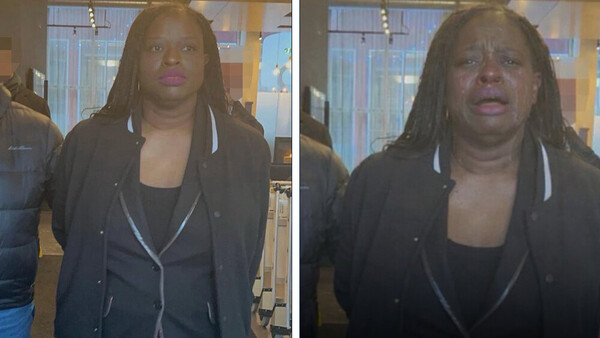
Photo fakery has existed since the darkroom days, with photographers removing poles from people’s heads or positioning dead bodies in photos for impact. But the fakery has shifted to the one place it never should have: the government itself.
Authoritarian governments have long engaged in photographic manipulation. When Iran had a series of failed missile tests, it tried to Photoshop one of those tests into a successful one. The U.S. government, on the other hand, had largely avoided such behavior — and had been among the loudest voices calling it out when other countries engaged in it.
That is no longer the case. Here are the full, original posts of the photos at the top of the article, where civil rights attorney and activist Nekima Levy Armstrong is shown being detained after protesting at Cities Church in St. Paul.
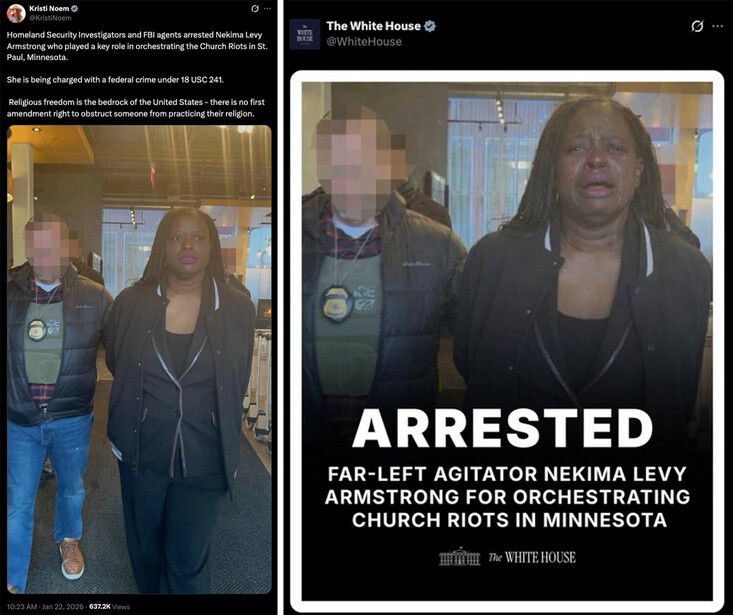
See the difference? The deception required little effort to expose. Secretary of Homeland Security Kristi Noem posted the original, unaltered photo of Armstrong (with the exception of a blurred agent's face), and then the White House posted the AI-edited version — both on X, formerly known as Twitter. When pressed by journalists, a White House spokesman responded, also on X, that, “the memes will continue.”
The implications of that response extend well beyond a single doctored image. In addition to generating fake photos that could plausibly be mistaken for real ones, this kind of official disinformation calls into question even content that is demonstrably authentic.
The shooting death of Minneapolis nurse Alex Pretti at the hands of federal Border Patrol agents offers a clear example. A retired general shared an AI-altered image of Pretti — who was holding a phone when he was shot — depicting him holding a gun instead.
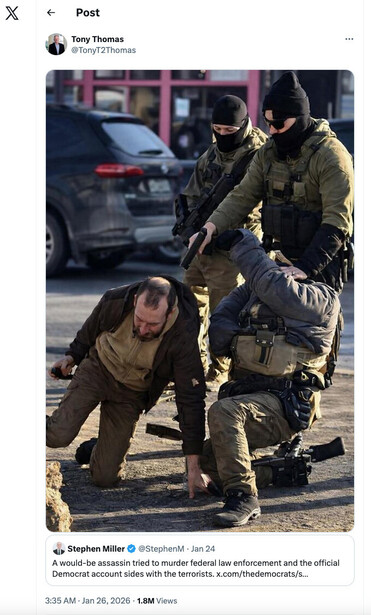
Multiple verified videos from that day contradict the altered image. The fakery is also technically obvious: one of the agents in the image is missing a head, and the fingers in the area where Pretti's phone should be visible are visibly distorted.
The deeper problem, however, is what happened next. When authentic video emerged showing Pretti kicking a tail light off a federal vehicle 11 days before his death, many social media users labeled it AI-generated, with no basis for that claim:
Longer footage from that same day, posted well before his death, corroborated the video. The proliferation of genuinely fake imagery had created enough ambient distrust that authentic documentation was being dismissed alongside it. That is perhaps the most damaging consequence of state-sponsored disinformation: it doesn't just deceive — it poisons the evidentiary environment entirely.
This problem is compounding at precisely the moment the industry is least equipped to address it. The Washington Post this month eliminated its entire photography staff as part of sweeping layoffs — all nine staff photographers and half its photo editors gone in a single day. The National Press Photographers Association's official statement on the layoffs put it best: “Every time a photojournalist and picture editor is laid off in our profession, it is one less set of eyes to document a reality that often challenges official narratives.”
And then there is the question of what comes after documentation fails entirely. The president of the United States recently reposted a video depicting AI-generated likenesses of Barack and Michelle Obama superimposed on the bodies of apes — a racist trope with a long history. Administration officials variously called it a joke, attributed it to other staffers, and ultimately deleted it without substantive comment.
A free press has always depended on a baseline assumption: that visual evidence could be evaluated on its own terms. That assumption is eroding, and the erosion is not accidental. Rebuilding public trust in visual documentation will require more than media literacy campaigns — it will require accountability from the institutions doing the manipulating.
How does that happen? I’m open to suggestions in the comments below.





Join the Fstoppers community for free
-
Post comments and join in the discussions
-
Browse the site ad-free
-
Share your work and get featured in the community
-
Compete in the photo contests for fun and prizes
3 Comments
We need a cryptographic system of digitally signed images such that digital signatures are validated *by default* on the apps consumers use to view the images: Facebook, Instagram, iMessage, TikTok, etc.
Basically cameras (starting with phone cameras) use a tamper-proof security chip to digitally sign images as they're captured. When viewing the image, devices check the hash to verify that the image hasn't been changed.
There's quite a bit more needed to make this work... like allowing basic edits (exposure, crop, etc) should probably be implemented within the metadata of the image, so the original image is still distributed but viewed with basic edits intact.
And how do you address the scenario of taking a picture-of-a-picture? Include extra data, such as secure GPS-based time and location, compass direction, so we can verify that the photographer really was there at the right place and time. Obviously this data should be stripped from sharing most images, but included by photojournalists or anyone sharing an "important" image.
It's a lot of work, but developing and deploying this requires way less effort than the AI infrastructure they're using to make the fake images.
Google & Apple need to start this effort, because they control the most popular operating systems and hardware. I pitched it to Google, and they asked how they would make money with it... soooo maybe Apple?? Honestly it's probably not coming anytime soon.
There is a little bit of this with the Content Authenticity Initiative but the major manufacturers need to embrace it in a big way, and they're not. It's crazy that Google said what they said to you.
What do you make of the photo the White House just posted of the hockey players at the WH? I feel like it's AI but it's to the point where I can't tell? The weather seems to be the dead giveaway.
Ahmad touches on the most dangerous byproduct of this era: not just the 'fake' image, but the erosion of our ability to recognize what is real.
As an educator focused on the architecture of seeing, I believe the antidote isn't just better metadata (though C2PA is vital), but a return to visual literacy as a core competency. When major outlets like the Washington Post eliminate their photography staffs, they aren't just cutting costs; they are dismantling the 'Institutional Eye'—the very gatekeepers trained to spot the structural and lighting inconsistencies that AI currently struggles to resolve.
Rebuilding trust requires us to move past 'consumption' and back toward 'observation.' We need to teach practitioners and the public alike to look for the structure of a scene—the geometry, the physics of light, and the narrative intent. I think in large part disinformation thrives in the shadows of visual illiteracy.