Scientists just released the highest-resolution images of the Sun's visible surface ever captured, taken in violet light at 416 nanometers. The pictures resolve features as small as 19 kilometers across and reveal tiny, swirling, whirlpool-like patterns nobody had directly seen on the Sun before.
The images and a time-lapse came out of the world's most powerful solar telescope, and the research was published in the journal Nature. According to the National Solar Observatory, an international team from the NSO, the NSF NCAR High Altitude Observatory, and Germany's Max Planck Institute for Solar System Research found the signature of Kelvin-Helmholtz instability on the Sun's surface, working from data collected by the NSF Daniel K. Inouye Solar Telescope near the summit of Maui's Haleakalā. These structures had been predicted by theory for decades but never confirmed on the Sun, and the new observations suggest they are not rare disturbances but an almost ubiquitous feature of the surface.
The physics here is the same thing you see when wind stirs waves on water. When two fluids move past each other at separate velocities, small disturbances along the boundary grow into swirling vortices, and you can watch the same shapes form in Earth's clouds and in the striped bands of Saturn. On the Sun, David Kuridze and colleagues zoomed into a magnetically active region near a sunspot and watched plasma boil up through convection cells called granules. The swirls appear at the edges of magnetic areas, and researchers suggest they might help explain why the Sun's outer atmosphere runs so much hotter than its surface, and how magnetic energy builds up and dissipates. That magnetic energy fuels flares and eruptions, the kind of activity that can reach Earth and affect satellites, power grids, and communications.
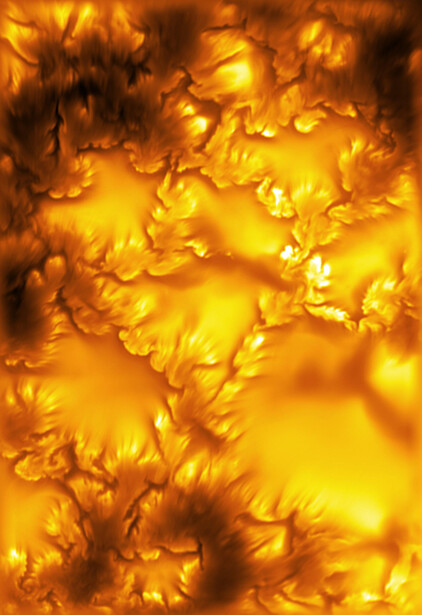
"The smallest resolved features in these images are around 19 km, which is also diffraction limit (highest achievable resolution) of the telescope," Kuridze said. That means the telescope is now working right at its optical ceiling, not leaving performance on the table. The Inouye pulls this off with a 4-meter (13-foot) mirror that collects roughly seven times more sunlight than any other solar telescope, paired with adaptive optics that correct for the atmosphere's blur in real time. The wavelength choice matters too. Shorter wavelengths resolve finer detail, and 416 nanometers sits in the violet end of visible light, which is part of why the surface detail is so extreme.
The team originally set out to test how far they could push the telescope's capabilities, not to hunt for these vortices specifically. That is a recurring pattern with the Inouye. Last year, researchers using its Visible Broadband Imager went looking for chromospheric spectral data and instead captured the smallest coronal loops ever imaged during a solar flare.
What comes next is less settled. The team is moving into a phase that uses software to automatically detect and study these swirls across the high-resolution data, which should reveal how much energy the instabilities carry into the upper atmosphere and how strongly they shape magnetic fields lower down. Improved space weather forecasting is a hoped-for downstream benefit. The immediate, verifiable win is the imagery itself: the Sun's boiling surface, with vortices swirling at the edges of every magnetic boundary in frame.
All images and videos courtesy National Solar Observatory (NSO).






Join the Fstoppers community for free
-
Post comments and join in the discussions
-
Browse the site ad-free
-
Share your work and get featured in the community
-
Compete in the photo contests for fun and prizes
No comments yet