
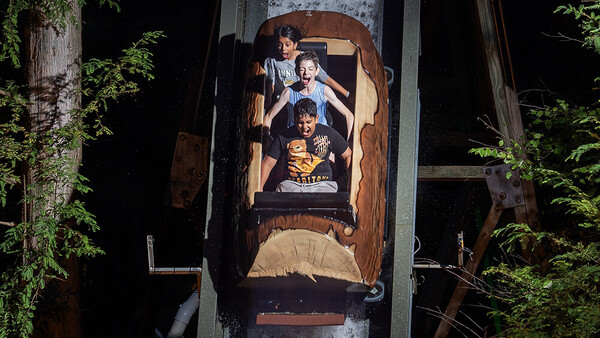
Who doesn't love a good theme park ride photo? Faces contorted in delicious mixes of fear, anticipation, and fun make for interesting photos. And while it's easier than ever to buy the photos, sometimes all you get is crushing disappointment in the form of thumbnail-sized photos that look like they were taken with a potato.
But the photo at the top of the post, at 8 megapixels, is much larger than a thumbnail-sized photo, and it decidedly does not look like it was taken with a potato. In fact, this night photo from Knoebels, in Elysburg, Pennsylvania, seems to have done better than this ride-cam photo in broad daylight from LEGOLAND in Goshen, New York, and is definitely much higher resolution than even the photos you pay for at Knoebels:
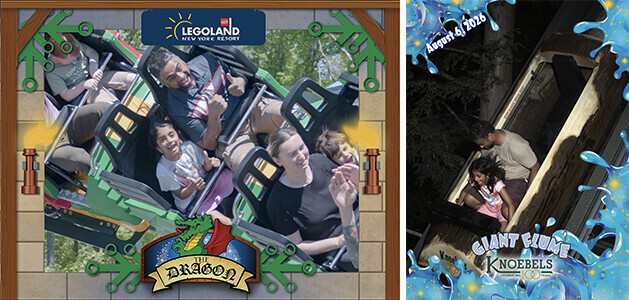
Why is that the case? The image of the three children on the log flume was taken using my own camera and not the theme park's. Even on an ancient camera, in this case the 11-year-old Olympus OM-D E-M5 Mark II, paired with a terrible-for-low-light lens, the OM SYSTEM M.Zuiko Digital ED 40-150mm F4.0 PRO, I still managed to make an image that worked out better than one would expect. Granted, I don't get the fun, themed frames, but I digress.
At first, I tried to brute-force the image. I changed the settings one would expect: ISO 6,400, f/4 (wide open for the lens), and a shutter speed that would give me a prayer of stopping the fast-moving log in action, 1/400. The results, unfortunately, speak for themselves.
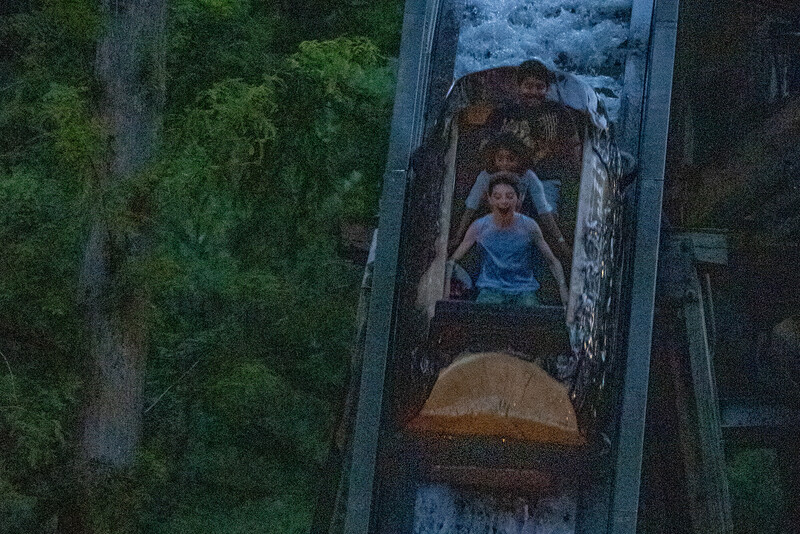
The resulting image has the image quality one would expect from a Micro Four Thirds camera at ISO 6,400 when trying to push the shadows in post. It's a noisy, blurry mess. Even if I had hit it, my kids' fairly dark skin made it hard to recover any details there. Simply put, this wasn't going to work.
Fortunately, with the help of my fellow traveling companion, who is also a photographer, we came up with a far better solution: use the park's flash system and make it work for me.
At first, I tried to time the shutter release at just the right moment for the log to pass. Even at somewhat slower shutter speeds, it was hard to time it just right. And there were only so many more times I'd let the kids talk me into letting them go on the ride again. I'd already let them go four or five times, in the name of science. But once my friend and I had that light-bulb moment, all it took was just one more ride.
Instead of trying to use my reflexes to catch the light, I balanced the camera on a railing, something steady enough to allow me to open up the shutter for a full second. That was enough to take the pressure off timing the flash and the log, allowing me a greater chance of capturing the kids in frame rather than relying on the split second they flew by.
In addition to slowing down the shutter speed quite a bit, I narrowed the aperture to f/7.1 for greater depth of field and a better chance of getting everything in focus (I had pre-focused roughly where the log would go, since on this camera, in this light, tracking focus is useless), and set the ISO to 320. This exposure, in the absence of the flash, appeared almost completely dark. But add in the flash, and there it is: the perfect theme park shot, in high resolution. The flash duration of whatever the park was using was enough to add the light needed to make the frame. You can even see the infrared beam in the photo that triggers the flashes when the log breaks the beam.
While this worked out, I still paid for the Photo Pass to get all of the photos from the trip that day (or at least the ones where I remembered to scan the QR code). I did it based on the principle of supporting a great, family-run theme park, but also so that I could be in some of the photos from the day. They may only be 810 × 1,080 pixels large, but at least I have them and the memories that go with them.


Join the Fstoppers community for free
-
Post comments and join in the discussions
-
Browse the site ad-free
-
Share your work and get featured in the community
-
Compete in the photo contests for fun and prizes
No comments yet