Most Iceland landscape work you scroll past now was made from the air, with wide drone panoramas that flatten an entire river system into a single graphic. Shooting the same terrain from the ground with a very long lens flips that habit and forces a different kind of seeing.
Andrea Livieri has been returning to the Icelandic Highlands for about eleven years, and he brought the Sigma 100-400mm on a Fujifilm body to break a pattern he felt in his own work. On an APS-C sensor, that lens gives roughly the same angle of view as a 150-600mm on full frame, which sounds absurd for landscapes until you watch what it does. Livieri shot almost everything handheld across an eight-day workshop, keeping the lens on his X-T4 even while driving between locations because scenes kept appearing along the road. At just over 1.1 kg, it takes up space, but paired with the Fujinon 50-140mm and the small Sigma 10-18mm, the kit stayed reasonable to carry.
Stabilization does not make a 600mm equivalent view behave like a normal lens, so Livieri held the camera firmly, raised the ISO without hesitation, and leaned on continuous low-speed burst mode. Between gusts, one frame in a short burst usually came out sharper than the rest, and he would rather accept a little noise than lose a shot to motion blur. He also makes a sharpness point most reviews skip entirely, using two frames of an IKEA sign in Rotterdam shot seconds apart, where the letters and edges physically change shape between frames. That is atmospheric distortion, not lens softness, and knowing the difference stops you from blaming a telephoto for something happening in the air between you and the subject.
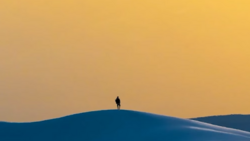
The creative argument sits underneath all the specs. Drone footage shows the Highlands from above beautifully, but it rarely shows the sand under your boots or the volcanic formations rising in front of you. Starting at 100mm meant Livieri could not zoom out when a composition got difficult, so he had to decide what mattered and cut everything else. In the Landmannalaugar area, he used the long end to pick out hikers moving through the terrain, and near Mælifell he isolated jeeps crossing an impossibly large landscape, tiny human figures that set the scale and added quiet action to an otherwise still scene.
There is a broader shift worth connecting here. The dominance of aerial imagery has made the overhead view the default way we picture certain places, which means the ground-level, tightly compressed telephoto shot now reads as fresh precisely because it is less common. Compression is the principle you can take from this regardless of where you shoot. A long focal length stacks distant elements against each other, pulls a far ridge up behind a foreground shape, and lets you build relationships between things that a wide lens would scatter across the frame. You do not need Iceland to practice it. Any layered landscape, hills behind hills, or figures set against something enormous, responds to the same approach, and the discipline of not being able to zoom wider teaches you to move your feet and find the smaller story inside the big one.
Not everything sailed through cleanly. Autofocus was quick and accurate in normal light but struggled when haze and sand killed contrast, costing him a few frames while stitching panoramas. The tripod collar is sold separately and runs well over €100, which he argues should be standard on a lens this long. He also compares the Sigma against the native Fujinon 100-400mm and the lighter Fujinon 70-300mm, laying out who each one actually fits, and the surprising limitation he ran into was the short end at 100mm, not the reach at 400mm.
Watch the full breakdown in the video above to see the Highlands frames Livieri built and hear exactly where he'd steer you toward each lens.



Join the Fstoppers community for free
-
Post comments and join in the discussions
-
Browse the site ad-free
-
Share your work and get featured in the community
-
Compete in the photo contests for fun and prizes
No comments yet