
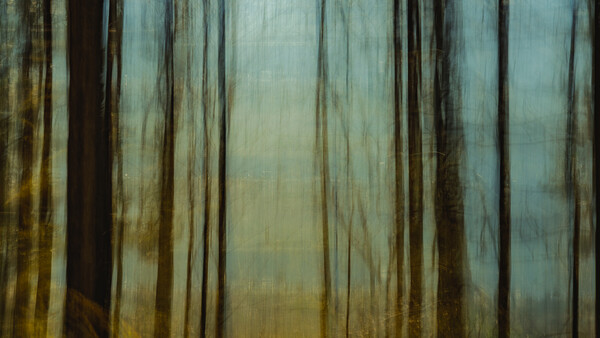
Photographers have been learning from painting for decades, but only from one half of it. Light, composition, proportion, tonal control — everything that strengthens representation has been absorbed and taught. And that is where the study usually stops. The moment painting stopped depending on the subject, photography largely stopped following it.
Photographers have been learning from painting for decades, but only from one half of it. Rembrandt's light, Vermeer's composition, Caravaggio's drama, the golden ratio, the rule of thirds, tonal transitions, and color harmonies all entered photographic education through academic painting. And that is where the study stops. Photography borrowed only the tools that strengthen representation. Once painting stopped serving the depiction of the world, photography treated the rest as irrelevant. Most curricula end at Impressionism. After that, it is no longer taught.
It is a strange omission. After Impressionism, painting went through at least another half-century of radical restructuring of the image. Color broke free from reality, form lost its stability, and the subject itself stopped being necessary. The image was no longer built around narrative but around relationships on the picture plane, between masses, intervals, directions, color zones, and empty space. Photography barely passed through any of these stages. It continues to learn from painting only as long as painting helps describe the world more effectively. Everything that begins after the abandonment of the subject remains outside its field.
But this is precisely where photographers run into the questions they face, especially when the subject weakens or disappears: how to organize the picture plane, how to create rhythm, how to hold attention without narrative, how to make an image work through form rather than recognition. These are no longer tasks of depicting the world but of constructing the image as a system. Not how to show the subject, but how to build a frame whose parts hold the eye even without the subject. Photographers almost never study this.
Fauvism was one of the first signals. Henri Matisse and André Derain showed that color is not obligated to obey reality. A tree may turn red, a face flatten into paint, a shadow lose its descriptive role. Color can alter the entire image at once, not just describe a thing. For a photographer used to treating color as a property of the object or the light, this matters directly. The Fauves showed that color can be an independent decision that restructures the whole frame. This already happens in photography, but it is rarely recognized. When the overall color of a frame shifts, the change is not about mood but about how the parts of the image relate to one another. Areas begin to carry different weight, and the boundaries between zones are read differently. The same applies when color becomes more saturated or more muted: the image does not simply become brighter or calmer, it restructures. Color no longer describes the scene but governs how it is read.
Cubism took the next step. Pablo Picasso and Georges Braque no longer treated the object as whole and stable. They disassembled form into parts, shifted viewpoints, and broke the familiar integrity of the subject. Painting moved away from describing how a thing looks toward showing how an image is assembled from fragments. For the photographer, the Cubist look is secondary. The operation matters: form can be reassembled, and the image is not bound to a single viewpoint. Photography almost never absorbed this lesson. It still too often treats the single viewpoint as natural rather than historically conditioned. This, too, already happens in photography, but it is rarely articulated. Reflections in a storefront overlay the scene behind the glass, a pane adds a second layer, a single frame can combine several moments of movement, and montage or collage brings together different fragments. The image stops belonging to a single viewpoint. The eye reads multiple layers at once, none resolving into a single object. The photograph no longer works as a window into a scene but as an assembly of distinct parts. The integrity of the subject matters less than the relations between those parts within the frame.
Abstraction went further and rejected the subject as mandatory. With Kandinsky, Malevich, and Mondrian, the object and the scene stopped being necessary. The move was deliberate. This marked a transition to an image built from lines, planes, color, and their relations. For photography, this is almost closed territory. Once the subject disappears, the photographer often loses the criterion. With it goes the logic of the image. This condition is familiar in photography, though rarely described. It appears in frames where the subject stops being legible: heavy blur, motion, dense urban fragments, macro views, reflections, and intersections of light and shadow where form no longer resolves into a recognizable object. Such images are often discarded as mistakes or failures because the subject cannot be named. Seen as a distribution of lines, shapes, and color zones, the image has not disappeared. Its logic has changed. The frame works through the relations between its parts, not through what it shows.
Abstract Expressionism turned gesture itself into part of the image. With de Kooning, each new layer of fast, overlapping strokes shifted the balance of the entire surface. With Kline, broad strokes on enormous canvases collided as large black and white zones, not as depictions of a subject. One zone occupies more space, cuts the surface harder, and feels heavier. The other opens up and feels lighter. The eye begins to read not an object but the distribution of weight in the image. Motherwell built a series of recurring black forms on a white ground, with rhythm set not by narrative but by the intervals between forms, the gaps between recurrences, and how often the eye moves from one to the next. In all these cases, movement creates relationships within the image. For a photographer working with motion, this matters. The gesture does not have to destroy the frame. It can organize it.
Color Field painting, within Abstract Expressionism, took a different path. Mark Rothko painted large rectangular fields of color with soft edges; one field reads denser and heavier, another more airy, receding into depth. Depth comes from how the eye reads adjacent colors, not from a depicted subject. Barnett Newman divided vast color planes with a single vertical line, a zip. The line does not split the image; it shifts the relation between two color zones. It introduces a sharp boundary, and the eye registers the difference across it. Color stops being a characteristic of a thing and becomes an independent force organizing the image. For a photographer working with blur, long exposure, or the weakening of the subject, this is a direct lesson: as the subject recedes, color relations can become the foundation of the image. This is rarely taught.
Minimalism showed something else: emptiness is a decision. Judd built works from repeating modules where the distance between elements mattered as much as the elements. Andre laid simple forms across a surface, and the space between them became part of the work. The point is not doing less. The point is that pauses between elements are as active as the forms. When something is removed from a frame, the remaining parts redistribute and hold the eye differently.
Hyperrealism appears almost opposite to abstraction, yet it comes after it. The hyperrealists returned to representation after these shifts, and did so consciously. Their realism was not a natural state of art but a position taken after painting had already learned it could exist without the subject. For the photographer, depicting the world after abstraction is a different act. After that experience, realism is no longer innocent: it becomes a choice the photographer makes.
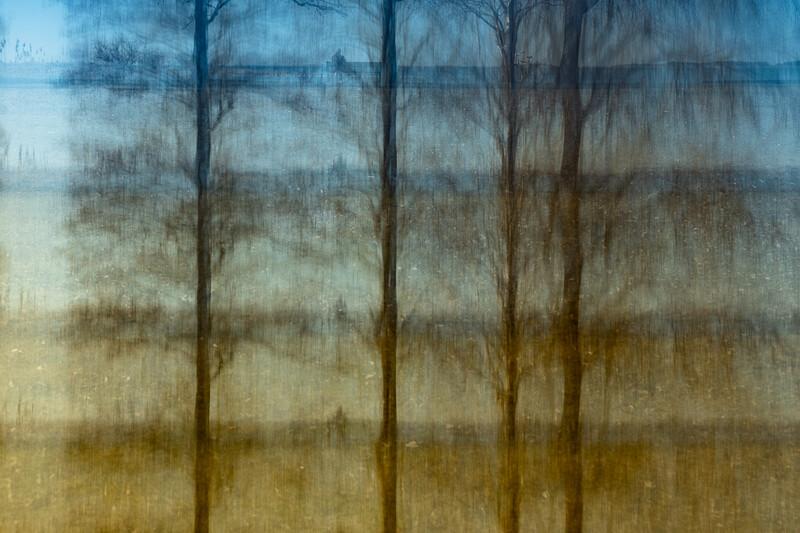
This is only a part of what happened to the image over the last 150 years, as the subject stopped being necessary. And this is where the question becomes practical. Photographers not knowing Rothko, Kline, or Judd is not the problem. Without that knowledge, they cannot see what is happening in their own frames when the subject weakens or disappears. They keep searching for narrative where they already need to see relationships. They keep searching for form as the shell of a thing where form has already become independent. They keep treating empty space as background, color as a property of the object, and movement as an effect rather than a means of constructing the image.
Looking at Rothko does not change what you are. It changes what you begin to notice in your own frames. One color starts to feel heavier than another. Large zones compete without any object. Empty space stops sitting in the background. Form no longer depends on a recognizable subject. In a portrait, the background stops being a neutral blur and works as a color mass in relation to the figure. In a landscape, the horizon line stops being just the boundary between earth and sky and works as a line that divides the plane, shifts the distribution of weight, and pulls the frame together. In abstract or semi-abstract photography this is easier to see, but it is not limited to it.
Knowledge does not oblige you to change your practice. It changes what you see, and therefore what you shoot. But as long as that knowledge is absent, half of art history remains invisible to those who make a living from images.



Join the Fstoppers community for free
-
Post comments and join in the discussions
-
Browse the site ad-free
-
Share your work and get featured in the community
-
Compete in the photo contests for fun and prizes
15 Comments
Really great article, as a photographer first who then transitioned to watercolour painting, I find the crossover between painting and photography fascinating, and often unexplored as your article clearly highlights. I also find so many painters who sneer at photography for not being an art - but I so disagree with that position, its just that many artists have not explored photography enough either.
Thanks! I actually came at it from the opposite direction. I started with watercolor and oil painting in my youth, and only discovered photography much later. So the feeling is very similar.
I also understand where that perception among painters comes from. Photography has a much lower visible labor cost, so at first glance, it seems to require less effort than painting. But photography works under different constraints. A painter can modify every element of the image directly. A photographer first has to find, recognize, and organize what already exists before deciding how to transform it. It doesn’t make the process easier. It simply shifts much of the work to what happens before the picture is made.
This is a great essay, Alvin. It prompted me to make the connection between Hopper and photographers like Gräf and Friedlander. Think of American empty urban landscape photographs, like gas stations, that draw directly from the American Realism movement. It's an obvious comparison (I'm no art historian), but when I see these photographs I think of Hopper's Nighthawks and the isolation they evoke.
Thank you. In my view, what matters is not whether the comparison is obvious or not, but what we compare, how we compare it, and how that leads us to reassess either our own work or someone else’s. I’m constantly trying to explore that territory.
Every photographer knows Rembrandt lighting. But there is also, for example, Caravaggio’s chiaroscuro, which I experiment with extensively. It is hard light—a Fresnel, for example—that literally pulls parts of the body or objects out of darkness. Or, for instance, I try to recreate in photography some of the artistic methods of Gerhard Richter, perhaps the most significant contemporary painter.
Stepping away from photographic routine and moving toward the study of art is a significant step. It doesn’t matter whether the resemblance ends up being formal or whether no resemblance emerges at all. What matters is that you are engaged in the process.
I’ve become deeply absorbed in this subject, and I’m genuinely interested in whether these ideas resonate with other photographers.
Lots to think about here Alvin! I'm often inspired by the abstract expressionists as I work with the chaos in my landscape work.
Thanks! That’s exactly the kind of connection I was hoping people would make.
Maybe photography stopped learning from painting, as painting evolved into surreal and abstraction, because photography is historically rooted in realism and that sort of painting is not. The camera was a device designed and manufactured to capture an image of the world as it is, not someone's imagination of it. I'm not trying to make a worn out "straight-out-of-the-camera" argument. I'm trying to distinguish between the basic fundamental purpose of a camera vs. paintbrush. Use the camera however you wish, but what's the point of trying to emulate a Rothko color field painting with a camera? It would be a weak imitation at best. That's like giving a hockey stick to a golfer and asking him to play the game with that. There's always a better tool than another for any given task. Naturally, the concepts of color and form and space are relevant to all forms of art and design, but without a subject, the photograph has no real meaning or substance.
Abstract photography has always existed alongside documentary photography. Just think of Man Ray, Ernst Haas, and many others.
And the article isn’t about imitating painting. It’s about something else. I find it difficult to imagine developing an original artistic voice in photography without understanding the language of modern art. Painting went through that process a hundred years ago. Now it’s photography’s turn. History repeats itself.
The meaning and application of abstraction has evolved.... from tightly cropped objects such as the human body as photographed in fragments by Alfred Stieglitz, and contrasty Paul Strand shadows which emphasized shape and form over subject -- to expressionist paintings that eliminated a subject altogether. The former merely looks closer at the subject, but nevertheless a photograph in its own right. The latter form of abstraction has no subject, which begs the question: why make the photograph instead of picking up a paintbrush?
While the purpose of your article may be secondary, the fundamental purpose and origins of ICM photography were to imitate painting. There is no such thing as original artistic expression in 21st century photography, because the act of clicking the shutter is inherently easy, and a gazillion pictures are made every day. I'm not saying that's inherently bad... everything we create is some sort of derivative of what we've seen before. And applying principles of color, shapes and form is a worthwhile endeavor in all art. In my opinion though, modern art serves mainly as a distraction for photography when one art form gets confused for the other, or when one attempts to mimic the other. I would rather be known for good photographs rather than photographs that look like a painting. I'll forgo any sort of originality and recognition in favor of simply making exceptionally good photos. There's a home for that too. Obviously I would have been more comfortable in the Ansel Adams camp instead of the Man Ray camp. Man Ray's total body of work was an experiment in everything but masterpiece of nothing. Adams created a few masterpieces of photography. That's my goal... to learn from the greatest photographers rather than painters.
It’s interesting that you mention Ansel Adams. He is actually one of the rare exceptions. Most of the photographers who fundamentally changed the language of photography did not study photography in isolation. Their work developed through an ongoing dialogue with painting, design, or architecture.
Here's an interesting side note. When photography was first invented around1880s–1915 there was a movement called Pictorialism. Photographers like Albert Steiner made photographs to resemble paintings by Claude Monet and Pierre-Auguste Renoir. It was a way to prove that photography was an art. It wasn't until you had Alfred Stieglitz, who decided that photography move to realism. So abstract from paintings is nothing new and in fact that was how the first photographers used it. The real question then is whether what the article is describing is going to gain popularity. It depends the aesthetics of the time and contemporary tastes.
I think that’s an important distinction. My point isn’t that photography should return to Pictorialism or imitate painting. It’s about understanding the visual language modern art has developed.
This is a very interesting and thought-provoking article, but I wonder if its central thesis—that many photographers have overlooked the lessons of modern painting—is fully accurate from a historical perspective. Entire photographic movements have been deeply influenced by modern art (including, it seems, the author's own intentional camera movement work), including Pictorialism and photographers such as Alfred Stieglitz, László Moholy-Nagy, Harry Callahan, Aaron Siskind, Minor White, Ernst Haas, and Franco Fontana.
Abstract photography has been a recognized genre for nearly a century, with many photographers drawing inspiration from modern painters such as Pablo Picasso, Henri Matisse, Jackson Pollock, and others. That makes me wonder whether the article's thesis applies more to much of today's photography education and camera-club culture than to the history of photography as an art form. It also made me think the headline might have been: "Have Today's Photographers Forgotten Yesterday's Abstract Photography Masters?"
Thank you. I’m really glad you left this comment. I intentionally simplified the argument to see whether it was worth developing further. In many ways, you’ve anticipated exactly where my thinking is heading.
I think you’ve identified the real issue. Mainstream photographic culture has gradually simplified the competencies it teaches, reducing them largely to the pursuit of technical perfection while leaving emotional perception largely to chance. And yes, my point is really about that educational gap, which has become much more visible today.
This might be the best article I've ever seen relating photography to all these concepts. I hope you write more along these lines and that others so gifted and informed are inspired to do the same. There might even be viable counter-arguments. If so, I'm up for them too.