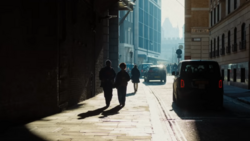
Street photography lives and dies by your ability to go unnoticed. In a genre where the goal is to capture real moments, your presence is the single biggest variable you can control.
Coming to you from Roman Fox, this practical video breaks down a concept Fox calls "bruising the scene," which refers to the moment your presence changes the behavior of the people you're trying to photograph. Once someone notices you and adjusts what they're doing, the shot is already different from what it would have been. Fox is clear that bruising the scene isn't always bad, since some street shooters do it intentionally to provoke a reaction or get eye contact. But if your goal is to capture moments as they naturally unfold, it's something worth learning to avoid.
Fox's first piece of advice is counterintuitive: don't try to be sneaky. Acting furtive, moving strangely, or doing half-hidden camera moves actually draws more attention to you, not less. The same logic applies to gear. Showing up with a Sony a1 and a 70-200mm lens plus a second body, an action camera, and a tripod sticking out of a backpack tells everyone around you that something is happening. Fox puts a Sony a7R with a 24-70mm lens roughly at the upper limit of what he'd bring without attracting unwanted attention. Smaller cameras like the Ricoh GR IIIx, the Fujifilm X100VI, or the Leica Q3 barely register.
Fox also talks about overstaying your welcome, and this is where things get more nuanced. A transient location like a cinema entrance gives you some buffer because people move through quickly and don't fixate on who's standing nearby. A small, quiet market is a different story. Stand in the corner for 20 minutes with a camera and people will notice, wonder who you are, and start imagining reasons you might be there. Fox's rule is simple: spend a minute or two, get what you can, and come back another day rather than grinding out an extended session that puts everyone on edge. He also shares a story about shooting in Morocco with his girlfriend, where a wardrobe change between two trips made a significant difference in how much attention they attracted while walking around. Blending in visually, matching the energy level of the environment, and not physically blocking people going about their day are all part of the same principle: minimize the footprint you leave on a scene.
There are a few more points Fox covers in the video that are worth hearing directly from him, including some specific advice about group size and social behavior that rounds out the full picture of how to move through a scene without disrupting it. Check out the video above for the full rundown from Fox.

Join the Fstoppers community for free
-
Post comments and join in the discussions
-
Browse the site ad-free
-
Share your work and get featured in the community
-
Compete in the photo contests for fun and prizes
1 Comment
I have an advantage. I'm 62 and a woman. I'm already invisible in society.