
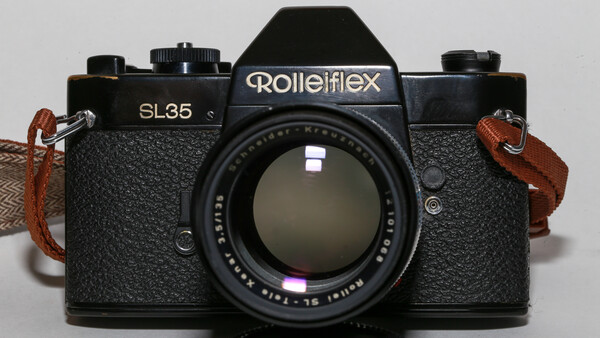
Every film shooter has a version of this story.
You finally talk a friend into trying film. They’re excited, they’ve seen all the moody Portra portraits and grainy street shots on Instagram, and they want to experience the magic themselves. You hand them a thrift-store SLR you scored for forty dollars, loaded with a fresh roll. They bring it back a week later with a nervous smile.
“The shutter sounds… weird. Is that normal?”
You get the scans back, and half the roll is banded, the other half is light-leaked, and one frame looks like it went through a microwave. Somewhere inside that camera, a forty-year-old capacitor is quietly giving up its last breath. That’s the moment you realize something:
We are trying to build the future of film photography on the corpses of cameras never meant to last this long.
If film has any sustainable future beyond nostalgia and boutique vibes, the camera companies must step in. Not with another film simulation preset. Not with a “retro-inspired” mirrorless body. With a real, honest-to-God, newly manufactured 35mm SLR.
One last great workhorse.
Film Isn’t Dead, But the Cameras Are Dying
The funny thing about the “film is dead” joke is that, economically speaking, film clearly isn’t.
Kodak is coating more than it was in 2015. Ilford is still happily selling ILFORD HP5 PLUS by the brick. Cine film is getting cut into still photography stock. Labs are opening, not closing, in a lot of cities. You can’t walk into a college photo program without seeing at least a few kids proudly clanking around with SLRs and point-and-shoots.
What’s missing isn’t enthusiasm. What’s missing is infrastructure.
Right now, if you want to shoot 35mm with any level of reliability, your options look like this:
- You gamble on a used body that’s older than you are, hope the seals aren’t dusty, and pray the shutter curtains still travel at the same speed they did during the Reagan administration.
- You spend as much on a CLA as you did on the camera, sending it off to one of the few remaining techs who have the parts and knowledge to work on it.
- Or you climb into rarefied air: Leicas, boutique rangefinders, and specialty cameras that are priced more like jewelry than tools.
None of that is friendly to the kid in the thrift store, the working photographer who wants to add film to their workflow, or the teacher trying to run an intro class without half the students’ cameras dying mid-semester.
Film stock can be manufactured if there’s demand and a coating line. But the cameras? They’re a finite resource. And every year, more of them cross the invisible line from “quirky and repairable” to “parts donor only.”
What a New SLR Should Actually Be
I’m not asking Canon to resurrect the Canon EOS-1V with eye-controlled focus and a spec sheet that reads like a 2002 brochure. I’m not asking Nikon to rebuild the Nikon F6 from scratch. That’s not realistic, and it’s not what film needs.
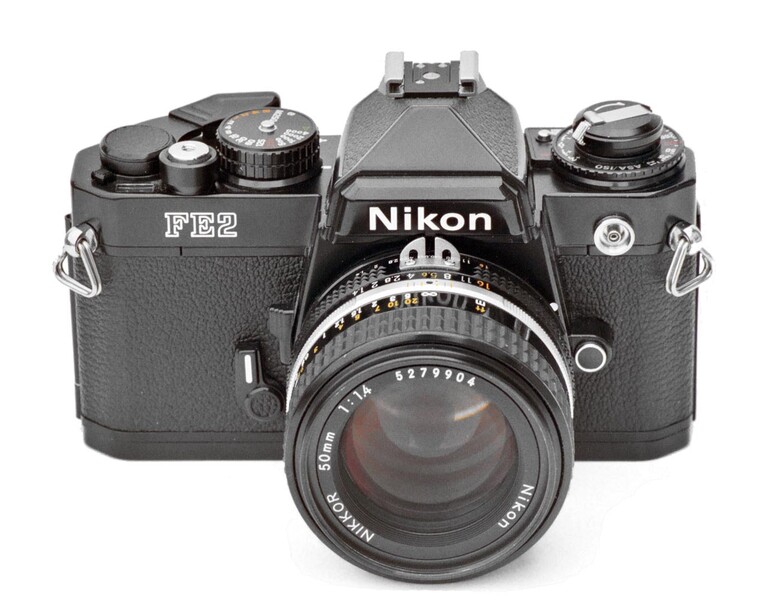
Film needs a new Pentax K1000. A new Canon AE-1 Program. A new Nikon FM2. A simple, robust, repairable SLR that can be sold to students, enthusiasts, and working photographers who want a dependable body that doesn’t come with a side of existential dread.
If I could design it, it would look something like this:
-
A mechanical shutter that works without a battery, with speeds of at least 1/1,000 s. The battery only powers the meter. If the electronics die, the camera doesn’t become a paperweight.
-
A native mount that takes existing lenses. Pentax sticks with K-mount. Nikon sticks with F-mount. Canon could make an EF-mount film body and instantly tap into a huge pool of lenses people already own. The marketing write-up basically writes itself: “Use the glass you already love, on film.”
-
A bright viewfinder with simple information. Meter readout in the finder, maybe a basic exposure scale or LEDs. No top LCD, no endless menus. Shutter speed dial, aperture ring, ISO dial. That’s it.
-
Basic, reliable metering. Center-weighted, maybe a simple evaluative mode. Give beginners something forgiving, but don’t try to compete with your mirrorless metering engine. Film shooters aren’t asking for 1,000-zone matrix metering. They just don’t want to guess.
-
Two models, not a cluttered lineup. One “student” body that’s purely mechanical with manual exposure. One slightly more advanced model with aperture-priority and maybe a built-in grip and better finder. Keep the choices simple and lean.
-
Service from day one. This is the big one. Build the camera to be serviced. Offer parts. Publish service manuals. Partner with independent technicians instead of locking them out. Make the camera something that can realistically last thirty years, not three.
That’s not a fantasy unicorn. That’s a modernized version of what the industry already did very well in the ’70s, ’80s, and ’90s. The difference is mindset: build for longevity and craft, not for being replaced by a new body in eighteen months.
“But It’s a Niche” (And Why That’s Okay)
Whenever this idea comes up, someone understandably points out the economics: retooling for film cameras isn’t cheap. The film market, while healthy compared to a decade ago, isn’t massive. Shareholders don’t get excited about “small but passionate niche markets.”
But that same logic falls apart the minute you look at what companies are already doing in other industries.
Vinyl never returned to mass-market dominance, yet turntables and records are a thriving business. Mechanical watches are a niche, yet brands pour R&D into them while smartwatches eat the mainstream. Fountain pens, typewriters, even analog synths—none of these are mass-market, yet they hold real value and cultural weight.
Camera companies don’t need film to “win” against digital. They just need it to exist in a serious, supported way.
A new SLR doesn’t have to be a loss-leader charity project. Price it honestly for what it is: a durable, specialized tool. Make it something a serious hobbyist or working photographer is willing to save for. If the body lands in the $800–$1,200 range, that’s not absurd in a world where people drop more than that on a single lens or a new phone every two years.
More importantly, it’s a branding move. In an era where cameras are racing toward “computers with lenses,” a film SLR says, “We still remember that photography is about more than firmware updates and subject-detection modes.”
That story has value.
Digital Nostalgia Isn’t Enough
Right now, most companies are chasing the film wave through simulations and presets.
Don’t get me wrong: I enjoy a good film profile as much as anyone. It can look great, and it has its place. But treating “film” as an Instagram filter misses the point of why people are coming back to analog in the first place.
They don’t just want grain. They want constraint.
They want the deliberate choice of ISO before they leave the house. They want the slow cadence of winding the advance lever and hearing the shutter. They want the suspense of waiting for lab scans or watching an image appear in the tray. They want to feel like they’re participating in a physical process, not just scrolling through twenty frames per second and picking the sharpest expression.
You can imitate the look of film. You can’t imitate the consequences of it.
That’s why film keeps pulling people in—even people who grew up completely digital. And that’s why, as fun as simulations are, they’re not enough on their own. If a camera company wants to honor that desire, it must give it the one thing it can’t download:
A brand-new, reliable, mechanical tool that shoots real rolls of film.
Every film shooter has a version of this story. You finally talk a friend into trying film. They’re excited, they’ve seen all the moody Portra portraits and grainy street shots on Instagram, and they want to experience the magic themselves. You hand them a thrift-store SLR you scored for forty dollars, loaded with a fresh roll. They bring it back a week later with a nervous smile.
“The shutter sounds… weird. Is that normal?”
You get the scans back, and half the roll is banded, the other half is light-leaked, and one frame looks like it went through a microwave. Somewhere inside that camera, a forty-year-old capacitor is quietly giving up its last breath. That’s the moment you realize something:
We are trying to build the future of film photography on the corpses of cameras never meant to last this long.
If film has any kind of sustainable future beyond nostalgia and boutique vibes, the camera companies have to step in. Not with another film simulation preset. Not with a “retro-inspired” mirrorless body. With a real, honest-to-God, newly manufactured 35mm SLR.
One last great workhorse.
A Challenge to the Big Three
Pentax launched the Pentax 17 in June 2024 under the Pentax Film Camera Project. Featuring a 25mm f/3.5 lens, zone focusing, and a vertical shooting orientation, the cool thing is that you can get up to 72 frames per roll due to it being a half-frame camera.
But imagine if Nikon built a modern FM2-style body that accepts every F-mount lens sold in the last 40 years. Imagine Canon releasing a stripped-down, rugged EF-mount film body specifically marketed to hybrid shooters: “Shoot your wedding on mirrorless, then load film for portraits.” Imagine any brand saying, “We know this is a niche, but we’re doing it because not everything has to scale to the moon to be worth doing.”
That’s the move that would earn loyalty from a generation tired of being sold nostalgia without substance. It would support film programs starved for reliable cameras and give repair techs a new, serviceable platform to keep alive. As Ryan Jones warned, repair expertise is disappearing—and without new cameras to work on, there’s little incentive for the next wave of technicians to learn those skills.
So, here’s the challenge, from one working photographer and film addict to the companies that built the cameras we love:
You’ve spent the last decade selling us on “heritage” through design language and marketing campaigns.
Prove you still mean it.
Build one last great 35mm SLR.




Join the Fstoppers community for free
-
Post comments and join in the discussions
-
Browse the site ad-free
-
Share your work and get featured in the community
-
Compete in the photo contests for fun and prizes
9 Comments
Presumably, these companies have lost their acquisition pipelines and manufacturing assembly lines for film cameras by this point. I'll be interested to hear from smarter folks than I, but I can imagine massive costs to make this happen again.
Just remember (or look up) the Pentax stories of the work going into their Pentax 17. Having to reverse engineer important parts of the camera, even though they had the working examples and (partly) archived Product Documantation from their own heritage available. Added indeed to the lost machining capabilities, supply lines and assembly comptences needed for a mechanically controlled camera. I think there's a reason for Pentax stopping after their "17".
Nikon made a special edition of their wonderful 1960s S3 rangefinder in 2000.
It would be lovely if they re-launched a special edition F. That would be the dream camera for me.
Surely the top camera companies could build this together, then just have a different mount so you can pick the body you need for the lenses you have.
This is where the L-Mount alliance could really make a huge impact.
The L-Mount is for mirrorless - flange distances don't match the mirror box in an SLR - thus foregoing the requirement to be able to use existing glass. A rangefinder might be conceivable, but in the alliance only Leica has any serious track record in such cameras, and they probably won't be tempted as they already have their M-Mount rangefinders.
At the age of six, i learned basic composition and how to use a light meter with grandad's Argus range finder. At twelve I learned to use dad's Honeywell Spotmatic with the three primes ( I still have two of them), at twenty one I bought my first SLR. It still works and uses those lovely old Takumar lenses. I have never stopped using film, although I shoot less of it now. Yes, the film SLR's I use are getting close to fifty years old, and I am quite careful with them. I can't envision Nikon or Canon playing on this field ever again, and Sony never did, but I would not bet against Pentax or Fuji giving it a try.
It all comes down to numbers, what's the market size at the required price point?
Production wouldn't be an issue as it would be outsourced, between 3D printing and China would make that possible. Something to consider, for the camera to be mostly mechanical, i.e. it can operate w/o a battery, that camera maybe more expensive to manufacture than entry level digitals. The resulting price might need to be $1600-$2000. What would be interesting to know, is what Leica's cost is to mfg the MA & MP or Pentax with the 17?
Former pro level SLR cameras in my collection continue to function well. These are now more affordable than a new build. For the $500 price of a Pentax 17, you can find a nice Nikon F4 or F5, both built like tanks.