
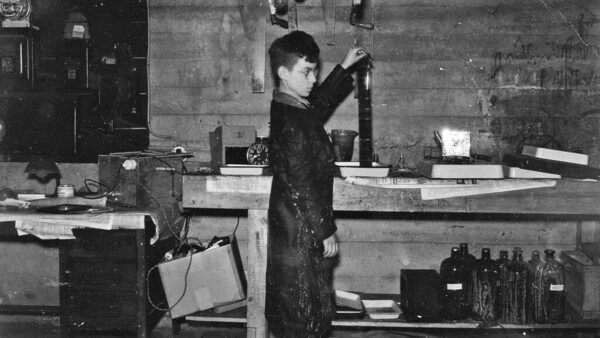
In late 2014, a lot of 31 undeveloped film rolls that had turned up at an auction in Ohio made its way to a photographer in Boise, Idaho named Levi Bettwieser, who started processing them one at a time. What rose up in the developer was a young American soldier's private record of World War II, shot on rolls that had sat exposed but unprocessed for roughly 70 years. Someone loaded those cameras, pressed the shutter, and then, for reasons no one will ever know, never got the film developed.
That box of rolls is the whole appeal of a strange little corner of photography compressed into one lucky buy. There is a small subculture of people who purchase exposed but undeveloped film sight unseen, gambling that a latent image is still hiding in the emulsion decades after the shutter closed. They buy it at estate sales, in thrift-store junk bins, and in "mystery roll" lots on eBay, and most of the time they have no idea what, if anything, is on it until the negatives dry.
The Mystery-Roll Gamble
Search eBay for exposed undeveloped film and you will find dozens of listings that read like lottery tickets. Sellers bundle unmarked 35mm canisters pulled from estate sales into lots of 4, 13, or 27 rolls and sell them as-is, with no promise about what is on them or whether anything survived. A listing might tell you the film is Kodak or Fuji, that the ISO is 200 or 800, that it came out of a deceased relative's closet, and nothing more. The pitch is the uncertainty. You are paying for the envelope, not the letter.
Some buyers are simply teaching themselves to develop, and a mystery roll is cheaper and lower-stakes than shooting a fresh one. Others are in it for the gamble itself, the chance that a random canister from a dead stranger's junk drawer holds a wedding, a road trip, or a face worth seeing. Most rolls deliver the mundane, when they deliver anything: blurred backyards, half-frames of a Christmas tree, a thumb over the lens. Every so often a roll pays off with something genuinely worth the wait, and that long tail of possibility is what keeps the market alive.
The Rescued Film Project
Bettwieser runs the best-known operation in this world, the Rescued Film Project, out of Boise. He spends his time trawling online auctions and flea-market bins for orphaned rolls, then develops them himself and posts the results. The project describes its holdings as an archive of more than 30,000 images pulled from lost and forgotten film, and Bettwieser has processed thousands of rolls to build it. His stated mission is blunt: to leave no roll of film undeveloped.
The WWII rolls are his signature find. Bettwieser has said the canisters carried handwritten labels with places like Boston Harbor, Le Havre, and a camp named Lucky Strike, all points along the path a soldier would have traveled to and through the European theater. A single unidentified man turns up in several frames, which led Bettwieser to guess the soldier handed his camera to others so he could get into his own pictures. Not every roll came back. Many were too far gone to yield anything, but enough survived to reconstruct a fragment of one anonymous life. You can see the recovered frames and read the details in the coverage of the 31 rolls of film.
Other finds have surfaced along the way, including a roll of seven previously unseen candid images of Dwight Eisenhower, which Bettwieser posted without being able to say where or when they were shot, asking the photography community for help placing them. None of this was made for the strangers who would eventually find it. These were personal cameras, loaded by people documenting their own ordinary and not-so-ordinary lives, and the film came loose from whoever shot it without ever being finished.
The Lab That Opens Time Capsules
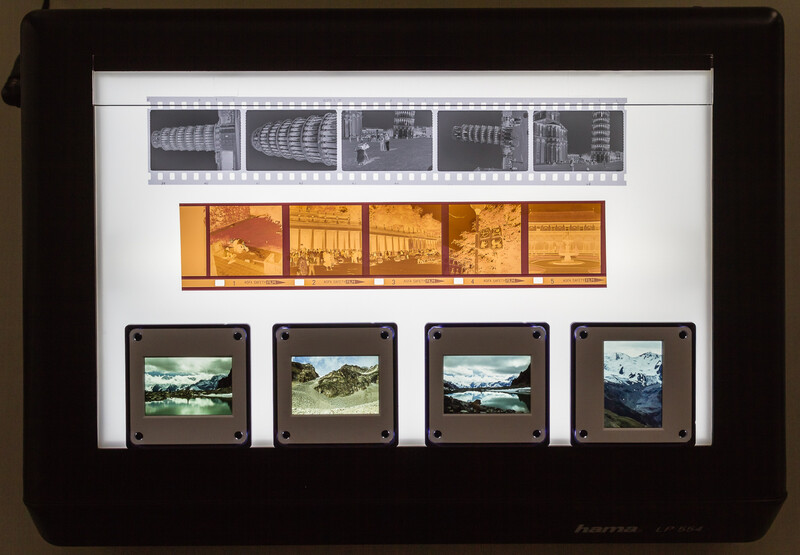
Not everyone who finds old film can develop it, and old film is not a job for your corner lab. That is where Film Rescue International comes in. Based in the small town of Indian Head, Saskatchewan, the company has specialized in expired and antiquated film since 1999, when Greg and Tracey Miller founded it. Greg had spent the previous 15 years running a motion-picture lab in Toronto and moved to Saskatchewan to work old film full time. The company keeps a reference database of more than 800 film types and does the processing in-house, because many antiquated stocks call for processes no ordinary lab still offers, while newer expired film may still need handling tailored to its age and condition.
The core problem is that a roll of orphan film is a puzzle. You often do not know the exact stock, the ISO, how it was exposed, or how it was stored, and every one of those unknowns changes how you should develop it. Film Rescue's safest route with much old color film is to process it as a black-and-white negative rather than gamble on the original color process, which is what they mean by "the safest way possible." A customer can ask for the color attempt instead when the stock and its condition justify the risk. By the company's reckoning, only 15 to 20 percent of long-expired film processed in color comes back with decent color. Their reasoning is that a recognizable black-and-white image beats a ruined color one, or as they put it, better "something recognizable in black & white versus nothing at all in color."
The company has worked with the Smithsonian and the LAPD and consulted for the Getty and the FBI, which tells you the work sits somewhere between darkroom craft and forensic imaging. Recently, Miller pushed it further toward the lab-coat end. He teamed up with an engineer he met on Reddit, Mattia Stellacci of the Technische Universitat Berlin, to build a purpose-built scanner. It carries a seven-channel light array: five visible-light channels and infrared, which together make the six exposures of a multispectral scan, plus a broad-spectrum white channel for live view and ordinary illumination. A 150-megapixel Phase One achromatic back records them, a monochrome sensor with no Bayer filter over it, so every channel arrives at full resolution. Merging those bands can tease detail out of a badly stained or faded negative that a single ordinary scan would lose entirely.
Why the Image Fades
When light hits film, it creates a latent image, a set of silver halide crystals nudged into a developable state but not yet turned into visible silver. Development is what amplifies that invisible change into a picture. But the latent image is not permanent. Over years, crystals that would have developed cleanly right after exposure quietly become undevelopable, so fewer exposed grains develop normally and the picture that finally comes up has less density and less contrast than it would have had. Left long enough in bad conditions, the latent image fades toward nothing.
Fading is only half the trouble. As film ages, it also fogs. Age fog is a general veil of density that creeps across the whole frame, exposed areas and blank areas alike, and it eats into the faint shadow detail you are trying to save. So a developer of found film is fighting two enemies at once: a signal that is dimming and a noise floor that is rising. Heat and humidity accelerate both, which is why a roll baked in an attic for 40 years often comes back as a gray smear while the same stock kept cold in a closet reads almost normally. It is also why a specialist may change the developer, the temperature, the time, or nothing at all, depending on the stock, to hold down fog before it swallows a fragile latent image.
Color makes everything worse. Color film carries multiple emulsion layers and the dye-forming chemistry that degrade unevenly and faster than plain silver, so an old color roll tends to shift, stain, and lose contrast in ways a black-and-white roll does not. That is the whole logic behind processing old color film as black and white. You give up the color that was probably already compromised to save the shape of the picture underneath.
If you want to gamble on your own mystery roll, work out what you are holding before you mix anything. An unmarked canister could be ordinary black-and-white, C-41 color, a stock made for a discontinued original color process, C-22 film or Kodachrome among them, that no home kit will return to color, or an emulsion fragile enough that one wrong bath ends it. Age carries a separate hazard as well. Cellulose nitrate was the most common film support of the early twentieth century, used by amateurs and professionals alike, and it turns up in roll film, sheet film, and motion-picture stock from roughly 1910 to 1950. Kodak phased it out around mid-century, but surviving nitrate is genuinely flammable and belongs with a specialist rather than in your bathroom. Where you know the roll is plain black-and-white film, home development is the forgiving place to start. A basic Paterson Super System 4 developing tank and a monobath like Cinestill Df96 let you develop at home in a single chemistry step, and a dedicated film scanner such as the Plustek OpticFilm 8200i will pull far more out of a thin, fogged negative than a phone snapshot ever could. When the stock is unidentified, genuinely antique, or the only copy of something that matters, a specialist lab is the cheaper mistake. From there, most recovered scans need real rescue work in software.
Whose Photos Are These?
Every rescued roll raises a question that no chemistry solves. These are often strangers' private pictures, developed and posted when the photographer is unidentified or cannot be asked, because the film has come loose from whoever shot it. Bettwieser is candid that the work has a voyeuristic edge. "It's pretty voyeuristic," he has said. "You're watching people in their most intimate, private moments that people never get to see." He has described wrestling with whether to put the images online at all, not wanting anyone to feel mocked or exposed.
He has said he set rules to keep the project on the right side of that line, chiefly that the film be genuinely orphaned from its original photographer, or in need of rescue because of extreme age or degradation. The defense is that the archive has real historical and anthropological value, a ground-level look at how ordinary people actually lived and photographed themselves across the twentieth century, and that the alternative to rescuing these rolls is a landfill. Both things are true at once. The pictures are a public good and an intrusion, and the people in them never got a vote.
There is a legal question underneath the ethical one, and buying the film does not settle it. Under US law, copyright in a photograph normally begins with the photographer, subject to exceptions such as a qualifying work made for hire, and it can later be transferred or pass to heirs. Owning the physical negative is a separate thing from owning that copyright, though a sufficiently old photograph may no longer be protected at all. Finding a roll in a junk bin settles none of it.
The ethics get murkier the closer a roll gets to living memory. A 90-year-old negative of a stranger reads as history. A 30-year-old roll might show someone's mother, alive and findable, who never chose to be seen this way. Part of the appeal of found film is exactly that tension, the sense that you are trespassing into a life that was meant to stay sealed. When you buy a mystery roll and drop it in the tank, you are betting on more than chemistry. You are betting that whatever surfaces was worth pulling back into the light, and hoping the stranger who shot it would have agreed.
Lead image: Don O'Brien (dok1), CC BY 2.0. Source.







.jpg)

Join the Fstoppers community for free
-
Post comments and join in the discussions
-
Browse the site ad-free
-
Share your work and get featured in the community
-
Compete in the photo contests for fun and prizes
1 Comment
I don't have to go to estate sales. I have several dozen rolls that I shot myself, but never developed, and have long since forgotten the subject matter. When I finally get a round tuit . . .