
Planning a landscape photography trip is something I spend a considerable amount of time doing, and living here in Ireland means that checking the weather is an important part of that process. The conditions can change quickly, and even when you use several weather forecasting apps, there is never a guarantee that things will work out as you hoped. However, I have learned that waiting for a forecast that promises perfect conditions can mean missing opportunities that were worth pursuing in the first place.
For me, planning is not about trying to guarantee that I will get the photographs I want. It is about understanding what might happen, assessing the chances of success, and deciding whether the opportunity is worth taking. Sometimes the forecast gives you a strong indication that the conditions will work in your favor. On other occasions, it offers little more than a possibility. The challenge is knowing when that possibility is enough to justify getting the camera ready and heading out.
Using Weather Forecasts to Plan a Photography Trip
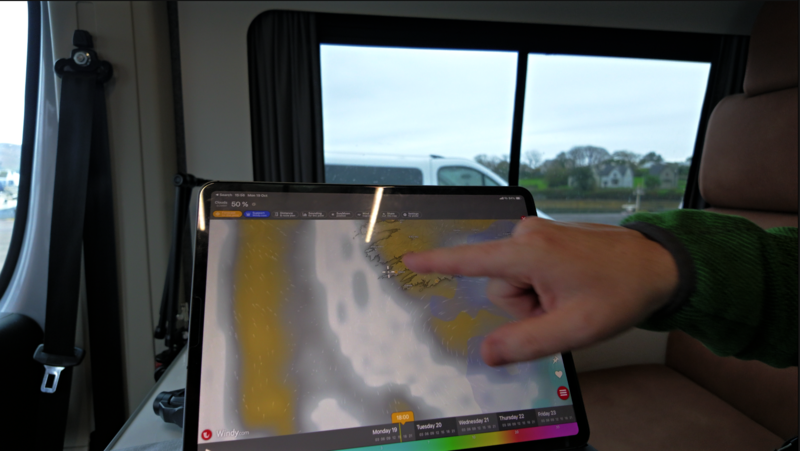
When I plan a landscape photography shoot, I regularly use Windy and Yr to look at the predicted weather conditions. Both are useful tools, but I do not treat either as a guarantee of what will happen. Instead, I look at the information they provide and try to build a picture of how the conditions might develop around the time I want to photograph.
Cloud cover is particularly important when I am planning a sunset shoot. It is easy to look at a forecast showing extensive cloud and assume that there will be little opportunity for photography. However, the amount of cloud is only one part of the picture. Where that cloud is positioned, how it is expected to move, and whether there might be a break near the horizon can all influence what happens at sunset.
This is why I like to look beyond the headline forecast. I want to understand the conditions across the area I intend to visit, rather than simply checking whether rain is expected or whether the sky will be cloudy.
Windy and Yr help me assess those possibilities, but I still need to interpret the information in the context of the location I plan to photograph. A forecast that looks unpromising at first can sometimes contain a small opportunity that is worth investigating.
The important thing is to recognize the difference between a forecast that offers no realistic opportunity and one that suggests there is a chance, even if that chance is relatively small.
Looking for the Opportunity Within the Forecast
One of the things I pay attention to when planning a sunset shoot is the area around the western horizon. If there is extensive cloud cover overhead but a gap towards the west, there may be an opportunity for the sun to reach the horizon through that opening.
Of course, there are several things that need to happen for this to work. The gap needs to remain open at the right time, the sun needs to be positioned appropriately, and the conditions between the photographer and the horizon need to allow some light through. There is no guarantee that all these factors will come together.
However, if the forecast suggests that they might, I will consider taking the chance.
This is where I think experience becomes important. Over time, you begin to understand which conditions are worth pursuing for the type of photography you enjoy. You also learn that a forecast should inform your decision rather than make it for you.
I am not suggesting that every forecast deserves a trip to the coast. If the conditions are completely unsuitable, or the time and effort involved outweigh the realistic opportunity, I may decide to stay home or choose another location. But when there is a possible gap in the clouds, and I have a suitable location available, I am often willing to give it a chance.
After all, the forecast cannot show you exactly what you will see when you arrive.
Why I Would Rather Have a Chance Than Miss the Opportunity
There is a simple question I ask myself when deciding whether to head out: What do I stand to gain if the forecast works out, and what am I likely to lose if it does not?
If I am already in the area, have a suitable location in mind, and can get there without too much difficulty, a small chance of good light might be enough. The same opportunity might not justify a long journey if the conditions look particularly uncertain and I have limited time available.
This is not about taking every possible chance. It is about making a decision based on the circumstances.
I also try not to think of success purely in terms of getting the sunset I originally wanted. A trip can still be worthwhile if the light does not appear. I might discover a composition I had not considered, learn something about a location, or understand how the tide and water movement affect the foreground.
That does not mean every unsuccessful trip needs to be presented as a learning experience. Sometimes the conditions simply do not work out. But I do not want the possibility of that happening to prevent me from pursuing an opportunity that could be worthwhile.
If I stay at home, I know I will not get the photograph. If I go, there is at least a possibility that things will work out.
Planning Beyond the Weather
Although the weather is an important part of my planning, it is not the only consideration. I also need to think about the location, the direction of the light, the tide, and the time available to work.
For coastal photography, tide levels can make a considerable difference to the compositions available. A beach that works well at one stage of the tide might offer very different opportunities a few hours later. I therefore try to understand whether the water level is likely to support the type of photographs I want to make.
I also consider access and safety. A possible sunset is not worth pursuing if the conditions make the location unsafe, and I always need to be aware of the sea and have a way to move away from incoming water.
Having a plan also means knowing what I might photograph if the light does not develop as expected. I may have a particular composition in mind, but I want to arrive with the flexibility to look for alternatives rather than relying entirely on one outcome.
This is especially important when working with uncertain weather. If the light does appear, I want to be ready to make use of it. If it does not, I want to have other options to consider.
The more thought I put into these decisions before leaving, the better prepared I am to work with the conditions when I arrive.
A Practical Example From the Beara Peninsula
My recent trip to West Cork provided a good example of why I am prepared to take these chances.
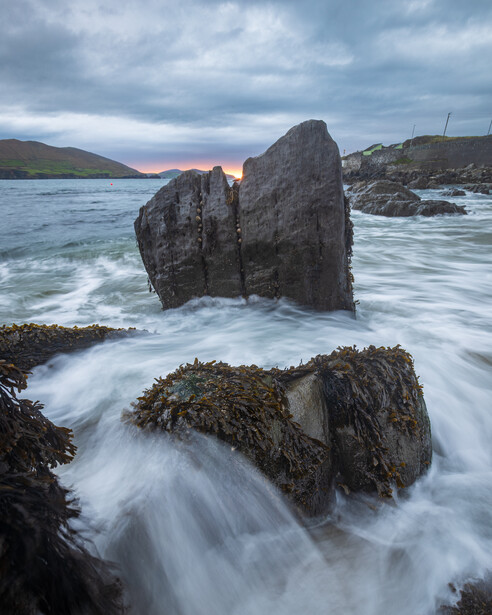
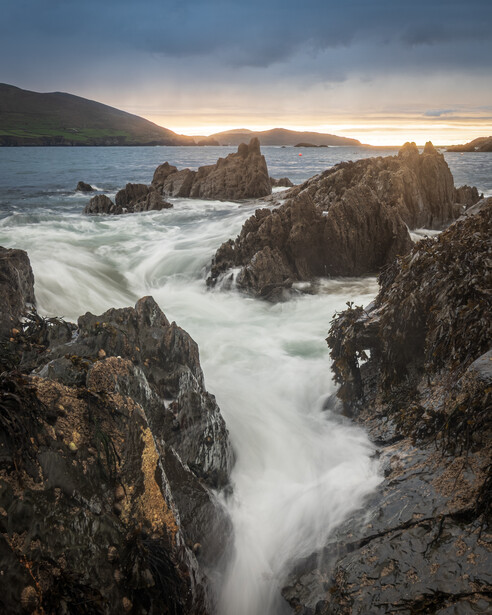
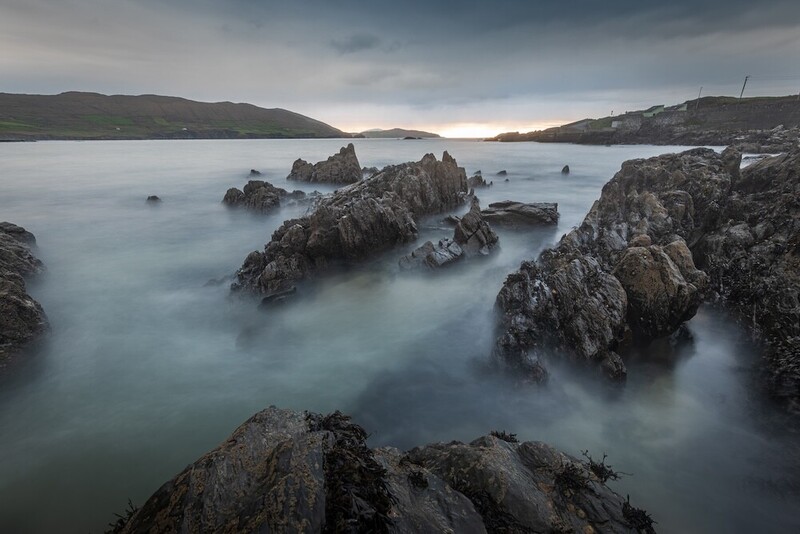
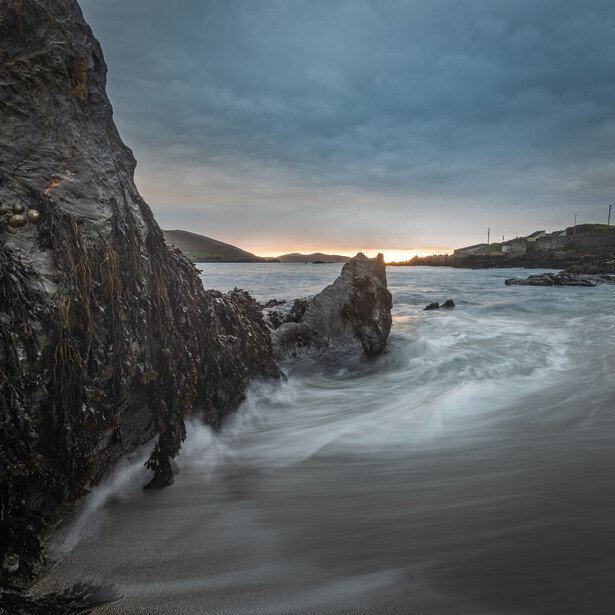
Before heading out to photograph Ballydonegan Beach on the Beara Peninsula, I had been looking at the forecasts on Windy and Yr. There was cloud all around, and the chances of getting the light I wanted appeared limited. However, there was a possible gap towards the west that the sun might drop into as it approached the horizon.
It was far from certain that the gap would remain open, but there was enough of a possibility to make the trip worthwhile.
When we arrived, we started working with the conditions available to us. The tide was not quite as high as I would have liked, but there was enough water around the rocks to provide several compositional opportunities.
As the evening progressed, a glow appeared along the horizon. We did not get the direct sunlight we might have hoped for, as a rainstorm between us and the sun prevented it from lighting the beach. Nevertheless, the opening in the cloud had provided enough light to make the decision to go worthwhile.
The important point is not that the forecast was completely right or that we somehow predicted the sunset perfectly. We identified a possibility, considered whether it was worth pursuing, and put ourselves in the right location to take advantage of it.
Had we decided that the forecast was too uncertain, we would have missed the opportunity altogether.
Sometimes, You Just Have to Go
I think one of the most useful things you can learn as a landscape photographer is to stop treating weather forecasts as a simple yes-or-no decision.
A forecast showing cloud does not automatically mean that a sunset will be unsuccessful. Equally, a forecast suggesting clear skies does not guarantee that you will get the light you want. There are too many variables involved, and that uncertainty is something we have to accept when photographing outdoors.
Using apps such as Windy and Yr helps me understand what might happen, but the final decision still comes down to assessing the opportunity and deciding whether it is worth taking.
My advice is to spend time looking at the forecast, understand what you are hoping to see, and consider whether the location and timing give you a reasonable chance of success. If there is a possible opening in the clouds, and the trip makes sense from a practical point of view, do not dismiss it simply because the forecast is not perfect.
You might arrive and find that nothing happens. That is part of landscape photography, and it will happen more than once. But you might also find that the conditions develop in your favor, even if they do not turn out exactly as you expected.
That is what happened on the Beara Peninsula. We took a chance on a narrow gap in the clouds, and although we did not get the direct sunlight we had hoped for, there was enough light to make the trip worthwhile.
Planning helps you identify the opportunity, but you still need to be willing to act on it.
Sometimes the forecast will be wrong, sometimes the conditions will disappoint you, and sometimes everything will come together. You cannot control which of those outcomes you get, but you can decide whether to give yourself the opportunity.
And sometimes, that means going out just in case.
Do you have examples of a scenario just like mine? I would love to hear about it. Let's chat in the comments below.






Join the Fstoppers community for free
-
Post comments and join in the discussions
-
Browse the site ad-free
-
Share your work and get featured in the community
-
Compete in the photo contests for fun and prizes
1 Comment
Where I live in Colorado, visitors from out of the area often plan photo trips based on their expectation of peak fall colors, a short window of time when forests are ablaze with color. Most photographers prefer stormy weather but weather in the mountains changes rapidly and often unpredictably. I can't say that an hour's drive into the mountains requires much planning, but when the grand landscape picture turns out to be a bust, I turn my eyes to what's underfoot. Light and clouds are less of an issue, and Plan B always yields interesting subjects if you look when plan A isn't working.