Sony's 24-50mm f/2.8 G is a compact fast standard zoom for full frame Sony bodies, and the Thypoch Voyager 24-50mm f/2.8 goes straight after it with autofocus, an internal zoom, and a much lower price. If you build a compact kit for stills and video, a cheaper lens that keeps pace with Sony's own glass changes how you split your budget between body and lens.
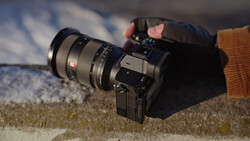
Setting up a card table on the shore of a bay as his test scene, Matt Irwin puts the Thypoch Voyager 24-50mm f/2.8 up against the Sony FE 24-50mm f/2.8 G at the lens maker's request. At B&H, the Thypoch sells for $649 to the Sony's $1,198. The two lenses share a lot on paper. Each has an AF/MF switch, a function button, and a lens hood in the box. The Sony's aperture ring can be clicked or declicked, and the Sony extends as you zoom. The Thypoch stays the same length from 24mm to 50mm, yet with hoods off, the two stand at nearly the same height. Irwin also finds the Thypoch nicer in the hand.
Irwin checks the frame size first. At 24mm and 50mm, the two fields of view look all but identical, so the rest of the comparison is fair. The sharpness results are close. Pixel peeping on an air vent in the top left corner and on the table and chair legs, the Sony looks a touch crisper. On the buildings and windows in the background, the Thypoch pulls ahead. That pattern suggests the gap may come down to where critical focus landed on each shot rather than the glass. Irwin calls the difference "a hair," and it only shows when the files sit next to each other at high magnification. He also runs video on a Super 35 crop, where 50mm gives roughly a 75mm field of view, and he sees nothing through the viewfinder that separates the two.
Tamron and Sigma have made autofocus zooms for decades, while most Chinese lens makers built their names on manual focus primes, then autofocus primes. A fast zoom with autofocus is a harder project, and the Voyager is Thypoch's first, which shows how far that group has come in a few years. The internal zoom has practical weight for anyone who shoots video. A lens that doesn't change length keeps its balance point fixed on a gimbal, so you don't have to rebalance every time you reframe. It also doesn't push air in and out of the barrel as you zoom. Irwin mentions that a Z mount version is coming. Nikon's own lens in this range is the Nikon NIKKOR Z 24-50mm f/4-6.3, a slower kit zoom, so a constant f/2.8 option at this size would fill a real gap in that lineup.
The autofocus test pairs the Sony a7 V and the Sony a1 II with matching codecs and matching settings: 1/1,000 s, f/2.8, ISO 100, and AF responsiveness and speed set to five and seven. Irwin racks focus from the background to a subject entering the frame and back again, first at 24mm and then at 50mm. He steps through the footage frame by frame to compare focus breathing. He also looks at how each lens renders out-of-focus highlights toward the right side of the frame, and one lens draws them in a noticeably different shape than the other. That bokeh comparison is where he says the two designs differ most.
The side-by-side bokeh frames are in the video above.




Join the Fstoppers community for free
-
Post comments and join in the discussions
-
Browse the site ad-free
-
Share your work and get featured in the community
-
Compete in the photo contests for fun and prizes
No comments yet