The Lumix S9 packs 6K open gate full frame recording into a body small enough to disappear in one hand. That combination of size and capability keeps pulling street shooters and hybrid creators toward it, even as newer bodies pile up on the market.
Wandering through central London with the Lumix S9 and the Lumix 24-60mm f/2.8 mounted up front, Samuel Bassett from OpticalWander works St. Paul's Cathedral from angle after angle instead of grabbing one clean frame and walking off. He shoots the classic reflection of the dome, then uses a metal grid on the ground as a leading line toward it. Then he flips the focus, throwing the cathedral into bokeh so the grid becomes the subject and everything else falls back into the story. The 24-60mm range lets him go wide at 24mm for the establishing shot, then punch into 60mm for something tighter and more unusual, all without swapping glass.
That habit of milking a single location is the real lesson buried inside the gear talk. When Bassett spots three or four stacked reflections of St. Paul's in the same puddle, he drops low, sticks to 24mm, and pulls a frame that looks nothing like the postcard version everyone else shoots. Later, in St. James's Park, he switches gears entirely with a panning shot at a 30th of a second, f/7.1, ISO 100, letting the background blur while a subject stays sharp. These are two completely different techniques pulled from one afternoon, and both come down to slowing down and looking harder at a spot most people would rush past.
Street reflection work like this rewards the wide end of a zoom more than most photographers expect. A 24mm focal length gets low and close enough to stack multiple reflections in a single puddle, something a longer lens compresses out of the frame. If you want to try it yourself, the move is to find any pooled water after rain, drop the camera nearly to ground level, and hunt for the angle where a recognizable landmark repeats. Pair that with a slow shutter panning technique for moving subjects, and a routine walk turns into a session with real variety. This approach fits anyone who shoots in dense cities where the same monuments get photographed a million times, because the goal is finding your own frame rather than repeating the obvious one.
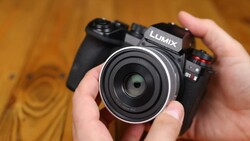
Bassett is honest about where the S9 frustrates him, and the grip tops the list. The front of the body is nearly flat, with a small notch that does little to help, and one-handed shooting leaves him worried the camera will slip out of his fingers. A cage plate or an add-on grip handle solves it, but the flat design is a knock against an otherwise pocketable body. He also misses the fully articulating screen he's grown used to on the Sony a7R V, since the standard tilt screen on the S9 can't flip up when it sits flush, and there's no EVF to fall back on. The single SD card slot gets a mention too, though he shrugs it off given how far data recovery software has come.
The value argument leans on the L-mount. Sigma makes more lenses for L-mount than any other mount, so you can build out a kit affordably instead of paying premium prices for first-party glass. The S9 with the 24-60mm runs around $2,000, but a Sigma alternative drops that number while keeping the same 24-megapixel full frame sensor and 6K capability behind it. That math is where the camera earns its place for creators who care about spending less to shoot more, and Bassett points out the color way and 440 g weight as small extras, even if the plasticky feel keeps it from feeling premium.
The video above walks you through every one of those reflection setups and the panning sequence, so watch it before your next city walk to see how Bassett reads a location.



Join the Fstoppers community for free
-
Post comments and join in the discussions
-
Browse the site ad-free
-
Share your work and get featured in the community
-
Compete in the photo contests for fun and prizes
2 Comments
Probably because eeven without a flash, the camera is freaking awesome. I am constantly amazed at the quality of the images that come out of this body and the Ibis is absolutely legendary. Honestly it's clarity of image that I wish I could get out of my R5 but it is what it is. In comparison and R5 images basically just a big 24 megapixel image smoothed over a bit. I love my R5 but I'm not faking what's actually coming out of it. It doesn't look any better and actually maybe slightly worse than images from a 5d3, high ISO notwithstanding.
And unlike my Canon r5, I just bought the sigma 35mm 1.4 MK2 and am currently testing it. It's beautiful to actually have lens choices even though Lumix definitely has its own challenges. Canon users have fantastic bodies to work with but also you're in lens jail. And you better have deep pockets.
Lastly - the S9 was the camera that Lumix needed, and the upgrade path to a version 2 iis the easiest upgrade out of any camera body currently on the market. It's going to be gangbusters. And it's also not as goofy as the a7c, although I would argue that without a metal cage grip the handling is absolutely atrocious.
My 2c, love my s9 and SIGMA.LENSES.
Personally for me the Sony A7C II wins over this camera. Better grip, battery, viewfinder, more megapixels, better selection of lenses with the E mount, very small and portable but...it is twice as expensive.