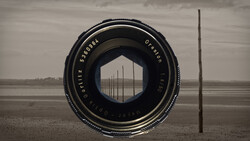
Low f-number lenses have always been a kind of optical myth. You chase them for that magical look in dim light, but the physics behind them is rarely simple. The pursuit of brighter images and faster glass isn’t only about collecting more light. It’s about understanding how light itself bends, refracts, and behaves once it passes through a lens.
Coming to you from Ben Krasnow of Applied Science, this detailed video breaks down what makes ultra-fast lenses work and where their limits really are. Krasnow builds a working f/0.38 lens using a microscope objective normally designed for oil immersion. It’s an unusual approach, but it works—sort of. He uses a single-board camera, a 3D-printed mount, and coupling oil to connect the lens directly to the image sensor. The oil eliminates the thin layer of air between the sensor and glass, which otherwise scatters light and reduces transmission. Removing the sensor’s protective glass, though, isn’t easy. Krasnow admits he destroyed several cameras getting it right. What’s fascinating isn’t just that it worked; it’s that this unconventional build reveals why the limits of low f-numbers are more theoretical than absolute.
The comparison footage between the custom f/0.38 build and a standard Micro Four Thirds camera with an f/1.4 lens is striking. The low f-number lens captures significantly more light, especially in shadowed areas. Yet the expected razor-thin depth of field never appears. Everything stays in focus, from close-up objects to distant details. The reason lies in focal length. The microscope objective Krasnow uses has a focal length of about 4mm, so even though it’s fast, that short focal length keeps the depth of field large. The video shows how aperture and focal length interact and why you can’t get cinematic blur from a lens designed for microscopy.
Krasnow also walks through why theoretical limits exist at all. The fastest commercial lens ever made, the Zeiss Planar 50mm f/0.7, used by Stanley Kubrick for Barry Lyndon, approaches the physical boundary of what’s possible in air. To go beyond the maximum possible aperture in air, you’d need to change the medium between glass and sensor, which is exactly what the coupling oil accomplishes. It’s a clever way of bending a physical rule by altering the environment rather than the optics themselves.
Later, Krasnow untangles a long-standing confusion between f-number and numerical aperture. He challenges a formula that appears all over the internet (numerical aperture equals one over twice the f-numbe) and tests it against real measurements. His experiments suggest that, while the math seems simple, the real relationship only holds for lenses corrected for spherical and coma aberrations, known as “aplanatic” lenses. In other words, if your lens is full of optical distortions, that clean equation doesn’t mean much. Check out the video above for the full rundown from Krasnow.




Join the Fstoppers community for free
-
Post comments and join in the discussions
-
Browse the site ad-free
-
Share your work and get featured in the community
-
Compete in the photo contests for fun and prizes
1 Comment
Glad to see there are limits! But like all Photographers are Mad Scientist without limits.
Canon film lens FD 55mm f/1.2 is great. I think and believe back in my film days fast class as it is called today was for hand holding captures with the right film. You will find many film lenses that are very wide f/# wise and as another point when on todays digital cameras very little if any lens correction is needed. When I went Sony in October 2014 with the A7SM1 you could buy on camera apps one was Lens Correction and using a $20 lens adapter you could have all your old film FD lens and for each a pre loaded LC that you could make and adjust, I found very little if any needed for my old film Lens. Yes they were not chipped so you had to use a program like LensTagger to put the lens info in the metadata of the digital info in Lr. Saving you money was a Sony early draw!