
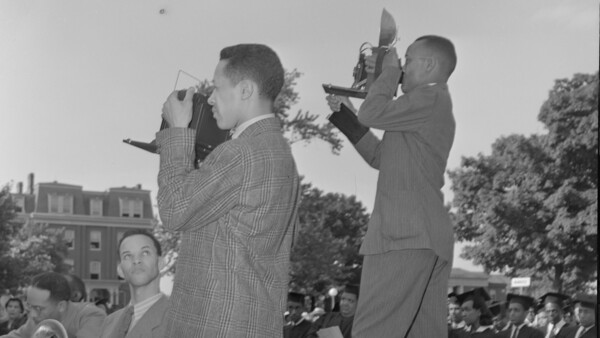
Florestine Perrault was fourteen when she started earning money in photography, hired as a clerk, photo finisher, stationery embosser, and developer by white-owned studios in New Orleans and by the Eastman Kodak Company. She got that work by letting her employers assume she was white. She was Creole of color, and in Jim Crow New Orleans, that fact would have kept her away from the picture-making end of the business.
The Only Way In Was a Job
Photography in 1909 was a trade you learned standing next to someone who already knew it. You cleaned the studio, mixed chemistry, spotted prints, and learned what a negative needed before it would make a flattering face, and after some years of that you might be trusted to pose a sitter. A handful of formal photography schools existed, but the ordinary route into the profession ran through employment, which meant that whoever did the hiring decided who got to become a photographer. In Jim Crow New Orleans, that gate was shut, and Perrault got through it by saying nothing.
The size of the exclusion is legible in the federal record. In the 1920 occupation tables, the Census Bureau counted 34,259 people aged ten and over who gave photographer as their occupation. Of those, 7,119 were women, a little over a fifth of the trade. Of the women, 101 were tallied as Black, which works out to about one in seventy women photographers and roughly three in every thousand photographers of any kind. The same table lists 507 Black men, so the number of people the government classified as Black photographers anywhere in the United States that year came to 608.
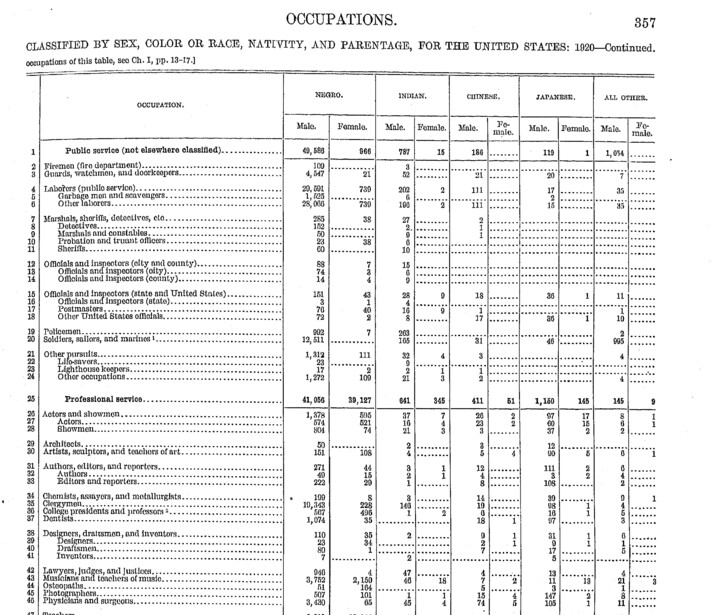
Those numbers are also an artifact of how they were made. A census figure for occupation is whatever an enumerator wrote on a line, next to a race the enumerator assigned from appearance and from whatever the household said at the door. Both entries were soft. Perrault spent her apprentice years inside photographic businesses whose owners believed she was a white employee, and a trade that ran on that kind of concealment is not one a headcount measures cleanly.
A Studio That Started in the Front Room
In 1920, Perrault stopped working for other people. She set up her own studio in the living room of her house on St. Peter Street and traded under the name Bertrand's, after her first husband. The parlor studio solved several problems at once. It required no lease from a white landlord, no signage, and almost no capital beyond what she already owned, and it let a married woman run a business without leaving the house she was expected to be in.
In 1923, she moved into a dedicated commercial space on North Claiborne Avenue, in the middle of the Creole neighborhood she was photographing, and eventually renamed the business Claiborne Studio. In 1935, six years into the Depression, she moved again, to South Rampart Street, the commercial and cultural spine of Black New Orleans, and renamed the business Collins Studio after her second husband, Herbert Collins. She stayed on South Rampart for the rest of her working life. Counting from the parlor in 1920 to her retirement to Los Angeles in 1949, she ran her own studio for twenty-nine years, through the Depression and a world war, and the addresses tell you she was reading her market carefully the whole time.
South Rampart was a foot-traffic decision. McDonogh No. 35, the city's Black public high school, sat on that street, and students walked past her window twice a day on the way to and from the bus. The block also carried barbershops, a billiard hall, music stores, and dance halls, which is to say it carried people already dressed up and already downtown.
The Business Ran on the Church and School Calendar
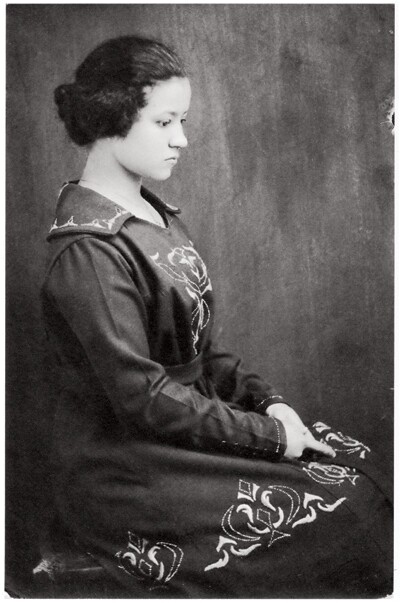
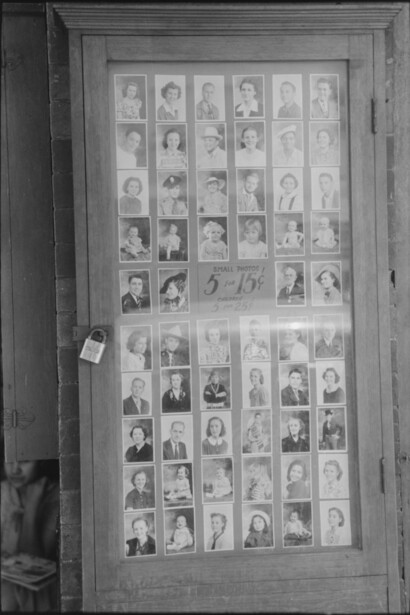
Her sittings tracked the liturgical and academic year. First Communions, confirmations, graduations, dance recitals, weddings, Mardi Gras costumes, and, from the early 1940s, servicemen passing through the city who wanted something to mail home. Ruth Barthelemy, a mother of five whose son Sidney later became mayor of New Orleans, described taking each new baby to exactly two places: the church, to be baptized, and the photographer. The photographer was Collins.
She went after that work directly. A September 1925 advertisement in the New Orleans Herald carried the line "I Like to Make Children's Pictures," which is a marketing decision as much as a preference, since a child photographed at a milestone is a family that comes back at the next one.
Then there were color prints. Collins sold hand-painted prints as a paid extra, and the painting was done in-house by young Black women she hired and trained. Phenella DuPlessis Perez, who worked for her in the 1940s, remembered doing it with little cotton swabs and watercolor. Collins herself drew a sharp line between that skill and the mechanical part of the job. "As each new girl came along we had to teach them how to paint… of course, teaching them how to make the pictures wasn't anything because it was all by machine. All they had to do was turn the crank," Collins said, in a passage quoted by her great-niece, the historian Arthé A. Anthony, in Anthony's book on her. Printing was a crank. Coloring was the craft, and the craft was what she charged for.
She staffed the studio out of her family and her neighborhood. In the early years the business ran on two people close to her, a sister, Mildred Gardina, and a family friend named Walterine Celestine, who shared the managing between them. She also taught the trade to her younger brother Arthur, who worked for her alongside his wife, Gladys Williams Perrault, until the pair struck out on their own in 1936 with Perrault's Studio, a few blocks along South Rampart. Most Black women who entered photography in that era learned it from a man in the family. Collins was the one teaching. Another sister, Thelma Lombard, came in later as a saleswoman. She hired teenagers with no experience and taught them; Valrian Burrell Montgomery, who started that way in the 1940s, paid for college with the job. Betty Goudeau Wethers, another employee from that decade, gave Anthony a one-line description of her boss: "She ran the business and she took care of business."
The Canon Runs Through the Men Who Left the Studio
The received history of Black studio portraiture is a short list of men. Writing in The Crisis in 1923, W. E. B. Du Bois urged young Black Americans into photography and named three practitioners he admired: Addison Scurlock in Washington, Cornelius M. Battey at Tuskegee, and Arthur P. Bedou in New Orleans. A century later, the New Orleans Museum of Art opened its own account of Called to the Camera with that same passage and told visitors they would see work by Battey, Bedou, and Scurlock alongside more than two dozen other artists. Collins was one of the two dozen. That list is not wrong. Scurlock, Battey, and Bedou made superb pictures and sustained long careers, and Collins belongs in the same conversation on the strength of the work.
The list also encodes mobility. Bedou traveled with Booker T. Washington and photographed Washington's last Louisiana tour in 1915, and he shot Xavier University's graduations, building dedications, and campus events from the 1920s into the 1950s. Work like that produces dated, captioned pictures of named public occasions, which is the kind of material an archive knows how to describe. Collins was confined to commercial portraiture. Her photographs rarely ran in the Louisiana Weekly, the city's Black newspaper, so she accumulated no public byline, and studio prints left in an envelope with the customer.
Even Bedou's survival came down to a relative. Xavier's Bedou collection runs to 0.8 linear feet in two boxes, and it reached the archive in September 1978 as a gift from his widow, Lillian Toledano Bedou. The difference between the two photographers is not that an institution went out and rescued one of them. It is that his pictures got an accession number and a finding aid under his own name.
Hold that against the census. One in six of the Black photographers the government counted in 1920 was a woman. The canon does not run one in six, and the gap is not a gap in talent or in output. It is a gap in what kind of work generates a paper trail that an archive will later accept.
You can watch that gap swallow people one line at a time. When Historic Artists' Homes and Studios went looking in 2025 for the other Black women in the New Orleans photography trade, most of what came back was census entries and nothing else. Amy Jackson appears in 1920 as a maid working for a photographer. Oryana Valentine appears the same year as a 24-year-old studio apprentice. Irma Lane turns up in 1930, aged 21, doing messenger work at a photography studio. Adine McLain owned a studio called Camera Masters on South Rampart Street, and the site of it is now a ground-level parking lot. Celeste Taylor Broadway is listed in 1950 as a proprietor in the photography industry, and, like Collins, she was married to a mail carrier. Those are careers, and what remains of them is an occupation column.
What Survives, and Whose Name It Is Filed Under
Collins died in 1988. No institution had collected her negatives or her business records, and there was no studio archive to transfer, because nobody had ever treated the studio as an archive. What survives was kept by relatives, and a substantial part of it was rescued from New Orleans after Hurricane Katrina and reassembled into Picturing Black New Orleans, published by the University Press of Florida in 2012.
The author of that book is Arthé Anthony, professor emerita of American studies at Occidental College and Collins's great-niece. She is family, not a disinterested biographer, and the book is built from family papers, oral histories she collected from former employees and sitters, and prints that came out of the flood.
The pictures that did land in public collections are scattered, and a good deal of what is there sits inside somebody else's file. The Historic New Orleans Collection holds Collins prints inside the George Lewis Collection, assembled around the jazz clarinetist. The Amistad Research Center at Tulane holds a 1945 Collins portrait of a junior bridesmaid inside the Lydia Sindios Adams Papers, filed under the sitter. In a 2025 research project for Historic Artists' Homes and Studios, image after image is credited courtesy of Anthony, meaning courtesy of a relative's house. Her work is in the record. Finding it means knowing whose name to look under.
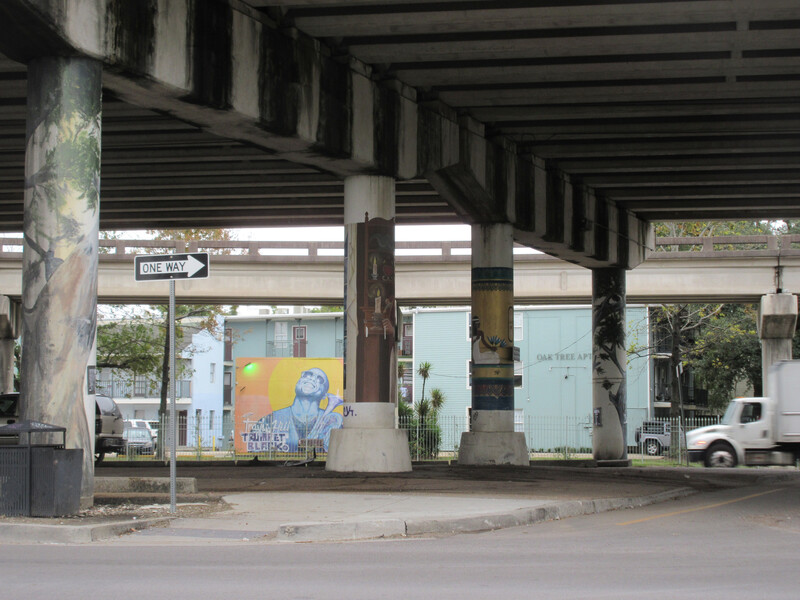
Her buildings did not fare any better. The North Claiborne Avenue studio was destroyed in the late 1960s to clear a path for the Interstate 10 Claiborne Expressway, which now runs on concrete pillars above the ground where the oaks used to be. On South Rampart, the block where Collins Studio stood was razed over the objections of preservationists. The address where she photographed Black New Orleans for the last fourteen years of her career is a parking lot. Nonetheless, it's there for those who know where to look.
Lead image by Gordon Parks, public domain (US Farm Security Administration / Office of War Information). Source.





Join the Fstoppers community for free
-
Post comments and join in the discussions
-
Browse the site ad-free
-
Share your work and get featured in the community
-
Compete in the photo contests for fun and prizes